
What a Lifetime Warranty on Cabinets Really Covers
"Limited lifetime warranty" is the most reassuring phrase in the cabinet industry, and one of the least examined. I've read a lot of competitors' warranty documents over thirty years — partly professional curiosity, mostly because clients bring them to us asking what they mean. The honest answer: a cabinet warranty is a map of what the manufacturer believes will never break, drawn carefully around everything that actually wears. That's not a scandal — it's how warranties work in every industry — but you should know how to read the map before it's the tiebreaker between two quotes.
Here's the full decoder, from someone who writes one of these documents as well as reads them.
First: "lifetime" means the product's life, not yours
Three definitions hide inside the word. "Lifetime" almost always means "as long as the original purchaser owns the home" — sell the house, and the warranty usually dies at closing (a few transfer once, within a window, with paperwork). It is not your lifetime, and it is certainly not the cabinet's plausible 40-year service life in the abstract. Meanwhile "limited" is doing heavy lifting: it means covered components, not covered kitchen. And nearly every document warrants repair or replacement of the defective part — not the labor of tearing out and reinstalling, not shipping, and pointedly not the six neighboring doors whose finish has aged three years while your replacement door arrives factory-fresh. Color-match-over-time is the quiet gap in every finish claim ever filed: wood ambers, paint mellows, and a new door in an old kitchen announces itself. Good manufacturers manage this with batch records and toner matching; the document itself promises no such artistry.
What's genuinely covered — and why it's the stuff that doesn't fail
The core coverage in virtually every quality-cabinet warranty is defects in materials and workmanship in the structural cabinet: box joints separating, panels delaminating on their own, face frames splitting, shelves sagging under rated load. Here's the manufacturer's secret: on a well-built frameless box — dowelled, case-clamped, quality substrate — these failures are vanishingly rare. That's precisely why the coverage can be "lifetime." The box is the part of a cabinet with no moving parts, no daily handling, no UV exposure, and no steam. Promising forever on the box is promising forever on the part engineered past failure. This is still worth something real: it tells you the manufacturer trusts its own construction, and it separates makers from importers of unknown provenance. But two "lifetime box" warranties tell you nothing about whose doors, finish, and hardware — the parts that live a hard life — will look right in year ten.
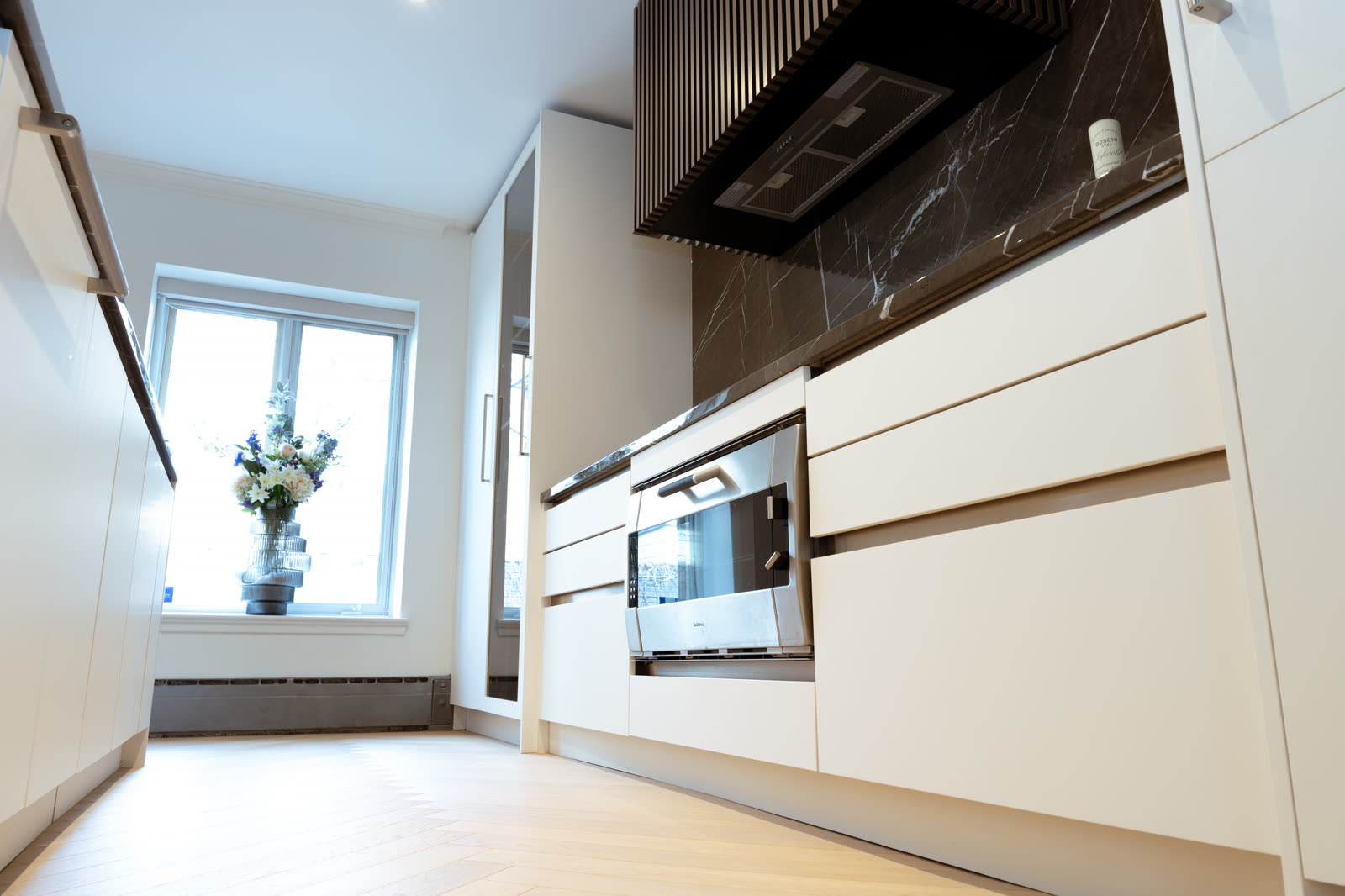
Hardware: the strongest warranty in the room isn't the cabinet maker's
Here's a genuinely useful fine-print fact: the best warranty in your kitchen usually belongs to the hardware inside it. Blum and Hettich both stand behind their hinges, drawer runners, and lift systems for the life of the furniture — these companies cycle-test mechanisms hundreds of thousands of open-close cycles precisely so they can. A quality manufacturer passes that through: hinge goes soft, runner loses its damping — the part is replaced, period, and the honest ones stock the parts for same-week service. When you're comparing cabinet lines, which hardware brand is inside is therefore a warranty question in disguise: unbranded hardware means an unbackable promise, whatever the paper says. The engineering behind those cycle counts is exactly what we unpacked in our European hardware comparison and the soft-close guide.
The exclusions that actually matter
Every warranty's exclusion list is longer than its coverage list. Most of it is boilerplate; five entries deserve your attention because they describe things that actually happen:
- Moisture and humidity damage. The big one. Steam from an unvented kettle, a slow dishwasher leak, a Florida garage install, humidity swings in a seasonally empty home — all excluded, everywhere, always. Since moisture is the leading real-world killer of cabinets, understand: the leading cause of cabinet death is not covered by anyone.
- Natural wood behavior. Grain variation, color change with UV, seasonal hairline movement at painted joints — excluded as "inherent characteristics," and legitimately so; that's wood physics, not defect. But note who decides where "characteristic" ends and "warping" begins: the document says a door must typically exceed a stated deviation — commonly around 1/4" measured corner to corner — before it counts as warped.
- Finish wear. Fading, sheen change, wear-through at handles' reach, damage from cleaners (ammonia, abrasives, magic sponges — which are micro-sandpaper) — excluded. The finish is warranted against manufacturing defects (peeling, checking on its own), not against life.
- Site conditions and installation. If a third party installed the cabinets, box-out-of-square and door-alignment complaints route to the installer, not the maker. This is the strongest practical argument for buying from a manufacturer who installs its own work: one signature owns the whole outcome, and "not our department" is off the menu.
- Accessories and consumables. Integrated lighting (drivers and strips carry their own shorter electronics warranty), waste bins, organizers — typically 1–5 years, not lifetime. Reasonable, but worth knowing before assuming the lit glass cabinet is covered forever.
How to actually compare warranties between quotes
When two proposals are on the table, skip the headline and ask these six questions — they take ten minutes and reveal everything:
- Who executes the claim? A local shop with a service department, or a form on an overseas website? A warranty is worth the service infrastructure behind it, nothing more.
- Is labor included? "Parts only" on a built-in product means you pay a carpenter to receive your free part.
- What hardware brand is inside, by name? Named European hardware = enforceable mechanism coverage. "Soft-close hardware" unbranded = hope.
- How long are finish and color-match handled, and how? Listen for batch records, spray-to-match capability, and honest talk about aged-finish blending — the answer tells you if they've ever actually done it.
- Does it transfer? Matters if you may sell within ten years; a transferable warranty is a small real-estate asset.
- How many years has the company existed under this name? The most underrated question in the industry. A lifetime warranty from a three-year-old importer is a lottery ticket; the same words from a shop in its fourth decade are a track record. Warranties don't outlive the companies that write them.
Fold those answers into the line-by-line method from our guide to reading cabinetry quotes apples-to-apples and the cheap-headline warranties sort themselves out fast.
The honest summary: what a warranty is actually for
After all the fine print, here's my manufacturer's-eye view. A cabinet warranty will realistically be used for: a hinge or runner replaced in minute-thirty, a door that warped past tolerance and gets remade, a drawer front with a finish defect that surfaced in the first months, a shelf that shouldn't have sagged. It will not be used to give you a new kitchen in 2046. Its real value is as a signal — of construction confidence, of hardware quality, of a service department that exists — and signals are best verified in person: open drawers in a showroom, ask to see a ten-year-old installation, notice whether the company's phone number reaches a human who can schedule a service visit. The paper matters; the shop behind the paper matters more.
Practical takeaways
- "Lifetime" = original owner, usually parts-only, structural box — the component engineered not to fail.
- Moisture, finish wear, and natural wood change are excluded by everyone; plan ventilation and care accordingly.
- Branded hardware (Blum, Hettich) carries the most enforceable lifetime promise in the kitchen — ask for names.
- Manufacturer-installed work closes the installer-vs-maker blame gap that voids real claims.
- Judge the company's age and service department, not the headline — warranties don't outlive their writers.
We're happy to walk you through our own warranty line by line — it's a short document, on purpose, because we'd rather build things that don't need it. Book a free design consultation to talk construction and coverage honestly — or see what three decades of standing behind the work looks like in our custom kitchens and the hardware on our accessories page.