
Handle-Free Kitchens: J-Pull vs Tip-On vs Servo-Drive
A handleless kitchen looks like the simplest thing in the world — clean planes, no hardware, nothing to catch a sleeve or the light. Which is exactly why it's one of the harder kitchens to build well. When you remove the handle, you don't remove the function; you relocate it into the door edge, the cabinet structure, or the runner mechanism itself. There are three fundamentally different ways to do that, they can be mixed, and they behave very differently at 6 a.m. with your hands full of flour.
Here's how each system actually works, from the machining up.
Option 1: The J-pull — the grip is carved into the door
A J-pull (or C-channel) door has the finger grip machined directly into the top edge of the door or drawer front — in section it looks like the letter J. On the CNC, we run a form tool along the back of the edge, leaving a curved recess deep enough for four fingertips, typically 18–20mm of reach. A shallower cousin, the angled finger-pull or chamfered edge, cuts a 30–45° bevel instead; it's more subtle and slightly less comfortable to grab.
The construction consequences are real. That machined edge exposes the door's core, so the substrate has to be worth exposing: MDF for painted work (the profile machines glass-smooth and the finish flows over it), or a thick-edge veneer construction for wood, because a routed profile through thin face veneer shows the core like a cut cake. Painted J-profiles also concentrate wear where fingers land — this is precisely where a catalyzed two-component finish outperforms softer coatings, a chemistry story we cover in the finishes library.
The honest pros: no extra hardware to buy or fail, works on any cabinet including sink bases, and the shadow line stays subtle. The honest cons: the recess collects crumbs and grease at exactly finger height (a weekly wipe, not a crisis), the grip is less positive than a rail, and on tall doors the pull location is dictated by the design, not your shoulder.
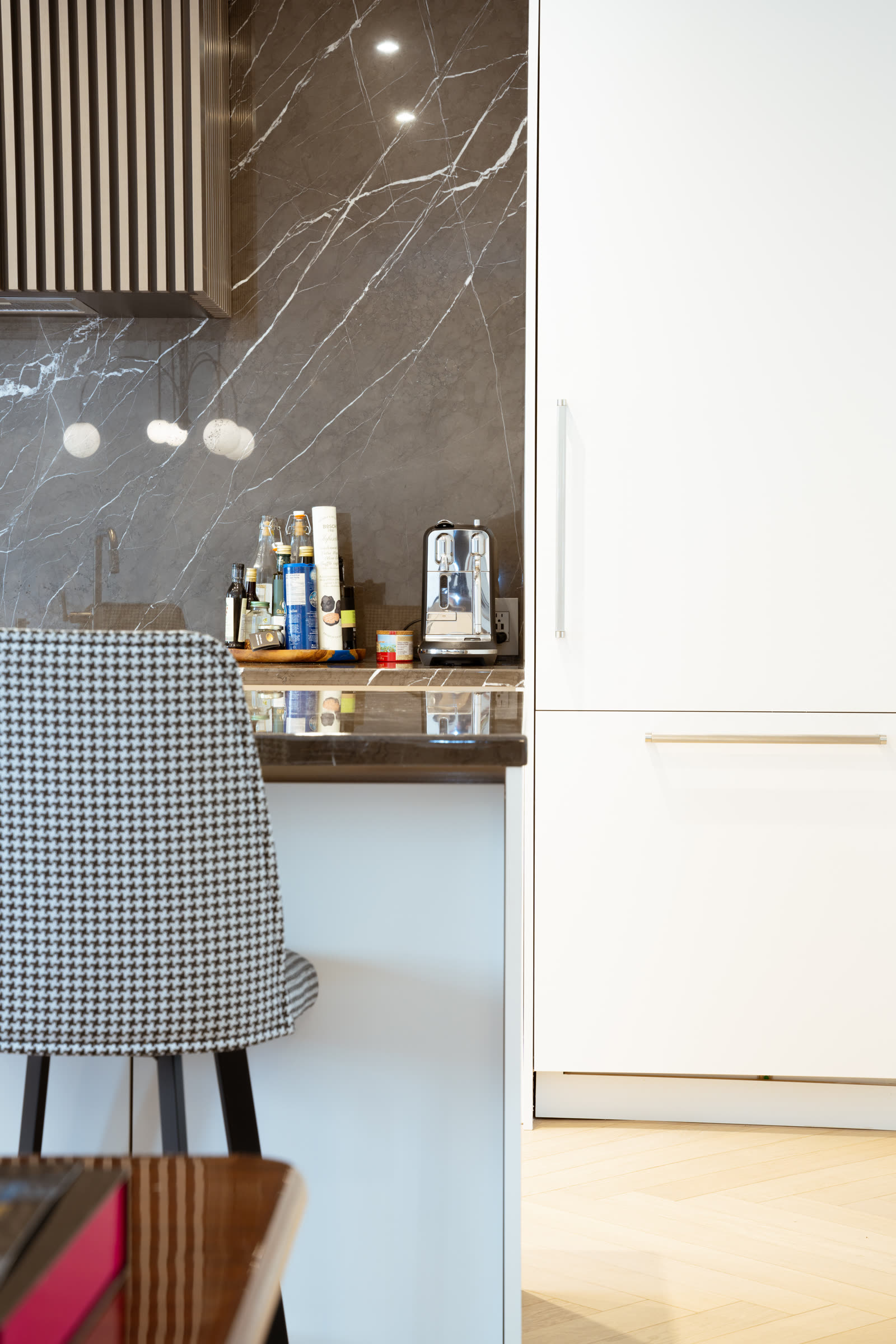
Option 2: The true handleless channel — a rail built into the cabinet
The system most people picture when they say "European handleless" is the integrated channel: a recessed aluminum rail — usually anodized, often lacquered to match or contrast — set into the cabinet structure between drawer fronts, or between the door top and the counter. Your fingers slip behind the front itself; the front stays a perfect uninterrupted slab.
Structurally this is the most invasive option. The channel consumes 25–30mm of cabinet height per rail, which means interior drawer capacity shrinks and the whole elevation must be designed around the rail lines from day one. The reward is the strongest architecture of the three: those continuous horizontal shadow gaps become the kitchen's grid, and when the rail is finished in bronze or black against a pale door, the "gap" is quietly doing the decorative work handles used to do. It's also the most expensive route — machining, rail stock, and assembly time add up to roughly the cost of very good handles you chose not to buy.
Grip comfort is excellent on drawers, good on base doors, and awkward on tall pantry doors, which is why full-height units in channel kitchens often go to push-to-open instead — the systems below.
Option 3: Push-to-open — mechanical Tip-On vs electric Servo-Drive
The third family removes the grip entirely: you press the front, and the cabinet opens itself. Two very different technologies live under this umbrella, and they're worth separating because their daily behavior differs.
Mechanical (Blum TIP-ON is the reference): a spring-loaded pin ejects the door or drawer 30–40mm when you press it, far enough to grab the edge and pull. No wiring, no cost shock, retrofittable. The engineering catch is a genuine physics conflict: a soft-close mechanism wants to pull the front closed and hold it; a push-latch needs the front to press in past closed to release. Standard soft-close and mechanical push-open fight each other. The proper answer is a system engineered for both — TIP-ON BLUMOTION runners integrate the ejector and the damper in one unit — not a hinge damper stacked against a push latch, which is how you get doors that neither close softly nor open reliably. This matters when comparing quotes; "push-to-open" on a line item hides a big quality range. Our deep dive on soft-close hardware explains the damping side of that equation.
Electric (Blum SERVO-DRIVE): a sensor detects the press — or a knee-nudge, or a wave near the front — and a motor drives the front open, with full soft-close on the return. It's the only genuinely great answer for three cases: bin pull-outs (hands full of chicken-covered cutting board, nudge with your knee), heavy wide drawers where a mechanical ejector feels weak, and lift-up wall doors that open overhead at the touch of a fingertip. It needs a discreet 24V power supply run in the toe kick or behind the cabinets — a planning item, not an afterthought. Cost is real: electric opening is a per-cabinet luxury, so we spec it surgically — the bin, the main prep drawers — rather than everywhere.
The daily-life caveat for all push-to-open: the front you press is the front you touch, so fingerprints concentrate in one spot. Matte, textured, and super-matte surfaces handle this gracefully; high gloss does not. And leaning on a push-open drawer opens it — households with large dogs learn this quickly.
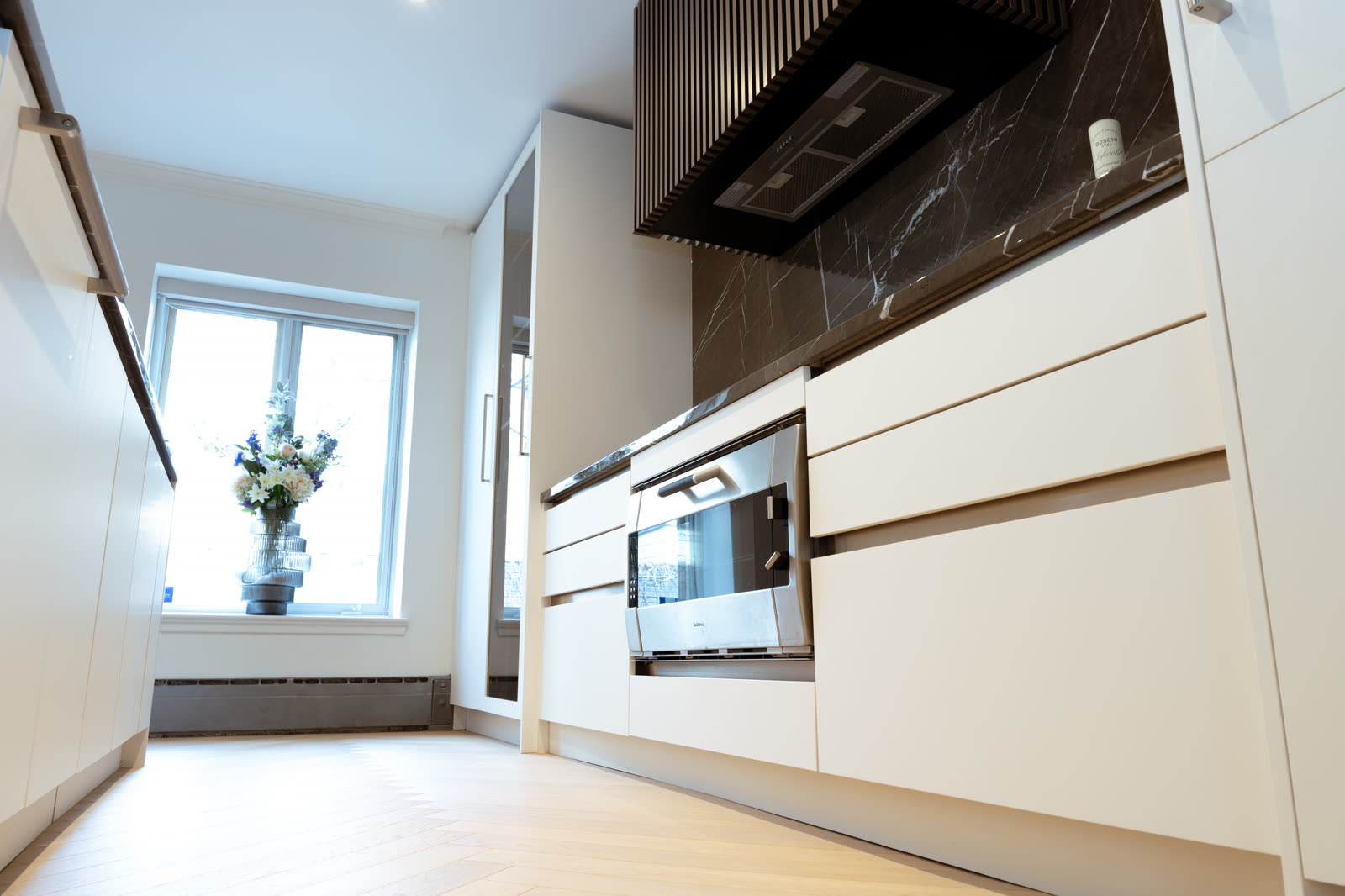
Mixing systems: how real handleless kitchens are specced
Almost no good handleless kitchen uses one system throughout. A typical spec from our shop: channel rail or J-pull on the base drawers (positive grip where you pull hardest), push-to-open on wall cabinets and tall pantries (nothing to grab at height, and the doors are light), electric opening on the waste pull-out, and a conventional recessed grip on the dishwasher and other integrated appliance panels, because appliance doors carry their own latch logic. The systems disappear into one visual language; only the builder knows where one ends and the next begins. The broader hardware ecosystem behind all of this — hinges, runners, lift systems — is compared brand-by-brand in our European hardware guide, and you can see the mechanisms in person on our accessories page or in a showroom.
Who should not go handleless
Honesty corner. If you love the look of ornate traditional kitchens, handleless isn't your battle. If your household includes someone with limited hand strength, a well-chosen handle is easier than any recess — though electric opening is, genuinely, the most accessible cabinet interface ever made. And if the budget is tight, remember that handleless moves money from visible hardware into invisible machining and mechanisms; a beautiful slab door with a great solid handle is the more economical path to a minimal look.
Practical takeaways
- J-pull: machined into the door, no mechanisms, modest cost — needs quality substrate and a weekly wipe of the groove.
- Channel rail: the true architectural handleless — strongest look, highest cost, steals a little drawer depth.
- Mechanical push-open: spec it as an integrated soft-close/ejector system, never two fighting mechanisms.
- Electric opening: worth it at the bin, heavy drawers, and overhead lifts; plan the 24V supply early.
- Mix systems by cabinet type — that's how the kitchens in the magazines are actually built.
The best way to choose is to press, pull, and nudge the real mechanisms side by side. Book a free design consultation and try every opening system in one sitting — or explore our custom kitchens to see handleless design in finished homes.