
Marine-Grade Aluminum vs Stainless vs Masonry Outdoor Kitchens
Every outdoor kitchen on the market is built one of three ways: welded aluminum cabinetry, stainless steel modules, or a masonry structure clad in stone or stucco. Salespeople for each will tell you the other two are mistakes. Having built with all three — and having been called in to repair or demolish plenty of each — I can tell you the honest answer is more interesting: each one wins somewhere, and each one fails predictably when it's used in the wrong place.
This is the comparison I walk clients through at the first consultation, with the numbers and failure modes the brochures leave out.
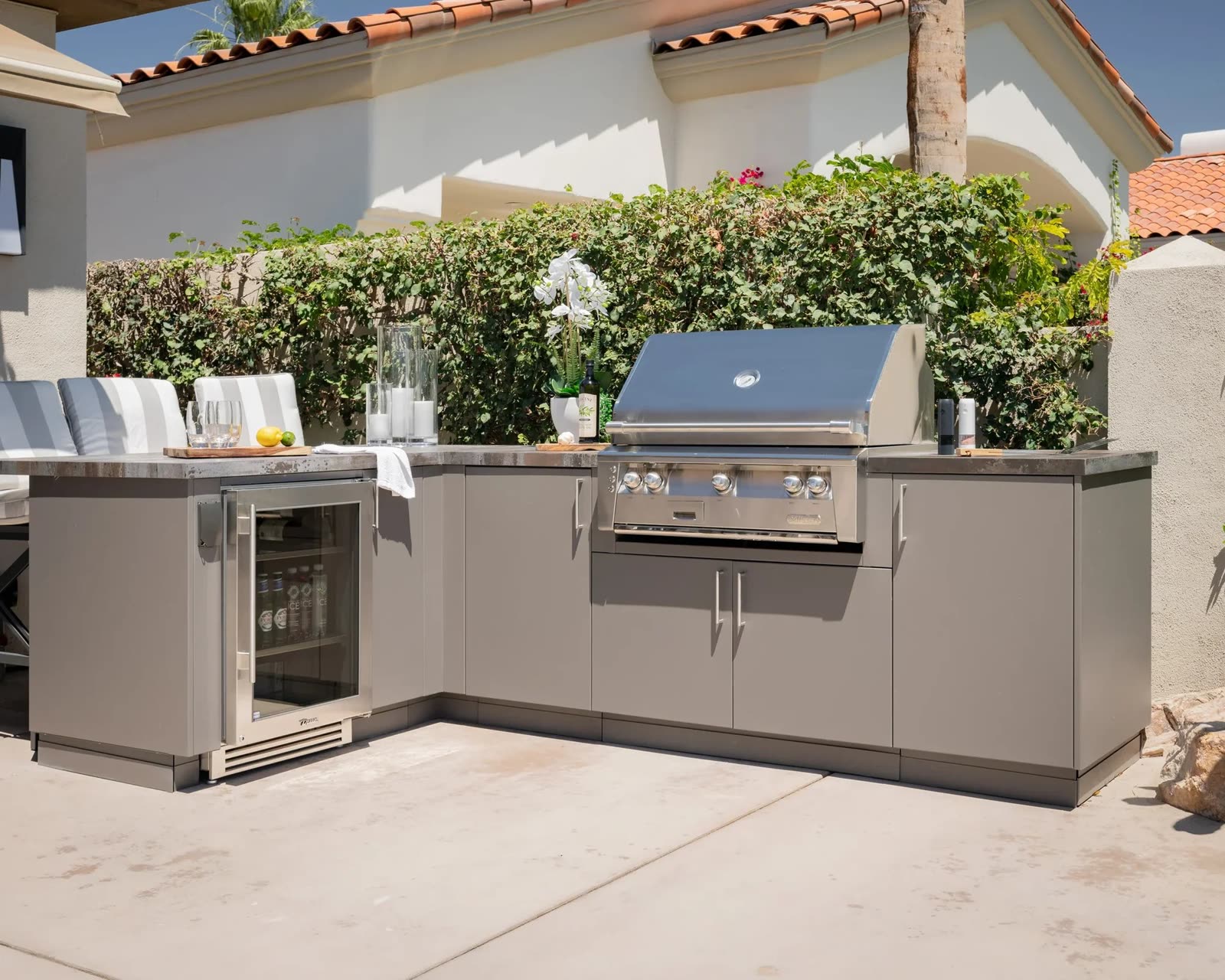
Marine-grade aluminum: the boat builder's answer
Our own outdoor kitchens are welded from 5052 and 5083 aluminum — the same alloys used for boat hulls, dock hardware, and offshore equipment. That's not a marketing flourish; it's the whole engineering argument. Aluminum doesn't rust. It forms a microscopically thin oxide layer the instant it's exposed to air, and if you scratch it, the layer re-forms. The 5000-series marine alloys add magnesium, which makes them resistant to the crevice and pitting corrosion that salt spray causes in lesser aluminum.
On top of the bare metal goes an architectural powder-coat — a baked polymer finish far tougher than paint, available in essentially any color. That combination handles coastal salt, desert UV, and freeze-thaw winters with a garden-hose rinse as its only maintenance. Weight is the sleeper advantage: an aluminum kitchen weighs roughly a third of a comparable stainless build and a tenth of masonry, which is why it's the only serious option for rooftop terraces and elevated decks.
Where it loses: aluminum cabinetry is a premium product, and cheap versions undermine the concept. Folded-and-screwed aluminum boxes with thin gauges dent and let corrosion start at every fastener. Look for welded seams, 1.5 mm-plus panel thickness, and marine-spec powder-coat. And aluminum is cabinetry, not structure — the grill, counters, and appliances are still separate decisions.
Stainless steel: great appliances, compromised cabinets
Stainless is the default material for grills themselves, and rightly so — it handles heat brilliantly. The trouble starts when the whole kitchen is built from it. Most stainless cabinet lines use 304 alloy, which performs well inland but "tea-stains" and pits within a couple of years near salt water. The marine grade, 316, resists salt far better thanks to added molybdenum — but full-316 cabinetry is rare and expensive, and many products advertising 316 use it only on door skins while the carcass stays 304 or, worse, galvanized steel.
Stainless also has livability problems people discover after installation. It reaches egg-frying temperatures in full sun. It shows every fingerprint and water spot, so it demands regular polishing to look like the showroom. And a field of brushed steel doors reads more commercial galley than resort — which is why even stainless-loving clients usually ask us to powder-coat or panel most of the visible surfaces.
Where it wins: appliance bodies, grill carts, and inland kitchens with an owner who enjoys the upkeep. If you go stainless near the coast, insist on documented 316 throughout and budget maintenance time like a boat owner. Our Florida salt-air guide covers exactly what happens when you don't.
Masonry: permanent in every sense
The traditional built-in-place kitchen — concrete block or steel-stud cement board, clad in natural stone, brick, or stucco — has real virtues. It's massive, it matches the architecture of a Mediterranean or ranch home beautifully, and the structure itself is effectively immortal.
Its weaknesses are everything that isn't masonry. The access doors and drawers set into those stone walls are usually builder-grade 304 stainless or powder-coated mild steel, and they rust out years before the structure ages at all. Interior storage is a damp cave unless it's lined. The mass — routinely over 2,000 lbs for an island — rules out decks and rooftops and can even matter on older patio slabs. And permanence cuts both ways: when a client wants to upgrade a grill to a different cutout size in year eight, we're cutting stone. When they move, the kitchen stays.
Cost surprise: people assume masonry is the budget route because block is cheap. Finished masonry rarely is. By the time you've paid a mason, poured footings, run utilities through block, and cladded it in stone people actually want to look at, a masonry island typically prices at or above welded aluminum cabinetry of the same size — with worse storage and no flexibility.
The side-by-side, from a builder's notebook
- Coastal lifespan: marine aluminum 20+ years; 304 stainless 2–5 before visible corrosion; masonry structure indefinite but doors/hardware 3–7.
- Weight per 10-ft island: aluminum ±400 lbs; stainless ±900 lbs; masonry 2,000–3,500 lbs.
- Maintenance: aluminum — rinse it; stainless — polish it; masonry — repoint, reseal, and replace doors.
- Storage quality: aluminum and stainless offer true cabinet interiors with adjustable shelves and drawers on soft-close runners (we fit stainless-rated Blum and Hettich hardware); masonry offers voids behind access doors.
- Reconfigurable / movable: aluminum yes, stainless mostly, masonry never.
- Installed cost for a full kitchen: broadly comparable at equal quality — $25,000–$80,000+ — which is why the decision should be made on performance, not sticker. The line items are broken down in our outdoor kitchen cost guide.
How to choose for your site
Within two miles of salt water: marine aluminum, full stop. Rooftop, balcony, or elevated deck: aluminum, for weight alone. Inland with a hands-on owner and a modern house: stainless is defensible if it's well-made. A hacienda or stone-clad estate where the kitchen must look grown from the house: masonry structure — but spec marine-grade aluminum or true 316 doors and drawers into it, which is a hybrid we build often and which fixes masonry's weakest link.
Climate matters too. Freeze-thaw cycles crack poorly built masonry and don't bother welded aluminum at all. Desert UV chalks cheap powder-coat, so ask for the coating spec in writing. Hurricane zones favor low, anchored, welded construction over modular anything.
The questions clients always ask
"Won't aluminum dent?" Thin folded aluminum will; welded 1.5–2 mm marine plate takes the same knocks a stainless cabinet does, and unlike stainless it never advertises the scratch with a rust streak. "Does powder-coat fade?" Architectural-grade coatings carry 10–20 year fade warranties; the bargain coatings that chalk in three Arizona summers are a different chemistry with the same name — ask for the coating specification in writing, not just the color chip. "Can I mix systems?" Absolutely, and the best projects often do: a masonry chimney wall for architecture, welded aluminum runs for actual storage, stainless only where the appliances demand it. The mistake isn't choosing any one material — it's letting a single vendor's catalog make the choice for the whole kitchen.
Practical takeaways
- All three systems can work; match the material to the site, not the brochure.
- Coastal or rooftop projects point hard toward welded 5052/5083 marine aluminum.
- Treat "stainless" as a question, not an answer: 304 or 316, skins or full cabinet?
- Masonry's structure lasts forever; its doors and hardware don't — spec them like a boat.
- At equal quality the three price within range of each other, so buy on lifespan and storage, not sticker.
We manufacture welded marine-grade aluminum outdoor kitchens in any powder-coat color, and we've detailed hybrid masonry projects across the Sun Belt. See the construction up close on our outdoor kitchens page, or book a free 30-minute design consultation — bring photos of your yard and we'll tell you which construction actually fits it.