
Outdoor Kitchens in Florida: Materials That Survive Salt Air
Drive any coastal street in Fort Lauderdale or Naples and you'll see them: outdoor kitchens that were gorgeous for eighteen months. Rusted grill hoods. Stainless doors freckled with brown "tea staining." Wood cabinets that grayed, checked, and swelled. Powder-coated steel bubbling from the inside out.
Florida is the most hostile environment in North America for an outdoor kitchen. Within a mile of the ocean you're dealing with airborne salt, 100% humidity mornings, UV strong enough to chalk automotive paint, four months of daily rain, and the occasional hurricane. Most outdoor cabinetry sold in this state was designed for Arizona. Here's what thirty years of building — and repairing — outdoor kitchens on the coast has taught me about what actually survives.
Why salt air destroys "outdoor-rated" products
Salt is hygroscopic — it pulls moisture out of humid air and holds it against a surface as a conductive brine film. That film turns every scratch, weld seam, and fastener hole into a tiny battery running a corrosion circuit around the clock. This is why coastal damage doesn't look like uniform aging; it starts at edges, hinges, and screws and spreads. Two products can both say "outdoor kitchen" on the box and have a tenfold difference in coastal lifespan. The label that matters isn't "outdoor-rated" — it's what the material does when it's permanently damp and salty.
The material rankings, from someone who's replaced all of them
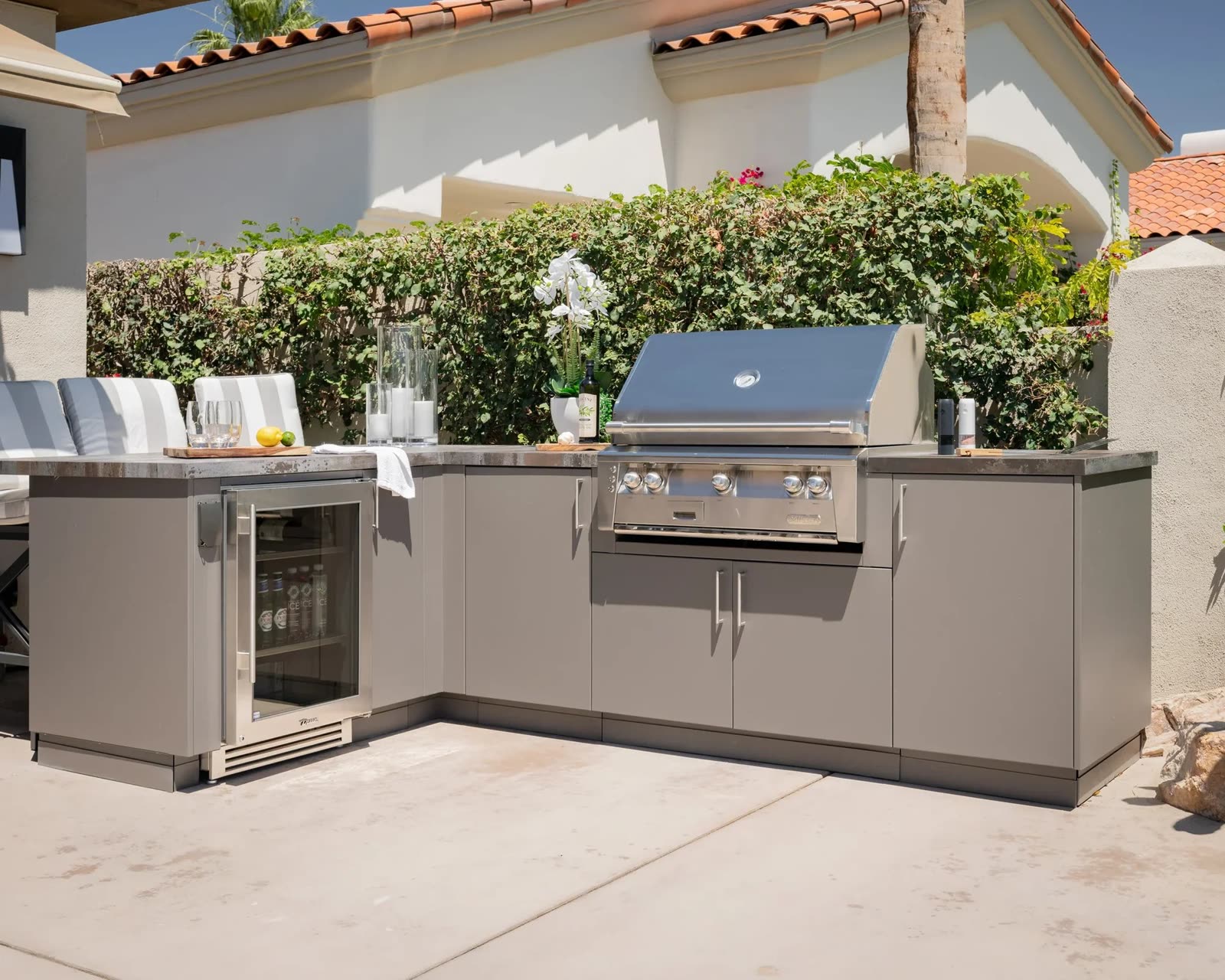
Marine-grade aluminum (5052/5083 alloys): the coastal winner. This is what boat hulls and dock hardware are made from, and it's what we build our outdoor kitchens with. Aluminum doesn't rust — it forms a self-healing oxide layer — and marine alloys resist even salt-crevice corrosion. Powder-coated with a marine-spec architectural finish, it shrugs off UV, takes a pressure-wash, weighs a third of steel (your paver deck will thank you), and survives a hurricane without shedding rusty water down your travertine. Every outdoor kitchen we ship is welded aluminum, not folded and screwed — because every fastener is a future corrosion site.
Stainless steel: good inland, risky on the coast. Here's the nuance vendors skip: 304 stainless — which is most of the market — tea-stains and pits within a year or two near salt water. 316 stainless (with molybdenum, the "marine" grade) performs far better but costs substantially more, and almost nobody builds full cabinets from it; check whether "316" applies to the whole cabinet or just the door skins. Stainless also gets brutally hot in Florida sun. Fine for the grill body itself — grills are almost universally stainless — but as cabinetry, it's a maintenance contract.
Masonry with veneer: durable structure, problem details. Concrete block clad in stone or stucco survives the climate, no argument. The problems are everything attached to it: steel door frames rust, wood access doors rot, and the mass is enormous — a masonry island can exceed 2,000 lbs, which matters on elevated decks and rooftop terraces. It's also permanent: no reconfiguring, no taking it with you, and repairs mean demolition. Budget-wise, nice-looking masonry with proper doors usually prices above aluminum cabinetry once you count the mason, the footings, and the veneer.
Wood and polymer "outdoor" cabinets: don't, and maybe. Teak and ipe survive but demand refinishing every year or two in Florida UV. HDPE polymer cabinets genuinely resist salt and are a fair budget option — but they read as plastic, tend to chalk in a decade of UV, and can't span the custom configurations a real outdoor kitchen wants.
Countertops and the details people forget
Granite and sintered stone (Dekton, porcelain slab) are the two counters I'll put my name on outdoors in Florida. Quartz is not UV-stable — the resins yellow, and most manufacturers void the warranty outdoors. For everything else, think like a boat builder: 316 stainless or coated-aluminum hinges and slides, no raw steel fasteners anywhere, sealed LED fixtures rated IP65 or better, and drainage — every horizontal surface and every cabinet interior needs a way for water to leave. A cabinet that traps water is a terrarium.
Hurricane season is a design input, not an afterthought
From Bonita Springs to West Palm Beach, we design outdoor kitchens with wind in mind: welded cabinetry anchored to the slab, appliances secured in their cutouts, and doors with positive latches — not magnetic catches that pop open at 60 mph and turn into sails. Low, anchored, heavy-gauge aluminum construction has come through recent storm seasons for our clients with nothing worse than a pressure-wash afterward. Loose modular units and pergola fabric are what end up in the pool. If your builder has no answer to "what happens to this in a named storm," keep interviewing builders.
The maintenance schedule that keeps a coastal kitchen new
Even the right materials appreciate ten minutes of routine. Here's the schedule we give every coastal client at handover — it's short on purpose, because a kitchen that demands more than this was built from the wrong things:
- Every week or two: rinse the cabinetry and counters with fresh water — a hose is fine. The entire point is washing the salt film off before it concentrates. Boat owners already know this ritual; it's the same physics.
- Monthly: wipe down the grill exterior with mild soap, and hit stainless components with a dedicated stainless cleaner with the grain. Check that door and drawer gaskets seat cleanly.
- Twice a year: inspect powder-coat for chips (touch up promptly — coating failures spread from wounds), clear cabinet weep holes and drainage paths of leaves, and pull the fridge forward to rinse condenser coils with low-pressure water. Compressors die of salt-caked coils, not old age.
- Before a storm: latch everything, remove loose accessories, shut the gas at the supply, and cover appliances if time allows. After: fresh-water rinse everything, immediately.
What coastal-proof actually costs
A properly built marine-grade aluminum outdoor kitchen — cabinetry, quality grill, refrigeration, sink, stone counters — typically runs $25,000–$80,000+ installed depending on size and appliances. That's real money, so I wrote a full line-by-line breakdown in our outdoor kitchen cost guide. The short version: the cheap version costs more, because you buy it twice. The corrosion difference between inland and beachfront isn't 20% — it's the difference between a 20-year kitchen and a 2-year one. And as with indoor projects, the budget logic in our custom kitchen cost guide applies outside too: spend on the bones and the hardware, save on the extras.
Practical takeaways
- Within two miles of salt water, marine-grade aluminum (5052/5083) cabinetry is the only low-maintenance choice that lasts decades.
- 304 stainless tea-stains on the coast; demand 316 for any stainless component and expect maintenance regardless.
- Granite or sintered stone counters only — quartz yellows outdoors and voids its warranty.
- Welded beats fastened: every screw is a future rust streak.
- Insist on drainage paths, IP65 electrical, positive-latch doors, and slab anchoring for hurricane season.
We design and build marine-grade outdoor kitchens for coastal homes from Fort Lauderdale to Naples — and you can see the construction up close at our Florida showrooms. Explore our outdoor kitchens, or book a free 30-minute design consultation and bring photos of your patio. We'll tell you exactly what will survive there — and what won't.