
Closet Rod Heights: Double-Hang Math That Actually Fits Your Clothes
Almost every disappointing closet I've been called to fix has the same problem, and it isn't the finish or the layout. It's that the rods are at the wrong heights, so half the garments drag on a shelf and half the space above them is air. Hanging is the primary function of a closet. Get the vertical arithmetic right and a modest room holds an astonishing wardrobe; get it wrong and a beautiful closet is permanently 40% full.
So let's do the arithmetic properly, using real garment lengths rather than the numbers in a catalog.
Measure your own clothes first
Before any closet we design, we ask the client to measure their longest item in each category on a hanger, shoulder to hem. Here's what we typically find, and where the standards mislead:
- Shirts and blouses: 32 to 38 inches. Men's dress shirts run longer than the standard tables suggest — 38 inches is common on a size L.
- Folded trousers over a hanger bar: 20 to 24 inches. Hung full length from a clip: 42 to 46.
- Skirts: 20 inches (mini) to 45 (maxi).
- Suit jackets and blazers: 30 to 40 inches.
- Dresses: 45 to 70 inches. This is the category that ruins plans — a floor-length gown on a hanger is 65 to 70 inches, and evening wear needs its own zone.
- Coats: 40 to 55 inches. A full-length wool coat is 55 to 60.
Add 2 to 3 inches to any of these for hanger height and clearance above the shelf below. That's the number nobody remembers, and it's why so many trousers brush the shelf.
The three zone heights
With those measurements, the standard zones fall out:
Double hang. Two rods stacked. Upper rod at 80 to 84 inches from the floor, lower rod at 40 to 42 inches. That gives roughly 38 to 40 inches of clear hanging above and below — enough for shirts, folded trousers, jackets and short skirts. Double hang is the highest-capacity configuration per linear foot and should be the majority of any closet: I aim for 60 to 70% of total rod length in double hang.
Medium or single hang. One rod at 60 to 66 inches, with a shelf or drawers below. Clear hanging of about 48 to 54 inches, which handles dresses to mid-calf, longer coats, and jumpsuits. Roughly 20 to 30% of a typical wardrobe.
Long hang. One rod at 72 to 78 inches with nothing below except perhaps a shoe shelf at floor level. Clear hanging of 66 to 72 inches for gowns and full-length coats. Most households need 2 to 4 linear feet of this, not more — but they need it, and closets designed entirely in double hang leave evening wear on the back of a door for a decade.
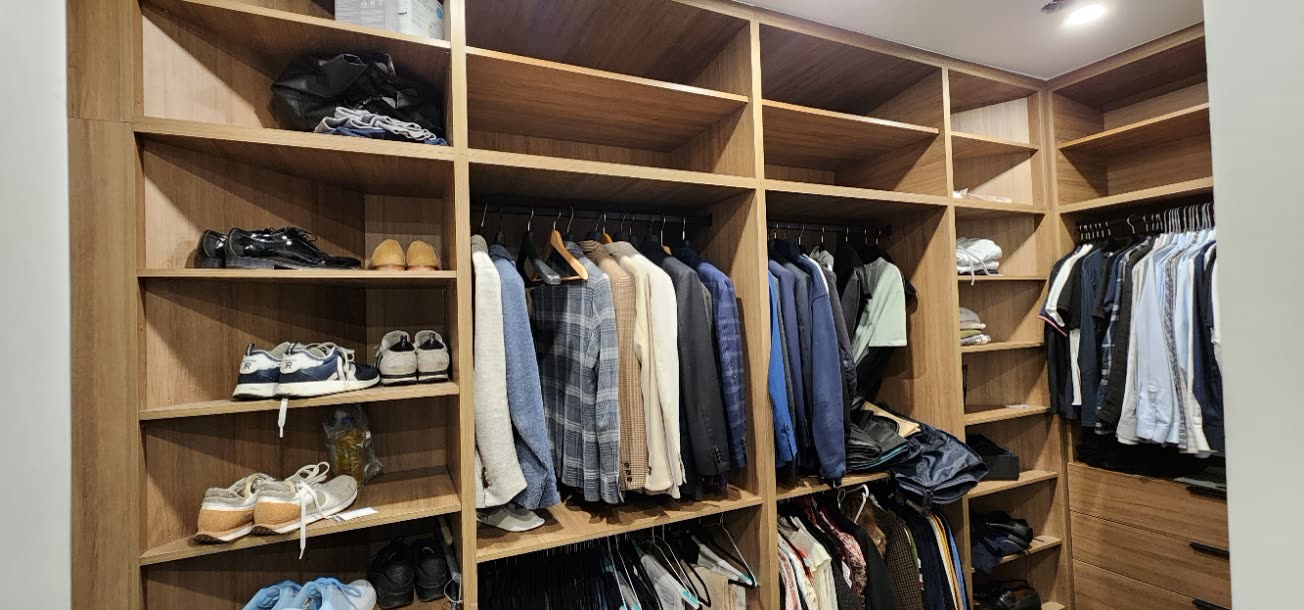
Reach: the constraint on the top rod
An 84-inch top rod is at the upper limit of comfortable reach for someone 5'4". At that height they're reaching to full extension to lift a hanger off the rod, which is fine for a shirt and unpleasant with a heavy coat. Adjust to the user, not the standard:
- Under 5'4": top rod at 76 to 80 inches, lower at 38 to 40.
- 5'4" to 5'10": 80 to 84 upper, 40 to 42 lower.
- Over 5'10": 84 to 88 upper is comfortable, and it buys you a taller shelf above.
In a shared closet with two people of different heights, set the zones by user rather than splitting the difference — this is one of the real arguments for zoning a closet by person, discussed in our guide to his-and-hers closet design.
Rod depth, shelf depth, and the 12-inch rule
The rod must sit 12 inches from the back wall, centre of rod, for a garment to hang without touching. Eleven inches works for shirts and pinches on jackets; 14 is comfortable for outerwear. The cabinetry around it should therefore be 14 inches deep minimum, and 16 inches is the depth we build most closets to — that extra two inches means winter coats and structured jackets hang free.
The shelf directly above a rod should sit 2 to 3 inches above the rod centreline, giving the hanger hook room to clear. Any closer and hangers snag.
One nuance on front-to-back versus side-to-side: a rod running perpendicular to the wall (garments facing you, boutique style) requires 24 inches of depth per rod but presents the clothes beautifully. It's the signature of a boutique-style closet and it holds far fewer garments per square foot. Use it for display, not for volume.
Rod spans, sag, and hardware
This is where cheap closets fail visibly. A wardrobe rod loaded with winter coats carries real weight — a 4-foot section of packed hanging can easily be 40 to 60 lbs.
Unsupported spans: a standard 1 5/16-inch chrome-plated steel rod is fine to about 36 inches under heavy load and 48 inches under light. Past that you need an intermediate support or a heavier section. Aluminium oval rods in a proper end-mount bracket handle 48 inches comfortably. What sags is the hollow plated tube with plastic sockets — I've seen those bow visibly within a year.
Specify: metal rod sockets screwed into a solid cabinet side or a hardwood cleat, not into a 1/4-inch back panel; rods no longer than 48 inches between supports; and if you want a jewel-like detail, a lit rod — an LED-illuminated aluminium rod that washes light down the garments. It's a genuine upgrade and it's covered in our closet lighting guide.
Pull-down rods: the honest verdict
A pull-down wardrobe lift puts a rod at 90+ inches and brings it down to chest height with a handle. In a tall closet with 10-foot ceilings, it converts dead air into real hanging capacity.
The honest caveats. The mechanism is typically rated to 25 to 45 lbs — that's roughly six to ten coats, not a season's wardrobe — and overloading it is the most common failure. It requires a cabinet depth of 14 inches minimum and clear space in front for the arc. And in practice, people use the top zone for out-of-season storage they touch twice a year, in which case a fixed rod and a step stool costs $700 less and never breaks. I specify pull-downs where ceilings are 9 feet or more and the user genuinely cannot use a stool.
How much rod do you actually need?
Count your hangers. Real densities: shirts and blouses at 12 to 15 per linear foot, jackets and coats at 6 to 8, dresses at 8 to 10. A wardrobe of 200 hanging garments, mostly shirts and trousers, needs roughly 16 to 18 linear feet of rod — which a 7x10 walk-in provides comfortably in double hang across two walls. Add 20% for growth, because everybody's wardrobe grows. The counting exercise is worth doing properly, and we walk clients through it in wardrobe inventory and closet planning.
Practical takeaways
- Measure your own longest garment per category and add 2–3 inches for hanger and clearance.
- Double hang at 80–84 / 40–42 inches; medium hang at 60–66; long hang at 72–78.
- Adjust top rod height to the user's height. Don't split the difference in a shared closet.
- Rod centre 12 inches off the back wall; build cabinetry 14–16 inches deep.
- Support rods every 36–48 inches into solid material. Pull-down lifts are rated to 25–45 lbs only.
Rod heights are free to change on a drawing and permanent once the cabinetry is built. Book a free 30-minute design consultation with your garment measurements, or explore our custom walk-in closets, built in the USA and Canada and shipped across North America.