
Wire vs Melamine vs Custom Millwork Closet Systems
"Custom closet" is the least regulated phrase in home improvement. It's applied with equal confidence to $89-a-wall wire shelving, franchise melamine kits, and furniture-grade millwork — three products as different from each other as a tent, a mobile home, and a house. I run a millwork company, so you know where my bread is buttered; I'll declare that bias up front and then argue against my own interest where it's deserved, because each tier genuinely has homes it belongs in. What I won't do is pretend they're the same product at three prices. They're three products.
Tier one: wire and ventilated shelving ($1,000–$3,500 per closet)
What it is: epoxy-coated steel shelving on wall-mounted tracks — the builder-grade standard in most North American homes.
The honest case for it: it's cheap, fast, ventilated (genuinely useful in damp climates and for kids' gear), and infinitely reconfigurable. In a rental, a garage, a laundry room, or a starter home you'll leave in three years, wire is rational. I have it in my own garage.
Where it fails: everywhere you touch it. Shelf lines print onto folded sweaters. Rods bow under winter coats. Small items fall through. There are no drawers, so the bedroom keeps its dressers. And the anchoring is only as good as the drywall installer's aim — the mid-life failure mode of wire closets is the whole assembly meeting the floor at 6 a.m. under a season's weight.
Verdict: utility spaces and short horizons. It is storage; it is not furniture.
Tier two: modular melamine systems ($3,500–$8,000 per closet)
What it is: the franchise closet industry — standard-width melamine panels (18", 24", 30") in stock finishes, cut to length, wall-hung on rails or floor-standing, assembled on site. The big national names all live here.
The honest case for it: a real upgrade over wire. Actual shelves, actual drawers, decent adjustability, quick turnaround — often two or three weeks. For a rental property, a guest room, or a budget that must cover four closets, tier two does a job.
Where it fails — and this is where marketing does the heaviest lifting: stock widths mean filler strips and stranded inches in every opening that isn't a multiple of the module — in a small closet that's real capacity lost. Panels are typically 5/8" and often wall-hung, which caps drawer weight. Drawer boxes are usually stapled melamine on visible epoxy side-rollers — the component where the price point hides most effectively. Finishes run to a dozen stock options. And the back of the closet is often your painted drywall, not a finished panel. It's sold as custom; it's stock, cut cleverly.
Verdict: the right call for secondary spaces and rental units — and the wrong thing to accept when the proposal says "custom" and the price says otherwise. Our guide to reading cabinetry quotes shows exactly which line items reveal the tier.
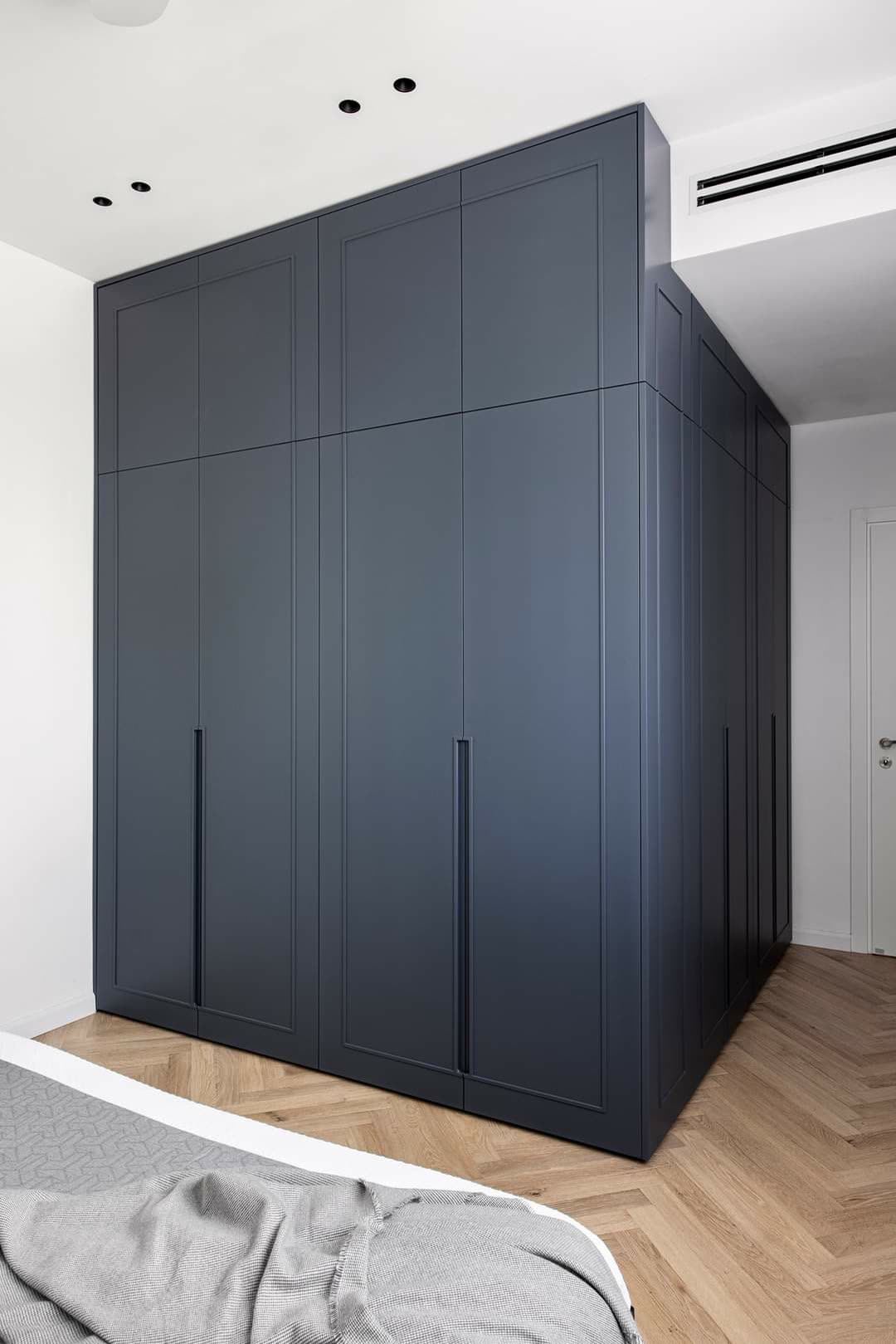
Tier three: custom millwork ($8,000–$20,000+ per walk-in)
What it is: cabinetry. The same construction as a custom kitchen, deployed in a closet: 3/4" cabinet-grade panels built to your room's exact dimensions — no fillers, no stranded inches — floor-supported, back-paneled, finished on every visible face, with dovetailed or steel-sided drawer boxes on full-extension undermount slides.
Why the construction difference is the whole story: a closet is the highest-cycle cabinetry in the house — opened morning and night, every day, loaded to the gunwales. Tier three is built for that duty cycle. We use Blum and Hettich hardware exclusively — the only names on our hinges and slides, same as our kitchens — because the moving parts are what you feel in year ten (our European hardware comparison explains the engineering). Panel construction follows the same rules as kitchen boxes (the material truths are here). Finishes come from the full cabinetry palette — textured woodgrains, painted fronts, veneers — not a stock dozen (browse the finishes library). And it's warrantied like furniture: ours, for life.
Where it's the wrong buy: short ownership horizons, utility rooms, and projects where the budget should go to the kitchen first. Millwork closets also take longer — ours run on the standard 8–12 week production cycle, fabricated in our facilities in the USA and Canada and shipped anywhere — because they're built, not picked from a warehouse.
The resale argument, quantified loosely
Wire adds nothing at resale; buyers price it at zero. Tier two adds modest appeal but reads as what it is on close inspection — and buyers inspect closets. Millwork closets photograph like furniture, show like furniture, and get called out by name in listings ("custom dressing room") — in the luxury market they've become an expected checkbox alongside the kitchen. I'd never sell a closet purely as an investment, but of the three tiers, only tier three shows up in an appraisal conversation.
How to choose in one paragraph
Match the tier to the room and the horizon. Utility spaces, rentals, short stays: wire, without shame. Secondary bedrooms and budget-spread projects: modular melamine, eyes open about what it is. Primary suites in homes you'll keep: millwork — it's the tier you touch every single day, and the one where the cost difference amortizes over decades instead of years. Mixed strategies are smart and common: we regularly build a millwork primary closet while the client puts tier-two systems in the kids' rooms. The mistake isn't choosing a lower tier — it's paying tier-three money for tier-two construction because the brochure said "custom."
Seven questions that expose the tier in two minutes
Whoever you're buying from — including us — these questions sort marketing from construction faster than any brochure:
- "What thickness are the vertical panels?" 5/8" is tier two; 3/4" is cabinetry. One-sixteenth of an inch you'll never see, and the difference between shelves that sag and shelves that don't.
- "Floor-standing or wall-hung?" Wall-hung rail systems cap loads at what the rail and your drywall anchors tolerate. Floor-standing transfers weight to the ground.
- "How are the drawer boxes made, and whose slides?" Listen for dovetail or steel-sided boxes and a hardware brand you can look up. "Soft-close" alone isn't an answer — there are $3 soft-close slides and there are Blum.
- "What happens at my walls' actual dimensions?" If the answer involves filler strips, it's modular. Built-to-measure has no fillers.
- "Is the back panel finished, or is it my drywall?" Small tell, reliable signal.
- "What exactly does the warranty cover, and for how long?" One year covers installation errors. Lifetime covers construction confidence.
- "Where is it made?" Not as a slogan — as logistics. Domestic fabrication (ours is in the USA and Canada) means an eight-to-twelve-week cycle you can plan around and a factory that still exists when you want a matching piece in five years.
A company selling honest tier-two product answers all seven cheerfully. Evasion on questions three, six, or seven tells you the price has been engineered more carefully than the closet.
Practical takeaways
- Three tiers, three products: wire (~$1–3.5K), modular melamine (~$3.5–8K), custom millwork ($8K+).
- The tell-tale components: panel thickness, floor vs wall support, drawer box construction, and whether the hardware has a name.
- Stock widths waste inches; millwork is built to the half inch of your room.
- Closets are the highest-cycle cabinetry in the house — buy the moving parts accordingly.
- Mix tiers by room: millwork where you live, modular where you don't, wire where you store paint.
If you're comparing proposals right now, bring them to us — we'll tell you honestly which tier each one is, including when the answer is "that's a fair tier-two price, take it." Book a free 30-minute consultation or see what tier three looks like in our walk-in closets.