
MDF vs Plywood vs Particleboard: Cabinet Box Truths
"Is it plywood or MDF?" is the question I hear most often when someone is comparing cabinet quotes, and it's almost always asked as if one answer means quality and the other means junk. After three decades of manufacturing, let me tell you the uncomfortable truth: the question itself is wrong. A great kitchen uses all three engineered panels — MDF, plywood, and particleboard — each in the position where its physical properties win. A bad kitchen uses the cheapest grade of any of them in the wrong place.
Here's what each material actually is, how it behaves, and where we put it — with the numbers a salesperson usually doesn't have.
What these panels actually are
MDF (medium-density fiberboard) is wood broken down to individual fibers, blended with resin, and pressed at heat into a panel of roughly 600–800 kg/m³. It has no grain direction, no voids, and a glass-smooth face. That uniformity is its superpower and its weakness at once.
Plywood is thin veneers of real wood — typically 1.5–3 mm each — glued in alternating grain directions. Cross-lamination is what gives plywood its stiffness-to-weight advantage and its screw-holding grip along the face. Quality varies wildly: a void-free Baltic birch with 13 plies in ¾" is a different animal from a 5-ply import with core gaps you could lose a pencil in.
Particleboard is wood chips and resin pressed into a panel, usually 650–750 kg/m³ in furniture grades. The word triggers memories of sagging 1980s flat-pack furniture, but modern industrial-grade particleboard — the kind pressed for European frameless cabinetry and faced with melamine — is a far denser, more consistent product than what most people picture.
Where MDF wins: painted doors, full stop
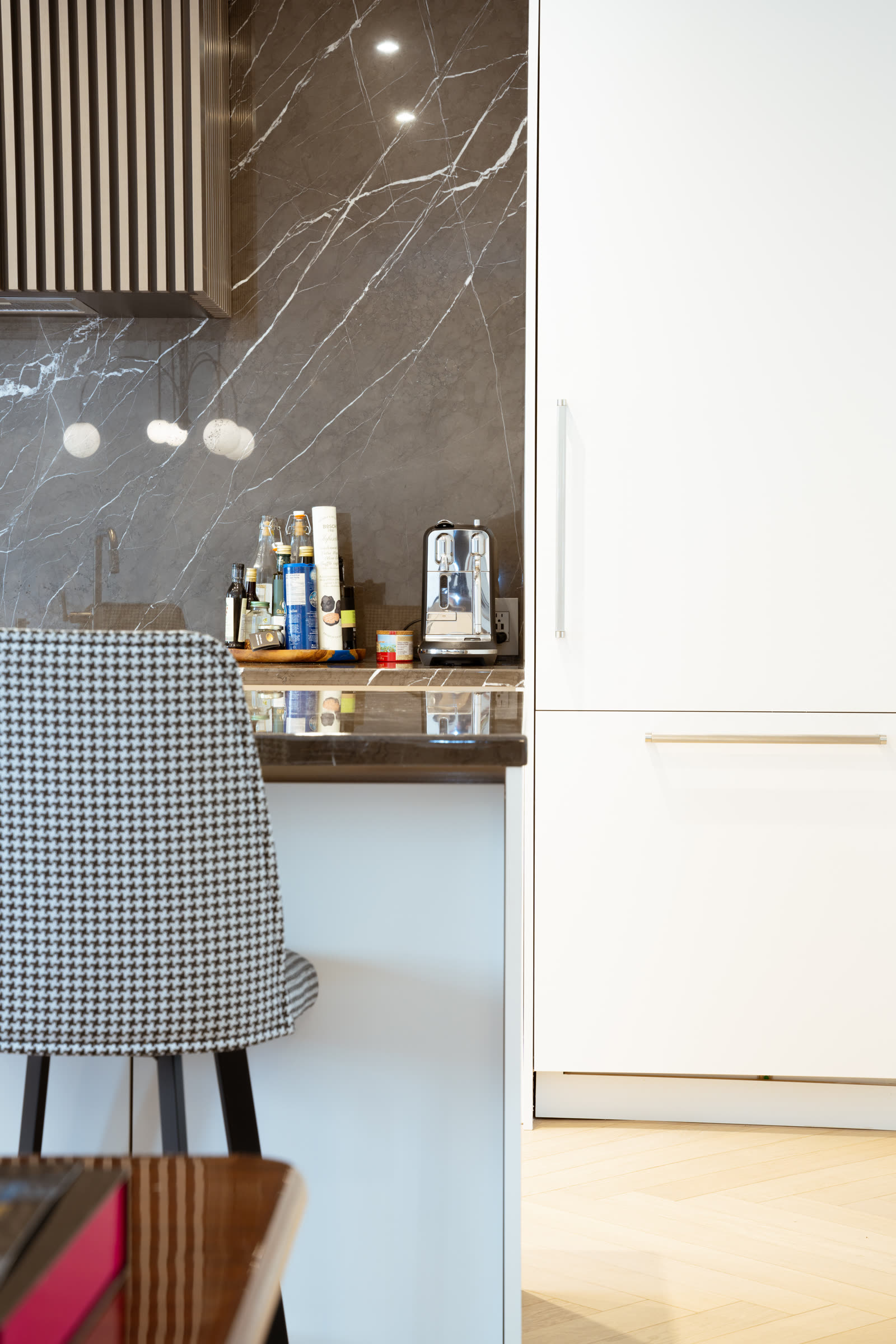
If you want painted cabinet doors, you want MDF in them — and any shop that tells you otherwise is either inexperienced or selling you future cracks. Solid wood moves with seasonal humidity: a maple center panel in a five-piece door expands and contracts across its width every year, and paint bridges the panel-to-frame joint until the movement tears a hairline crack right through the finish. It shows up as a fine grey line at every stile-and-rail joint, usually in the first winter when your furnace drops indoor humidity to 20%.
MDF doesn't do that. No grain means no directional movement worth measuring, so a one-piece MDF door — or a five-piece door with an MDF center panel — holds paint like a car holds lacquer. It machines beautifully too: a shaker profile or a routed detail comes off the CNC crisp, with no tear-out. The weaknesses are real but manageable: standard MDF swells if its raw edge sits in water, and it's heavy — a large MDF pantry door pulls hard on its hinges, which is one reason we spec premium Blum and Hettich hardware rated for the load. For wet locations we use moisture-resistant (MR) MDF, the green-core variant, which swells dramatically less in thickness when soaked.
Where plywood wins: structure, moisture, and weight
Plywood is the strongest choice per pound. Its cross-laminated veneers give it roughly twice the screw-holding of particleboard in the face, superior stiffness over span, and — critically — much better behavior in a water event. When a dishwasher supply line lets go (and across thousands of kitchens, some eventually do), a plywood cabinet floor typically dries out and survives; raw particleboard wicks water and swells permanently at the edges.
That's why our default for sink base cabinets, cabinet floors, and anything carrying stone above it leans on plywood, and why island structures that get bolted, re-bolted, and leveled during install appreciate plywood's forgiveness — it will take a screw twice where particleboard wants a fresh hole. Plywood is also 15–20% lighter than MDF at the same thickness, which matters on wall cabinets and on the installers' backs.
Its flaw? It's the least dimensionally perfect of the three. Plywood panels can bow, telegraph core irregularities through thin veneer faces, and vary a few thousandths in thickness across a sheet — which is exactly why nobody should make a painted slab door out of it.
Where particleboard is honestly fine — and where it isn't
Here's the part of this article that surprises people: most premium European frameless cabinetry — including lines that cost six figures — is built on high-grade melamine-faced particleboard or MDF cores, not plywood. The reasons are engineering, not cost-cutting. Frameless construction lives or dies on panels that are dead flat and dead consistent in thickness, because doors gap at 2 mm reveals and hardware bores at 32 mm centers. Industrial particleboard, pressed and calibrated, is flatter and more consistent than plywood will ever be. Faced with melamine and edged with 1–2 mm ABS banding on modern laser or PUR-glue edgebanders, the core is effectively sealed on all six sides.
Where particleboard fails is at the bottom of the market: thin low-density board, paper edge tape, stapled backs, and shelves that span too far. A ¾" particleboard shelf holding dishes will visibly sag past about 30–32" of span; plywood buys you a few more inches, and either one should get a stiffener or a mid-support beyond that. When you're comparing quotes, the honest question isn't "particleboard or plywood?" — it's "what density, what facing, what edge treatment, and what hardware is bored into it?" That's the same discipline we recommend in our guide to custom vs semi-custom vs stock cabinets.
Formaldehyde, off-gassing, and the labels that matter
All three panels are made with resins, and the question of formaldehyde comes up in nearly every consultation. The short version: look for CARB Phase 2 / TSCA Title VI compliance, which caps formaldehyde emissions at levels a fraction of older product, and NAF (no added formaldehyde) or ULEF (ultra-low-emitting formaldehyde) panels where sensitivity is a concern. Every panel that enters our Canadian production line is TSCA Title VI certified, and NAF cores are available on request. A sealed, melamine-faced, edge-banded panel also emits far less than raw board, because the facings themselves are a barrier.
How we actually build a box
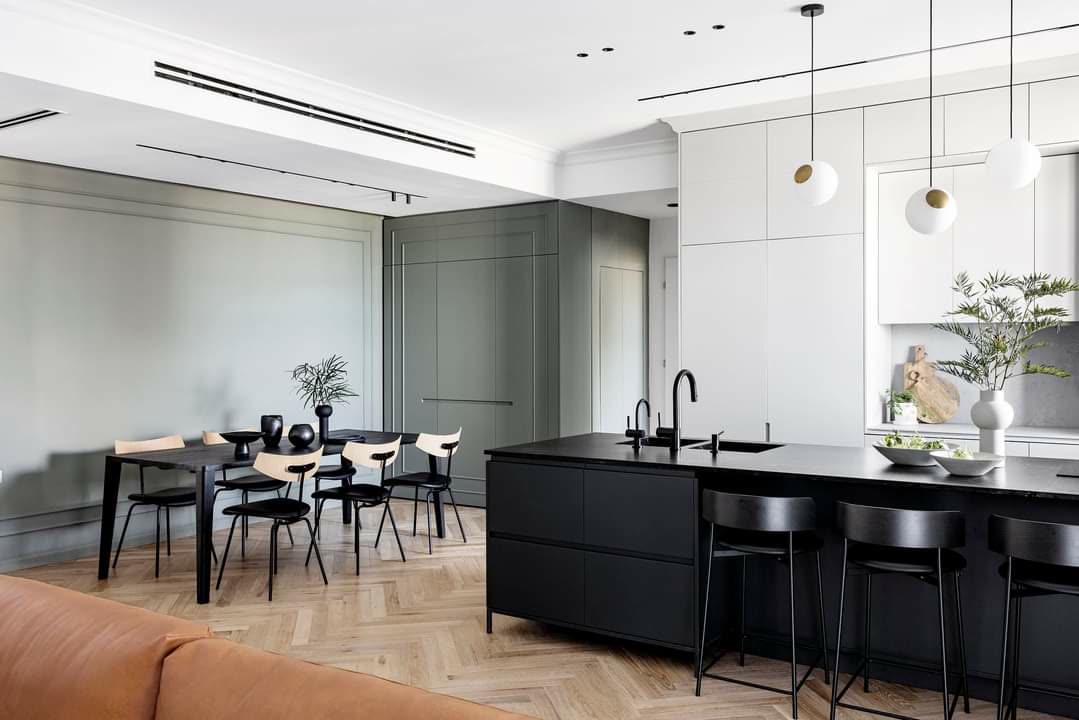
So what does an iKitchen cabinet look like inside? A typical build: ¾" case sides and floors in the material the location demands — plywood where water and load argue for it, calibrated board where flatness and machining precision argue for that — with 1 mm ABS edgebanding on every exposed edge, a captive back panel in a groove (never stapled on), and doors in MDF for paint or veneered engineered cores for wood, hung on Blum, Hettich, or Häfele hardware bored to European system standards. Every joint is doweled or cam-and-dowel with glue, not just screwed, because the connector spreads load that a single screw would concentrate.
That mixed-material approach is what lets us back cabinetry with a lifetime warranty. We're not betting on one panel being magic; we're putting each panel where physics says it belongs, over an 8–12 week production cycle where every part is cut, edged, bored, and assembled in our own plant.
Practical takeaways
- Painted doors should have MDF in them — solid wood centers crack paint at the joints when humidity swings. This is a feature of good construction, not a shortcut.
- Plywood earns its keep in sink bases, cabinet floors, and structural positions: better screw-holding, better water-event survival, lighter weight.
- High-density, melamine-faced, properly edge-banded particleboard is legitimate premium construction in frameless cabinetry — thin, low-density board with paper edges is not.
- Watch shelf spans: past roughly 32", any ¾" panel wants support.
- Ask about certifications (TSCA Title VI, NAF availability), edge banding thickness, and back-panel attachment — those reveal quality faster than the plywood-vs-MDF question ever will.
The best way to judge cabinet construction is to open a drawer, look at an edge, and feel the door — in person. Book a free 30-minute design consultation and we'll walk you through cutaway samples of every construction we build, or explore our custom kitchens to see the finished result.