
Custom vs Semi-Custom vs Stock Cabinets: An Honest Comparison
I run a custom cabinetry company, so you might expect this article to end with "buy custom." It won't — at least not for everyone. In thirty years I've told plenty of people that stock cabinets were the right call for their situation, and I've watched others pay custom prices for cabinetry that was semi-custom wearing a tuxedo. The labels are marketing terms, not regulated standards, and the industry counts on you not knowing the difference.
So let's define the terms the way a manufacturer defines them, compare them honestly, and figure out which one your project actually needs.
What the three tiers actually mean
Stock cabinets are pre-manufactured boxes in fixed sizes — typically 9" to 48" wide in 3-inch increments, one depth, one or two heights. You pick from a short list of door styles and finishes, they ship in days from a warehouse, and any gap between the last cabinet and the wall gets covered by a filler strip. Construction is usually particleboard with stapled or cam-lock joints.
Semi-custom cabinets start from those same standard platforms but allow modifications: reduced depths, some extended heights, more door styles and finishes, and a better fittings catalog. You're customizing a catalog, not designing from zero. Lead times run 4–8 weeks. Quality varies enormously — this tier holds both excellent product and the industry's best-disguised junk.
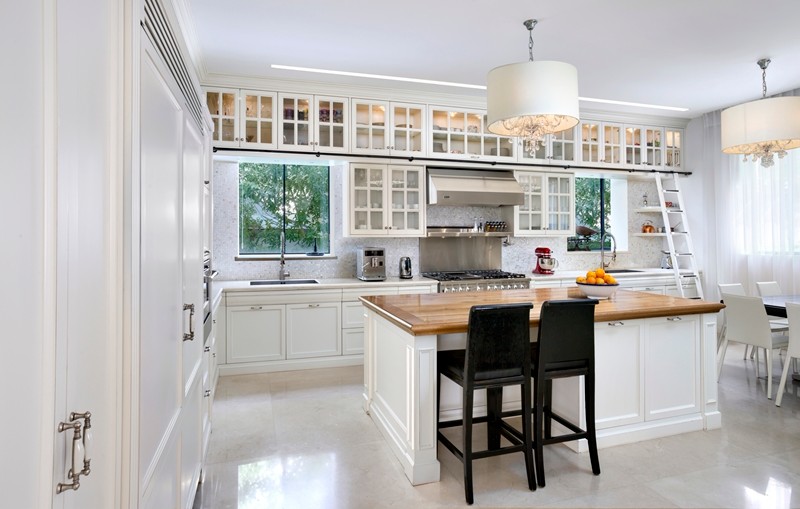
Custom cabinets are built from a cut list generated for your kitchen. Any width to the millimeter, any height, any depth, any door, any finish, any interior. The cabinetry is designed around your walls, your ceiling line, your appliances, and your habits — not the other way around. Lead times at our shop run 8–12 weeks from approved drawings.
The honest cost comparison
For a typical 10x12 kitchen, cabinetry only, 2026 pricing:
- Stock: $6,000–$16,000. Add assembly and installation if it ships flat-packed.
- Semi-custom: $15,000–$40,000 depending on brand tier and finish.
- Custom: $28,000–$85,000+ depending on materials and complexity — full ranges in our 2026 custom kitchen cost guide.
Here's the part the brochures skip: the overlap zones. High-end semi-custom with all the upgrade boxes ticked routinely crosses $40,000 — which is squarely inside entry-custom territory, especially from a manufacturer-direct shop that isn't stacking dealer markups. If your quote for semi-custom is within 15% of a custom quote, take the custom. You're getting a fundamentally better product for the difference of a countertop.
Construction: where the money hides
Put a stock cabinet and a custom cabinet side by side with the doors closed and painted the same color, and from six feet away they look similar. Open them:
- Box material. Stock: 1/2" particleboard, often with a 1/8" hardboard back. Custom: 3/4" plywood or high-density board, full 1/2"–3/4" backs that let you hang the cabinet anywhere on the wall, not just at studs behind a rail.
- Edges. Look at a shelf edge. Thin peel-prone banding versus thick, machine-applied edging is a five-second quality test that never lies.
- Drawers. Stapled melamine sides on epoxy rollers versus dovetailed or double-wall metal drawers on full-extension undermount slides rated for 100+ lbs. This is the difference you feel every single day. Our take on Blum vs Hettich vs Häfele covers why the slide matters more than the wood.
- Hinges. Count the adjustment screws. Quality European hinges adjust in three dimensions so doors stay aligned for decades; budget hinges adjust barely, and once the kitchen settles, gaps appear that no one can fix.
The fit problem no filler strip solves
Stock and semi-custom kitchens are designed in 3-inch increments; your house was not. The result is fillers — dead strips of material that eat 2 to 6 inches of storage per run. In a small kitchen, fillers can consume the equivalent of an entire cabinet. Custom cabinetry builds to the wall, so a 121.5-inch wall gets 121.5 inches of storage. Walls out of plumb, bulkheads, radiators, off-center windows, 9-foot ceilings: these are the conditions where custom stops being a luxury and starts being the only thing that actually works. It's also the only tier where the cabinetry can absorb the quirks of older homes — which is most of what we do in Brooklyn and Montreal.
Who each tier is actually right for
- Buy stock if: you're renovating a rental, flipping, staging, or you need a functional kitchen this month on a hard budget. Spend your savings on decent hardware upgrades and a good installer.
- Buy semi-custom if: your kitchen is a simple rectangle with standard ceilings, you like one of the catalog door styles, and the brand you're considering publishes its construction specs (plywood option, drawer construction, hinge brand). If they won't tell you what's inside the box, that's your answer.
- Buy custom if: your space is irregular, your ceilings are over 8 feet, you want integrated appliances, you plan to stay 10+ years, or the design in your head simply doesn't exist in a catalog. Custom is also, counterintuitively, the strongest value at the top of the market — because at $40,000+ the alternatives are charging custom money for catalog product.
What about IKEA and the online "custom" startups?
Two newer players deserve an honest word. IKEA's system is the best stock cabinetry value in the business — genuinely good hinges and drawer hardware bolted to lightweight boxes in a small set of sizes. For a rental or a first house on a tight budget, it's a rational buy, and the aftermarket door companies that dress IKEA boxes in better fronts push it surprisingly far. Its ceiling is structural: the sizes are the sizes, the boxes are the boxes, and a 9-foot ceiling or an out-of-square 1920s wall defeats it immediately.
The online direct-to-consumer "custom" brands are trickier. Some deliver decent semi-custom product with a slick configurator; the catch is that nobody measures your kitchen, nobody sees that your floor drops an inch across the run, and when box 14 of 22 arrives damaged, your recourse is a chat window. Cabinetry is 40% product and 60% fit — the measure, the design judgment, the install, the person who answers when something's wrong. Buy boxes online if you have a contractor who'll own the fit. If nobody owns the fit, you own the problem.
Questions that expose any quote
- What is the box material and thickness — sides and back?
- What brand are the hinges and drawer slides? (A real answer is a name, not "soft-close.")
- Are drawers dovetailed or metal double-wall? What's the weight rating?
- How many filler strips are in this layout, and how wide?
- What exactly does the warranty cover, and for how long? (Ours is lifetime. Most stock warranties are one to five years and exclude "wear.")
Practical takeaways
- "Custom" is a marketing word — judge quotes by construction specs, not labels.
- Stock wins under $16,000 and under 4 weeks. Custom wins on irregular spaces, tall ceilings, and any budget past $40,000.
- The five-second tests: shelf edges, drawer corners, hinge brand, filler count.
- Loaded semi-custom pricing overlaps entry custom — always price both before deciding.
If you're not sure which tier your project deserves, that's a 30-minute conversation, not a leap of faith. Book a free design consultation and bring your measurements — we'll tell you honestly if custom is worth it for your space, and you can see the construction difference in person at any of our showrooms. Start with our custom kitchens to see what made-to-measure really looks like.