
Shoe Storage Done Right: Angled Shelves, Flat, or Drawers
Nothing in closet design generates more strong opinions per square inch than shoes. Clients arrive with a Pinterest board of angled display walls; their shoes arrive in forty mismatched boxes and a pile by the door. Somewhere between the boutique fantasy and the pile is a storage plan that actually works — and it starts, as everything in our studio starts, with counting. How many pairs do you own, how many do you wear weekly, and how tall are your boots? Those three numbers design the shoe section for you.
Here is the full decision framework we use, with the capacity math the brochures leave out.
The pairs-per-foot math
Every storage format trades density for display. Real numbers from our elevations, using an average pair at 8 inches wide:
- Flat adjustable shelves: 3 pairs per 24-inch-wide shelf section, shelves every 7–8 inches vertically. Densest fixed option, easiest to adjust, cheapest per pair.
- Angled display shelves (15–20° with a fence): the same 24 inches holds 3 pairs, but the tilt costs you vertical space — you fit roughly 30% fewer shelves per column. You're paying capacity for presentation.
- Pull-out shoe shelves: flat density plus full visibility of back rows; adds hardware cost per shelf.
- Deep drawers with dividers: 6–8 pairs per drawer, dust-free and invisible. Costliest per pair, best for flats, sandals, and off-season rotation.
- Two-deep flat shelving: the space-saver's cheat — back row on a 3-inch riser (the shop-window trick), nearly doubling a 16-inch-deep section's capacity for pennies.
Depth matters more than people expect: women's shoes need 12–13 inches of shelf depth, men's need 13–14, so we build shoe sections at 14–16 inches — which conveniently matches the shallow shelving depth we recommend throughout a walk-in (see our closet design guide).
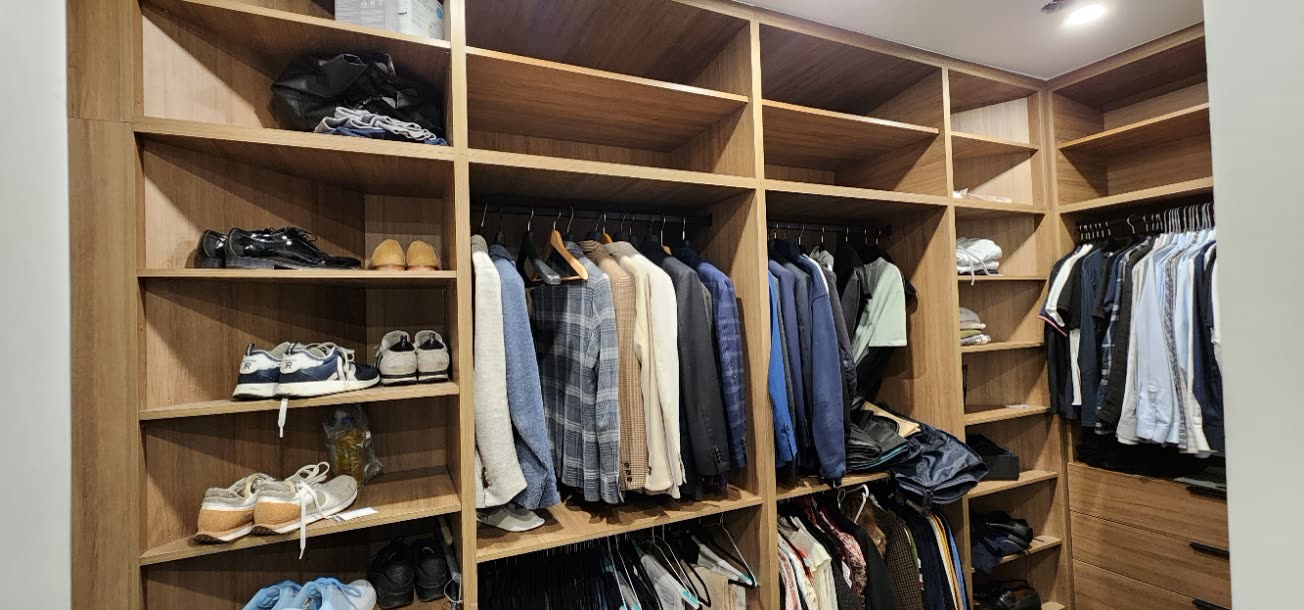
The 80/20 strategy: display the favorites, store the fleet
Our standard recommendation after thousands of closets: give the ten or twelve pairs you actually rotate the prime real estate — eye-level, angled if you love the look, lit if the budget allows — and store the rest dense: flat shelves above and below, drawers for the delicate, high shelves for the seasonal. You get the boutique moment where your eyes land, and triple the capacity everywhere else. A fully angled wall for sixty pairs is the closet equivalent of a restaurant with forty daily specials — impressive at the sales meeting, exhausting to live with, and it goes stale the first time a pair migrates to the floor because its slot is too far away.
Boots: the section everyone forgets
Boots ruin tidy shelf math. Ankle boots need 8–10 inches of height, riding and knee boots 16–20 inches, and tall shafts flop unless supported. Plan a dedicated boot bay: one or two shelf sections with taller spacing, deep enough (16") that toes don't overhang. Cedar boot shapers keep shafts upright and photogenic. In four-season climates we often put boots on adjustable shelving that reconfigures twice a year — boot bay in winter, folded-denim shelves in summer. That flexibility is exactly why we drill our panels on the 32mm adjustable system rather than fixing shelves at build time.
Sneaker collections: a different sport
Collectors need different specs and know it: display density, dust control, and UV honesty. Glass-front doored sections keep dust off without hiding the collection; integrated shelf lighting (4000K, CRI 90+ — the same spec as our closet lighting guide) turns a column into a vitrine. Two honest warnings from experience: sunlight yellows midsoles, so keep display columns off the window wall; and collections grow, so build adjustable and leave one empty shelf. For serious collections we've built entire wall units — closer to library millwork than shoe storage — with the same Blum and Hettich soft-close hardware and lifetime warranty as everything else we make.
Don't forget the shoes that never reach the closet
The daily pairs live at the door, not the dressing room — pretending otherwise designs a closet for a household that doesn't exist. The best shoe plans we build are two-part: the closet system plus a mudroom or entry bench — a seat, ventilated shoe drawers or cubbies below, hooks above. Ventilation matters at the entry (daily shoes arrive damp; solid doored cubbies get musty), so we louver or slot those fronts. These entry pieces are built-in cabinetry in their own right, matched to your home's finishes from the same finishes library as the closet upstairs.
Costs and specifying it right
Within a custom closet project, shoe storage prices roughly like this: flat adjustable shelving is the baseline (included in per-foot pricing), angled shelves with fences add modestly per section, pull-outs add hardware cost per shelf, and drawer storage is the premium tier — the full cost picture sits in our custom closet cost guide. A dedicated glass-front lit display column typically adds $1,500–$3,500. Like all our millwork, shoe sections are fabricated in our facilities in the USA and Canada, ship anywhere, and install on the same 8–12 week cycle as the rest of the closet. The pull-out fittings and dividers come from the same program as our accessories collection.
Keeping shoes well: the storage conditions that matter
Storage design is also preservation design, and shoes are the most climate-sensitive thing in the closet after silk. Four conditions worth building for:
- Air. Leather needs to breathe and to dry for a day between wears — which is the functional argument for the two-shelf rotation: today's pair rests while yesterday's airs. Sealed plastic boxes trap moisture against leather; if you want dust protection with visibility, the drop-front boxes with ventilation holes are the acceptable version, and glass-front millwork sections are the better one.
- Shape. Shoe trees for the good leather pairs, boot shapers for tall shafts, and — the free version — stuffing with acid-free tissue for the occasional-wear pairs. We size shelf spacing to shoes with their trees in, which adds about an inch of height per row and is exactly the kind of detail that separates measured design from guessing.
- Light. Display lighting is cool-running LED and safe; sunlight is not. Midsoles yellow, dyed leather fades, and the window-adjacent shelf quietly ruins the favorites you put there to admire. Display columns live on interior walls.
- Humidity. In damp climates, shoe sections benefit from the same ventilation thinking as the rest of the closet — louvered fronts on entry cubbies, breathing gaps behind closed sections. Mildew starts at the floor, in the darkest corner, in the shoes you wear least; ventilated design is cheaper than replacing suede.
None of this requires fuss day to day. It requires the sections to be designed for it once — spacing, ventilation, placement — which is precisely the sort of thing that gets settled in the drawings during the design retainer stage, while changes still cost nothing.
Practical takeaways
- Count pairs first: weekly rotation gets display, the fleet gets density.
- Flat shelves store ~30% more per column than angled; use angled only where eyes land.
- Build shoe sections 14–16 inches deep; boots need 16–20 inches of height in their own bay.
- Riser-backed double rows nearly double capacity for almost nothing.
- Solve the front door with a ventilated bench, or the closet plan solves only half the problem.
Bring your pair count — honest number, we've heard everything — and we'll design the section around it. Book a free 30-minute design consultation or browse our walk-in closets for built examples.