
Lacquer, Polyurethane, and 2K Finishes Compared
The finish is the part of your cabinetry you actually touch every day, and it's the part buyers know least about. Doors get discussed for months; the 100 microns of chemistry protecting them gets a single line on the quote — "lacquered" — that can mean five completely different products with completely different lifespans.
I've run spray booths since the days when everything was nitrocellulose and the shop smelled like a nail salon. Here's a plain-language tour of what actually gets sprayed on cabinets in 2026, what each chemistry does well, and the trade-off nobody explains: toughness and repairability pull in opposite directions.
The core idea: films that dry vs films that cure
Every cabinet finish is a liquid that becomes a solid film. How it makes that leap defines its character.
Evaporative finishes (classic nitrocellulose lacquer, shellac) simply dry: the solvent leaves and the resin remains — and the film can always be re-dissolved by that solvent. That's why old-school lacquer repairs are magic: a new coat "burns in," melting into the old one with no visible seam.
Reactive finishes (conversion varnish, 2K polyurethane, UV-cured coatings) undergo a chemical reaction — crosslinking — that builds a dense molecular network. Once cured, no solvent will re-dissolve them. They're far tougher against water, alcohol, and cleaners. They're also far harder to spot-repair, because new material sits on the old film rather than melting into it.
Hold that trade-off in mind; it explains almost every choice below.
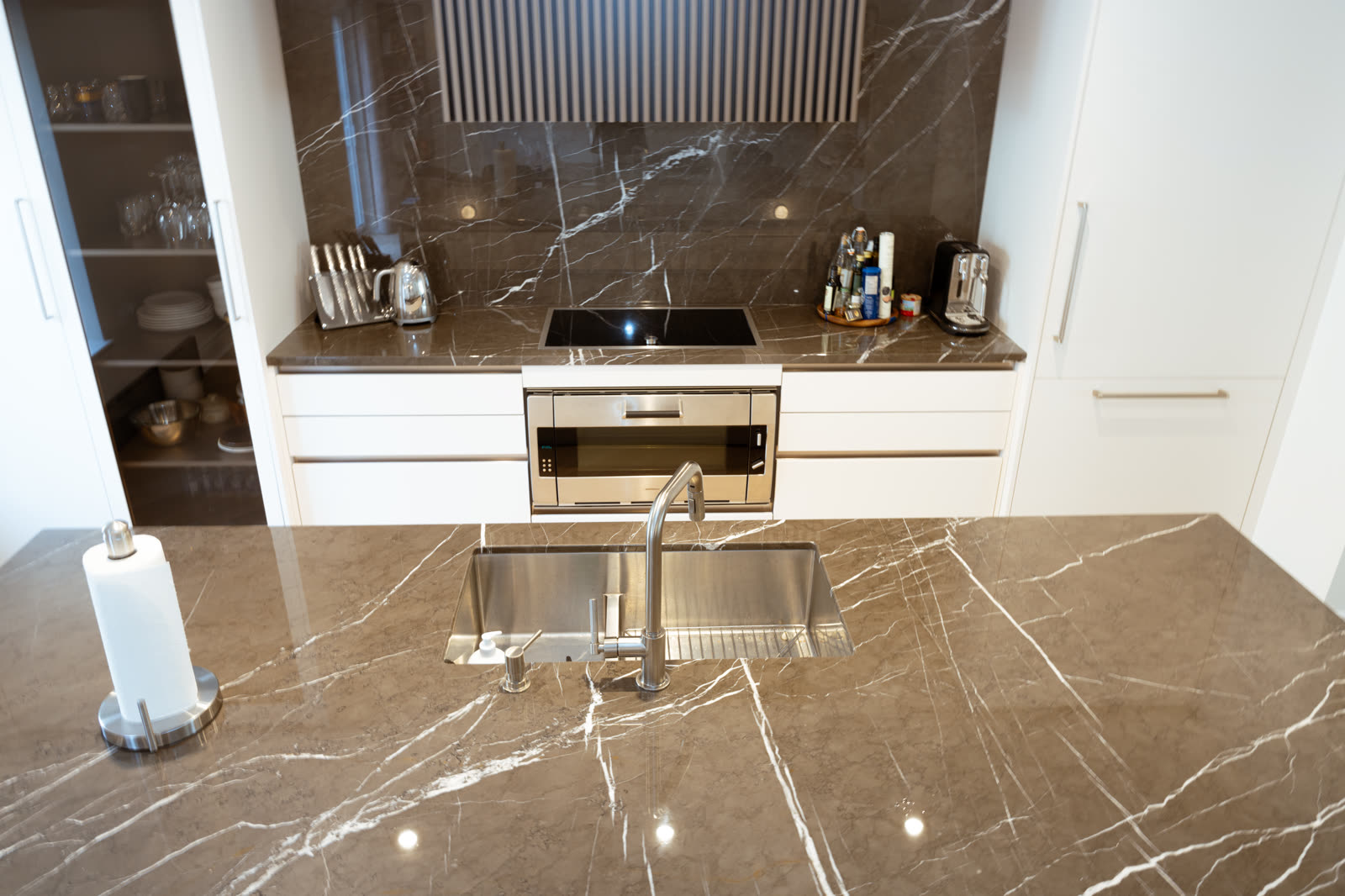
The five finishes you'll actually encounter
1. Nitrocellulose lacquer. The heritage finish — fast, beautiful, endlessly repairable. But it stays soft, ambers noticeably with age, and its water and chemical resistance are poor by modern standards. A wet glass can print a ring into it. In 2026 it survives mostly in furniture restoration; on kitchen cabinets it's obsolete, and if a quote says "lacquer," you should ask which kind.
2. Catalyzed lacquers (pre-cat and post-cat). Nitro's college-educated descendants. An acid catalyst — blended at the factory (pre-cat) or added in the shop (post-cat) — triggers partial crosslinking, giving much better durability while keeping some of lacquer's forgiving application. Pre-cat is a fine mid-grade finish; post-cat approaches conversion varnish. Limits: film thickness must stay modest (build it too thick and it cracks), and cold-checking can appear over the years in rooms with big temperature swings.
3. Conversion varnish. The North American workhorse for premium sprayed cabinetry. Fully catalyzed, high solids, excellent resistance to water, household chemicals, and wear. Sprayed and cured properly it's a 20-year finish. Its sins: a formaldehyde-bearing cure in older formulations, a hard limit on total film build, and near-zero burn-in repairability.
4. 2K polyurethane. The European standard, and what most of our painted and clear work leaves the plant wearing. Two components — a polyol resin and an isocyanate hardener — are mixed just before spraying and react into a dense urethane network. The result is the toughest practical cabinet film: superb scratch, water, and chemical resistance, excellent flexibility (it moves with the substrate instead of cracking), and, in acrylic-urethane versions, genuinely non-yellowing — critical over white paints and pale oaks. It demands disciplined mixing, pot-life management, and a clean booth, which is why it lives in factories rather than garages.
5. Waterborne and UV-cured systems. Waterborne acrylics and urethanes have matured from "acceptable" to "excellent," with tiny VOC loads and water-white clarity that never ambers — we reach for them where preserving a raw, pale oak look matters. UV-cured coatings — acrylate resins hardened in seconds under ultraviolet lamps — are the flatline-consistent, extremely durable finishes applied on automated lines, mostly to flat panels. If your doors come from a modern European-style line, there's a good chance their clear coat cured in under a minute of intense light.
How to judge a finish (the tests that matter)
North American cabinet finishes are graded against KCMA/ANSI A161.1 — a gauntlet that includes 24-hour exposure to vinegar, lemon, ketchup, coffee, and 100°F detergent solution, plus hot/cold cycling. Ask whether your cabinetry passes it; ours does, and that certification plus our lifetime warranty says more than any adjective. Beyond the lab, three homely tests tell you a lot in a showroom: press a fingernail into an edge (a quality catalyzed film resists), look across the sheen in raking light (orange peel and dust nibs reveal booth discipline), and ask what happens if a door chips in year six. A manufacturer who keeps your color formula and sheen on file — as we do — can refinish one door to match nine-year-old neighbors. A shop that can't will refinish your whole run or leave you patchy.
Yellowing, sheen, and the details people notice at year five
Two slow-motion behaviors separate finishes long after install day. First, ambering: nitrocellulose and some solvent systems yellow markedly; conversion varnish slightly; acrylic 2K and waterborne systems essentially not at all. Over walnut, ambering is invisible; over a white kitchen or a "raw" Scandinavian oak, it's the difference between year-five delight and year-five disappointment — a topic that pairs closely with the species discussion in white oak vs walnut. Second, sheen stability: lower sheens hide micro-wear dramatically better. The 5–10 gloss "super-matte" finishes dominating current design aren't just fashion — they're the most forgiving surfaces we've ever sprayed, though they demand flawless prep because a matte film shows a shiny polished spot wherever it's rubbed hard.
Cost-wise, finish is a meaningful slice of custom cabinetry — multi-step spraying is skilled, slow work, and it's one reason two quotes for "the same kitchen" can differ, as we broke down in what a custom kitchen costs in 2026. Paying for a 2K or certified conversion finish is buying decades; saving $2,000 with a mystery "lacquer" is renting years.
What we spray, and why
Our standard at iKitchen: 2K polyurethane systems for painted and most clear work, waterborne where water-white clarity over pale species is the goal, and UV-cured lines for high-volume flat components — all applied in our Canadian facility during the 8–12 week production window, all KCMA-tested, all documented so any door can be matched years later. It's less romantic than "hand-rubbed lacquer," and it will still look right when your kids leave for college.
Practical takeaways
- "Lacquer" is not one thing. Ask specifically: pre-cat, post-cat, conversion varnish, 2K urethane, waterborne, or UV?
- Reactive (catalyzed/2K) finishes are far tougher; evaporative finishes are far more repairable. Modern kitchens should choose tough — and partner with a maker who can refinish single doors to match.
- Over whites and pale oaks, insist on non-yellowing chemistry (acrylic 2K or waterborne).
- Ask for KCMA/ANSI A161.1 compliance and a written warranty on the finish, not just the box.
- Low sheens hide wear; they also expose sloppy prep. Judge them on a full-size door in raking light.
If you want to feel these differences rather than read about them, our showrooms keep finished samples of every system side by side. Book a free 30-minute consultation, or see the finishes at work across our custom kitchens.