
White Oak vs Walnut: Choosing Your Kitchen Wood
If you're building a custom kitchen in 2026 and you want real wood, the conversation almost always narrows to two species: white oak and walnut. Between them they account for the overwhelming majority of the wood kitchens leaving our shop — and for good reason. Both are stable, beautiful, and age gracefully. But they are very different woods, and I've seen people choose the wrong one because they fell in love with a photo taken in someone else's light.
Here's how I walk clients through the decision, with everything I know from three decades of cutting, finishing, and living with both.
Color and how it changes — because it will
The single most misunderstood fact about wood: it doesn't stay the color you bought.
White oak starts light — pale straw to soft tan with a slight grey-brown cast. With UV exposure it ambers gently and warms over the years. A clear matte finish keeps it closest to that raw, Scandinavian look everyone photographs; a light cerused or "nordic" treatment holds the pale tone longer.
Walnut does the opposite of what people expect. It starts deep chocolate brown, sometimes with purple undertones, and then lightens — mellowing over five to ten years into a warmer honey-brown. That doorstyle sample in the showroom is the darkest your walnut kitchen will ever be. Clients who wanted "dark, moody walnut forever" need to hear this before they sign, not after.
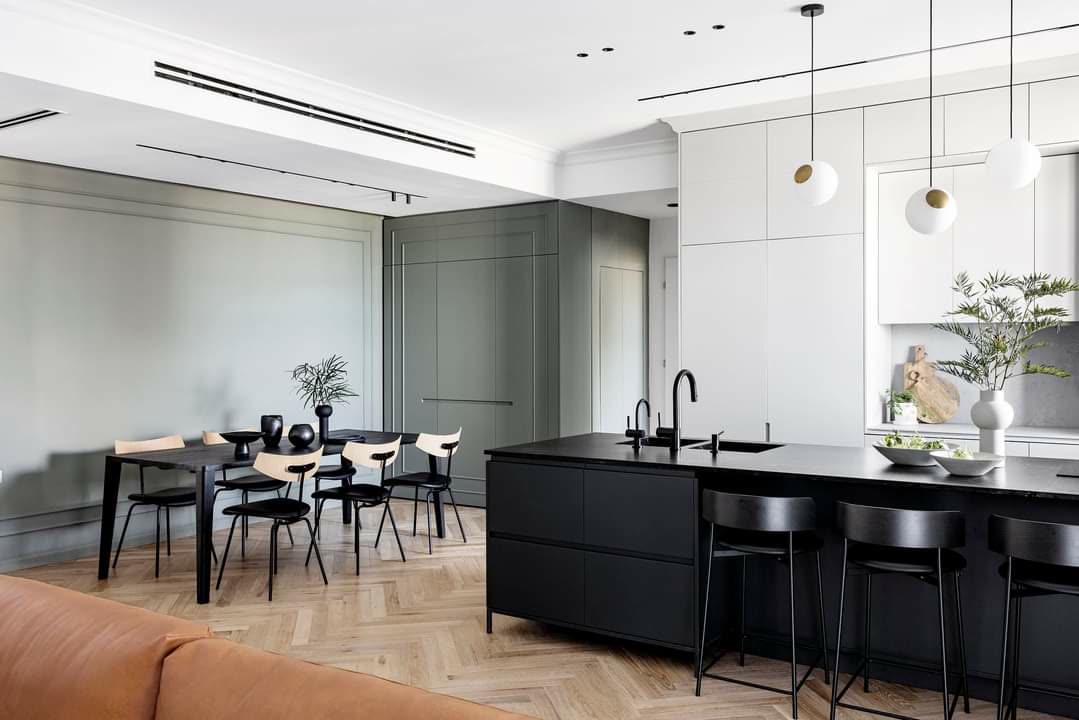
Grain: cathedral drama vs quiet linear calm
Grain character is where the cut matters as much as the species. Plain-sawn white oak gives you big cathedral arches — bold, rustic, farmhouse. Rift-sawn white oak gives you tight, straight, almost pinstriped grain, and this is the look driving the modern white oak boom. Rift cutting wastes more of the log, which is why rift oak costs 30–50% more than plain-sawn. Quarter-sawn sits between, with the medullary ray flecking that Stickley made famous — beautiful, but polarizing in a minimal kitchen.
Walnut's grain is naturally more varied: swirls, curls, occasional sapwood streaks of pale yellow against the brown. You can spec walnut for consistency (we sort and sequence veneer leaves so adjacent doors flow) or lean into the variation. Either way, walnut reads as organic and warm where rift oak reads as tailored and architectural.
Hardness and daily life
On the Janka scale, white oak measures about 1,360 lbf; walnut about 1,010. In practice: both are plenty hard for cabinet doors, which take far less abuse than floors. But walnut's finish shows fine scratches slightly more readily because scratches expose lighter wood underneath, while oak scratches tend to disappear into the grain. In kitchens with young kids or big dogs, I gently steer toward oak — or toward a matte finish on walnut, which hides micro-scratching far better than any sheen.
Oak's deep open grain also does one quiet favor: it hides fingerprints and water spots near handles and sinks. Walnut's smoother, tighter surface shows them a bit more. Neither is a problem; one just asks for slightly more wiping.
The cost difference, honestly
In 2026, expect walnut to run 15–30% over rift white oak, and rift white oak to run 30–50% over plain-sawn oak or a painted door. On a typical custom kitchen that means the oak-to-walnut decision swings the cabinetry price by $5,000–$15,000. Where does that money go? Walnut lumber and veneer simply cost more — the trees are smaller, clear boards are scarcer, and demand from furniture makers never lets up.
A trade secret that stretches budgets: mix the media. Many of our best kitchens put walnut or rift oak on the island and tall pantry wall — the surfaces at eye level — and a complementary painted or textured finish on the perimeter. You capture 90% of the effect for 60% of the wood budget. More on where money hides in our custom kitchen cost guide.
Veneer vs solid: the question everyone asks wrong
Clients often ask for "solid wood doors" as a proxy for quality. Here's the truth from the shop floor: for large flat-panel (slab) doors, premium veneer over an engineered core is the superior construction — it's dimensionally stable, won't cup or crack with seasonal humidity swings, and lets us sequence-match grain across an entire wall of doors from the same log. Solid wood is the right call for five-piece doors, face frames, and edge details. A quality kitchen uses both, each where physics says it belongs. Anyone selling "100% solid wood slab doors" is selling you future warping. This is exactly the kind of construction detail worth probing when you're weighing custom vs semi-custom vs stock quotes.
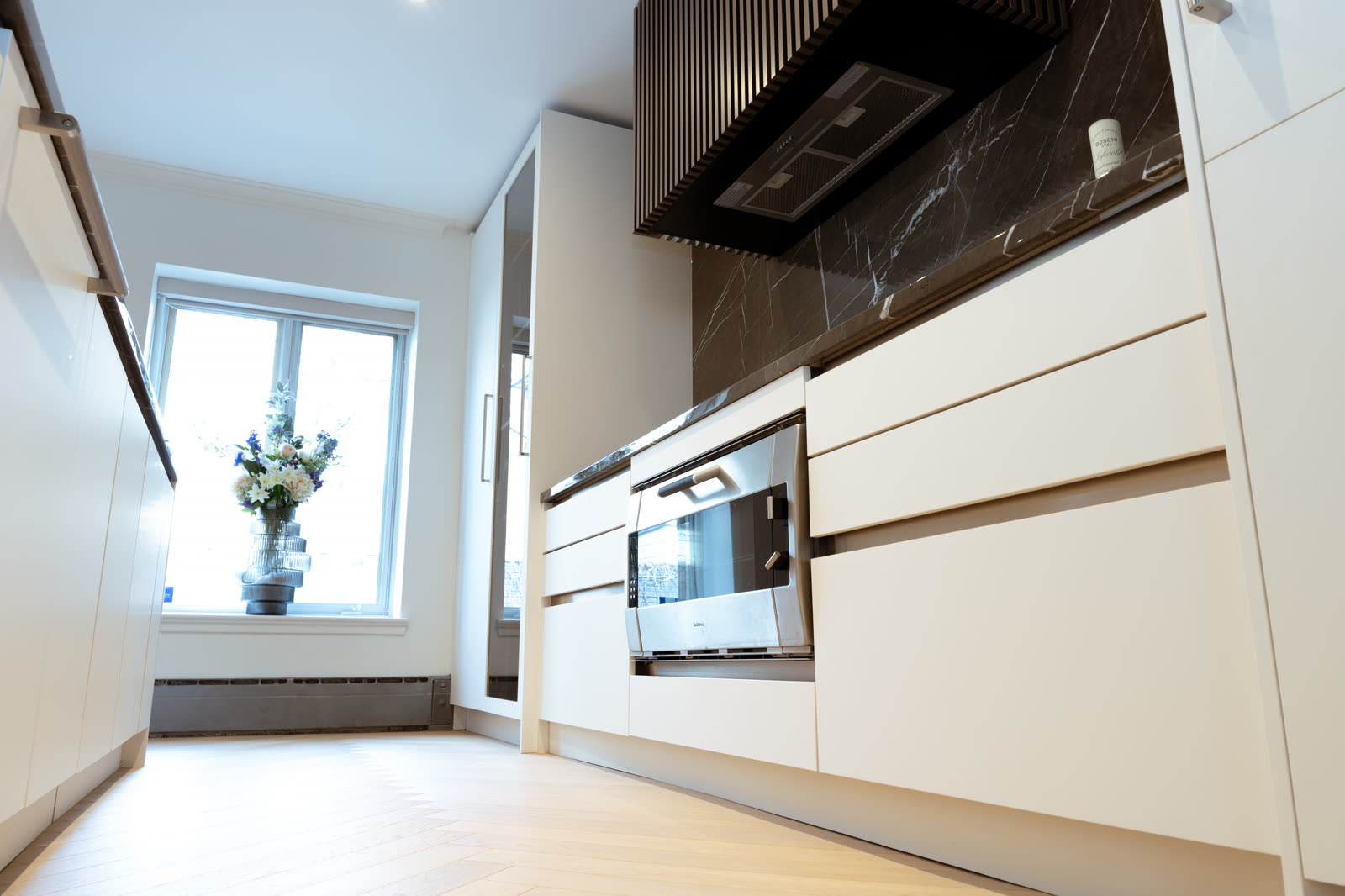
Living with wood: care, repairs, and the ten-year view
Both species are low-drama if finished properly, and the care routine is identical: dry cloth or barely-damp microfiber, never furniture polish (silicone polishes build a film that complicates future refinishing), and wipe standing water at the sink run the way you'd wipe any fine surface. The failure points we actually see at year ten aren't the wood — they're sun and steam. A south-facing window will visibly shift the color of the two doors beside it relative to the rest of the kitchen; if your layout has strong direct sun, ask for UV-inhibiting finish on that elevation, or plan window treatment. And run the vent fan when you boil — the doors directly over a hard-working, unvented kettle age faster than the rest of the kitchen combined.
Repairs favor wood over paint, which surprises people. A chipped painted door needs factory retouching to hide; a scratched oak or walnut door usually blends with a wax stick and twenty minutes, because grain camouflages what solid color advertises. It's one reason wood kitchens age with dignity in busy houses — they accumulate character where painted kitchens accumulate touch-up appointments.
Which one suits your home?
- Choose white oak if: your light is cool or limited (north-facing rooms love oak's warmth), your style leans Scandinavian, coastal, japandi, or transitional, you want durability with kids and pets, or you're pairing with cooler stones and concrete tones.
- Choose walnut if: you want depth and richness, your space gets generous natural light (walnut can go heavy in dim rooms), your palette includes brass, bronze, cream, and warm stone, or the kitchen doubles as an entertaining showpiece.
- Choose both if: you have the square footage to zone them — walnut island, oak perimeter is a combination we've built many times and it never misses, provided the finishes share an undertone.
Practical takeaways
- Walnut lightens with age; white oak ambers. Judge samples in your kitchen's light, at three times of day, before deciding.
- Rift-sawn oak is the tailored modern look — budget 30–50% over plain-sawn for it. Walnut adds another 15–30%.
- Matte finishes hide wear on both; gloss on wood is a maintenance commitment.
- Veneer on engineered cores is the correct construction for slab doors — it's a feature, not a shortcut.
- Mixing a feature wood with painted perimeter cabinetry captures the look at a fraction of the cost.
The right way to choose is with real samples in your real light — which is why we hand them out freely. Book a free design consultation and we'll bring oak and walnut door samples to the conversation, or browse our custom kitchens and the 2026 catalog to see both species living in finished homes.