
Cedar Closets and Ventilation: Myths and Facts
Every few weeks a client asks for a full cedar closet, usually because a grandmother had one and her sweaters survived forty winters. I love these conversations, because cedar sits exactly at the intersection of folklore and wood science — my favorite neighborhood — and because the honest answer surprises people: cedar does some of what legend claims, none of the rest, and there's a better way to get everything grandma's closet actually delivered. Let's take the myths one at a time, then talk about what we build instead.
Myth one: "Cedar kills moths"
Mostly false, with a true core. Aromatic red cedar oil can be lethal to very young clothes-moth larvae at high concentration in a sealed space. That's the entire fact. It does not kill adult moths, mature larvae, or eggs — and the concentration required is far higher than an open closet ever maintains. What cedar does moderately well is deter: adult moths prefer not to lay eggs in strong cedar scent. So a tightly sealed cedar chest earns its reputation; a walk-in closet with the door opening twice a day is a lightly cedar-scented room whose moths have adapted to the decor. The actual anti-moth protocol is unglamorous: clean garments before storing (moths seek body oils and keratin debris, not clean wool), seal off-season knits in garment bags or lidded bins, and vacuum the closet floor where larvae actually live. Cedar is the garnish, not the meal.
Myth two: "The scent lasts"
False, on a schedule. Cedar's volatile oils evaporate from the surface within one to three years — faster in warm rooms — leaving handsome but inert pink planking. Light sanding re-exposes oils, and cedar oil sprays exist, which means a full cedar closet is a maintenance subscription: sand or spray annually, forever, in a room full of clothing you must first remove. Almost nobody does it twice. Every "cedar closet" we're asked to renovate has been scentless for a decade.
Myth three: "Cedar controls humidity and mildew"
Half true, and the half matters. Cedar is dimensionally stable and moderately hygroscopic — it buffers small humidity swings and resists rotting itself. It does not dehumidify a room, and it will not protect your clothes in a closet with a moisture problem. Ventilation does that, and ventilation is the genuinely underrated subject hiding inside every cedar conversation. The rules we build by: closets on exterior walls in humid or cold climates get airflow paths (door undercuts or louvers, gaps behind panels); packed clothing needs breathing room — the two-inch rule between garment groups; and in genuinely damp climates, a closet is a candidate for a continuous trickle of conditioned air more than for any species of plank. Damp performance is an engineering problem, and materials play a role too — the same moisture logic that governs our bathroom vanity construction applies to closets in humid regions.
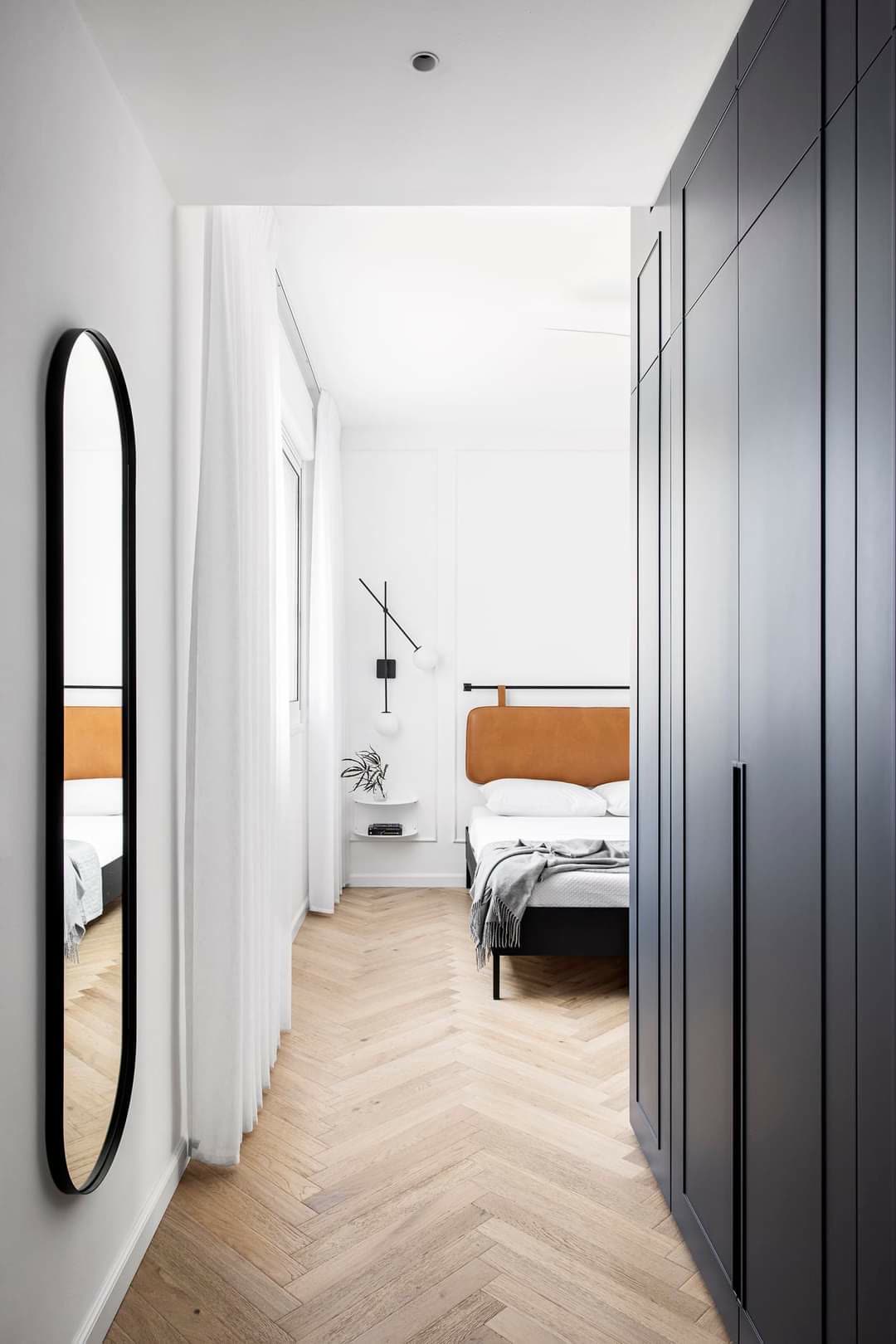
What we build instead: the targeted cedar strategy
Here's the design that captures everything true about cedar and discards the folklore, and it's what I recommend in nearly every case:
- One or two cedar-lined drawers or a cedar-lined hutch section for knitwear and woolens — small, closeable spaces where cedar concentration actually stays high enough to deter. Lining a drawer costs $100–$300; lining a room costs thousands and works worse.
- Removable cedar panels or blocks inside those drawers, swapped or sanded in minutes instead of sanding a room.
- Sealed off-season storage — the high shelf zone designed for lidded bins and garment bags, where the real moth protection happens.
- The closet itself in modern materials: cabinet-grade construction with durable finishes chosen from the whole palette (see the finishes library), on the ventilation principles above. Full design logic in our walk-in closet guide.
This targeted approach also frees you aesthetically. Full cedar planking locks a room into one look — knotty, pink, cottage — that fights the rest of a modern home. A cedar drawer inside walnut-toned millwork gives you the function and keeps the design.
If you still want the full cedar room
Sometimes the answer is sentiment, and sentiment is a legitimate design driver — we've built full cedar closets for clients who wanted the childhood smell, eyes open. If that's you: use aromatic Eastern red cedar (the fragrant one), plank the walls but keep shelving and drawers in cabinet-grade material (cedar is soft and splintery for working surfaces — it snags knits, which is why even cedar chests were traditionally lined), leave it unfinished (any topcoat entombs the aroma permanently), and calendar the annual light sanding. Expect $15–$30 per square foot for quality tongue-and-groove planking installed. It will be beautiful. It will smell wonderful for two years. You know the rest.
The construction underneath any of it
Whatever the species story, the closet under it is still cabinetry, and the rules don't change: 3/4" cabinet-grade panels built to the room, floor-supported, every drawer on Blum or Hettich soft-close runners — the only hardware names we install — covered by our lifetime warranty. Everything is fabricated in our own facilities in the USA and Canada, ships anywhere, and runs on the standard 8–12 week production cycle, with cedar linings and ventilated fronts specified during design like any other interior fitting (they live in the same program as our closet accessories).
Cedar questions, answered fast
"Which cedar is the moth one?" Aromatic Eastern red cedar (technically a juniper). Western red cedar — the fencing and sauna wood — smells different and carries little of the folklore oil. Spanish cedar, the cigar-humidor wood, is a third species again. Buying "cedar" generically gets you whichever was cheapest that month; specify aromatic Eastern red or you're buying pink pine.
"Do cedar balls and rings from the store work?" In a sealed drawer or garment bag, modestly, while fresh — same chemistry, same radius of effect, same expiry. In an open closet they're potpourri. Refresh or sand them twice a year if you use them.
"Is cedar safe next to all fabrics?" Direct long-term contact can transfer oils to delicate textiles — another reason chests were lined and another argument for cedar as drawer lining under a cotton barrier rather than as the touching surface for your knits.
"What actually stops an active moth problem?" Not wood. Freeze or dry-clean the affected garments, vacuum every crevice of the closet including the carpet edge, and use pheromone traps to confirm the cycle is broken. Cedar is prevention theater during an active infestation; treat first, deter after.
"My builder-grade closet already has cedar planking — keep it?" If you love it, keep a section and sand it back to life. Structurally it's fine as a wall surface behind new millwork; we routinely build over it, and the drawer-lining strategy works just as well in front of legacy planking as anywhere else.
Practical takeaways
- Cedar deters moths in small sealed spaces; it does not protect an open walk-in.
- The scent — and the active protection — fades within 1–3 years without re-sanding.
- Real moth defense: clean clothes, sealed off-season storage, and a vacuumed floor.
- Ventilation and humidity management protect clothing better than any wood species.
- Best of both: cedar-lined drawers inside modern millwork — function without the folklore.
If you're weighing cedar — or fighting humidity, moths, or a musty closet — bring us the problem, not the folklore, and we'll design for the actual physics. Book a free 30-minute design consultation or explore our walk-in closets.