
Drawers or Doors? Base Cabinet Strategy for Kitchens You Actually Use
If I could change one thing about the average North American kitchen, it wouldn't be the finish or the countertop. It would be the base cabinets. Somewhere between the 1950s and now, we standardized on a door with a fixed shelf behind it, and we've spent seventy years kneeling on tile floors reaching into the dark for a stockpot. European kitchens went the other way decades ago. When a client tells me their old kitchen "just didn't work," nine times out of ten the problem was doors where drawers belonged.
But drawers aren't automatically right everywhere, and they aren't free. Here's the real comparison.
Capacity: drawers win, but not by magic
A 24-inch-deep base cabinet with a door and one shelf gives you two horizontal surfaces, both of which you access by bending, reaching, and moving the front items to see the back. In practice people use the front 14 inches. That's roughly 58% of the depth doing real work.
The same box as a three-drawer bank on full-extension slides gives you three trays that travel completely out into the room. You use 100% of the depth, you see everything from above, and you never move a front item to reach a back one. Same cubic volume on paper; the usable difference is enormous. The one honest caveat: drawer boxes have side walls, so you lose about 1.5 inches of interior width per drawer to the box and slides, and each drawer bottom is a lost half-inch of vertical space. Net usable volume is roughly 8 to 12% lower with drawers. You will not notice, because you can reach all of it.
The configurations we specify most
- Two-drawer bank (one shallow, one deep): the workhorse for pots and pans. Typically a 6-inch-high top drawer and a 21-inch-high bottom in a 30 or 36-inch width. This is what goes under a cooktop and beside a range.
- Three-drawer bank (6 / 10 / 12): for cutlery, utensils, and dishes. In a well-designed kitchen we stack plates in the bottom drawer with pegboard pegs rather than in an upper — it is dramatically easier on shoulders and the reason so many aging-in-place kitchens go drawer-heavy.
- Deep drawer with an internal drawer: a 21-inch-high drawer with a 4-inch tray riding above it inside. The best pantry storage in a base cabinet, and Blum and Hettich both build proper systems for it.
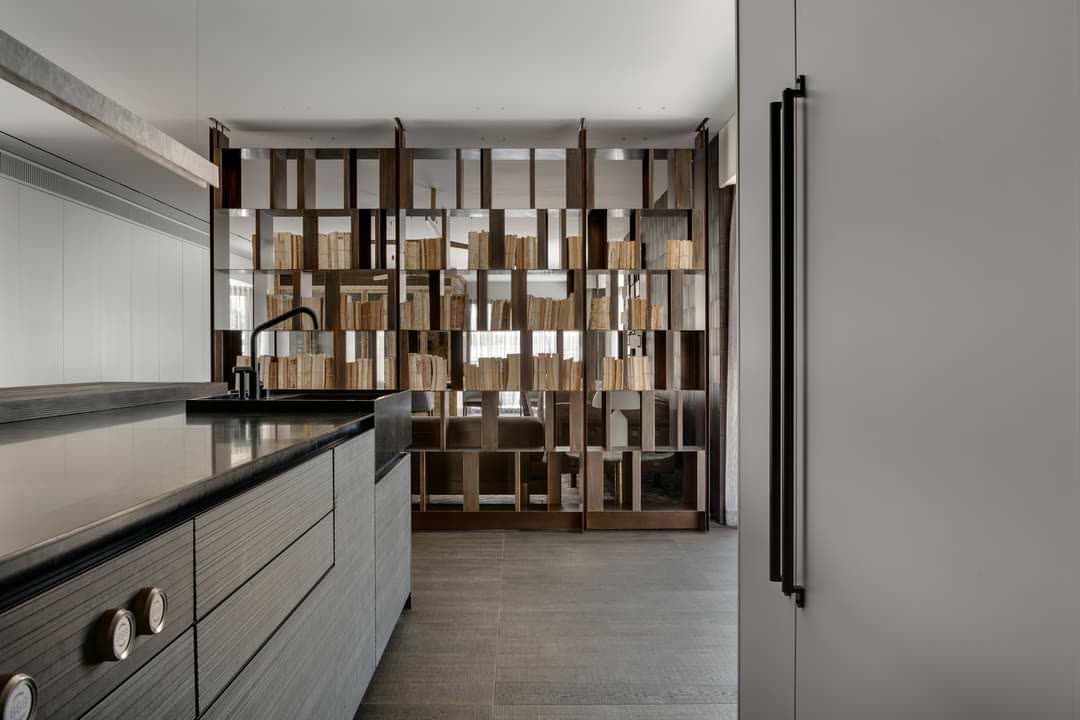
- Drawer behind a door (the compromise): a door face with pull-out trays behind. Costs almost the same as drawers, works almost as well, and preserves an unbroken door-front look for clients who want a furniture-like elevation.
Where doors still win
I'll defend doors in five places, and I mean it:
Under the sink. Plumbing, disposal and the trap make a drawer impossible unless you build a U-shaped notched drawer, which is doable but fussy and costs more than it returns. Doors plus a pull-out trash unit is correct here.
Corners. Corner mechanisms are door-based by nature — blind-corner pull-outs, bi-folds, rotating shelves. A drawer in a corner is a drawer that hits the return wall.
Very tall items. Sheet pans, cutting boards, large platters and stand mixers stored upright want a single open cavity with vertical dividers, not a stack of trays. One door cabinet with tray dividers is worth more than four drawers here.
Appliance housing. Anything panel-ready — dishwasher, undercounter fridge, wine unit — is a door by definition.
Budget triage. If money is tight, doors on the low-traffic runs and drawers on the cooking and cleanup zones is a smart split. A blanket "all drawers" spec on a 24-linear-foot kitchen adds real money for cabinets you open twice a month.
What it actually costs
A three-drawer base costs meaningfully more than a door base of the same width — in our shop the delta typically runs $180 to $450 per cabinet, depending on width, box construction and slide grade. Over a full kitchen with twelve to sixteen base cabinets, converting from a door-heavy plan to a drawer-heavy one is usually a $2,500 to $5,500 line item. It is, in my professional opinion, the single best return on spend in a kitchen budget — better than a waterfall edge, better than a fancier faucet, better than upgrading from good stone to great stone. Our post on where to splurge and where to save puts it in the same tier.
Why the cost difference? A drawer bank is three or four boxes built inside one box. Dovetailed maple or 15 mm engineered sides, bottoms captured in a groove, a slide pair per drawer, plus assembly and adjustment time. A door base is a shelf and two hinges.
Hardware: where drawers live or die
A drawer is only as good as what it rides on. Specify full-extension undermount slides — the runners hide beneath the box, so you get the full interior width and a clean look when the drawer is open. Load ratings matter more than people think: a standard slide is rated around 75 lbs, heavy-duty versions 100 to 130 lbs. A 36-inch-wide deep drawer holding cast iron, a Dutch oven and a stockpot is easily at 80 lbs. Spec the heavier slide on the two cabinets flanking your range and nowhere else, and you've spent your money precisely.
Soft-close is standard on everything we build, and the good systems are rated to 100,000 open-close cycles — twenty-plus years of daily use. We build on Blum and Hettich, and both offer tip-on electric options for handleless kitchens. There's more detail in our guides to dovetail drawers and undermount slides and to soft-close hardware.
Organizing the inside, not just the box
A drawer is a blank rectangle until you divide it, and undivided deep drawers become the same rummaging exercise as the doors you replaced. The interiors worth specifying: adjustable wood or aluminium cross dividers in the cutlery and utensil drawers; pegboard systems with movable pegs in the dish drawer, which stop a stack of plates from sliding every time you close it; a knife block insert cut to your knives rather than a generic one; and vertical dividers in one deep drawer for cutting boards and sheet pans stored on edge. Budget roughly $80 to $400 per drawer depending on material — solid maple inserts sit at the top of that range and last decades. Order them with the cabinetry so the dimensions are exact; aftermarket organizers are sized to standard modules and rarely fit custom widths cleanly.
The mistakes I see most
Drawers too shallow to matter: a 4-inch drawer under a 6-inch drawer under a 6-inch drawer looks organized in a rendering and holds nothing tall. Give at least one drawer per bank 20+ inches of interior height. Second mistake: drawer fronts that don't align across the run. In custom work, the reveal lines between drawer fronts should run dead level across an entire elevation, including across appliance panels. That's an installation and shop-tolerance question, and it is the clearest visible marker of quality cabinetry.
Third: forgetting the handle. On a deep drawer holding 80 lbs, a small knob concentrates the pull into one point and eventually racks the front. Use a pull at least a third of the drawer width, mounted into the front with machine screws, not the box.
Practical takeaways
- Default to drawers in base cabinets everywhere except sink, corner, tall-item and appliance locations.
- Budget $180–$450 per cabinet for the conversion; $2,500–$5,500 across a full kitchen. Worth it.
- At least one drawer per bank should have 20+ inches of interior height.
- Full-extension undermount slides; upgrade to heavy-duty only at the pots-and-pans cabinets.
- Doors with internal pull-outs are a legitimate middle path if you want unbroken door fronts.
If you're mid-plan and staring at an elevation full of doors, that's the conversation to have before drawings are approved. Book a free 30-minute design consultation, or look through the drawer systems and mechanisms in our accessories catalog.