
Fluted, Reeded, and Slatted Cabinet Fronts
Texture is the story of this design decade. After fifteen years of dead-flat slab doors, clients walk into our showrooms and run their hands along the fluted island panel before they say a word. Vertical ribbing — fluted, reeded, or slatted — has moved from boutique hotel bars into serious residential cabinetry, and it photographs so well that Instagram has convinced a lot of people they need a fully ribbed kitchen.
They usually don't, and this is the honest guide to why. Texture is a wonderful accent and a punishing default. Here's how the three profiles differ, where each one earns its place, how a real shop actually machines and finishes them, and the cleaning conversation nobody has until it's too late.
Fluted vs reeded vs slatted: get the vocabulary right
The three terms get used interchangeably online, but they're distinct profiles with distinct shadows:
- Fluted is concave — half-round grooves scooped into the surface, the language of classical columns. Flutes read soft and traditional; light pools gently in the hollows. Typical scale: 10–25 mm groove width.
- Reeded is convex — half-round beads standing proud of the surface, like a bundle of reeds. Reeding reads more tailored and contemporary, with crisper highlight lines. It's the profile you see on most "fluted" glass, which is technically reeded too.
- Slatted is rectilinear — square-edged battens with flat gaps between them, the spa-and-sauna language. Slats cast the strongest shadow lines and skew most modern, especially in warm woods. Typical scale: 20–40 mm slats with 8–15 mm gaps.
Scale matters as much as profile. Fine 6 mm reeding on a vanity reads as jewelry; the same profile blown up to 30 mm on a full wall reads as paneling. We always sample two scales before committing a project, because texture that looks refined on a 4-inch sample can shout in a 12-foot run.
Where texture works — and where it fights you
The best textured cabinetry follows one rule: put the ribs where hands and grease aren't.
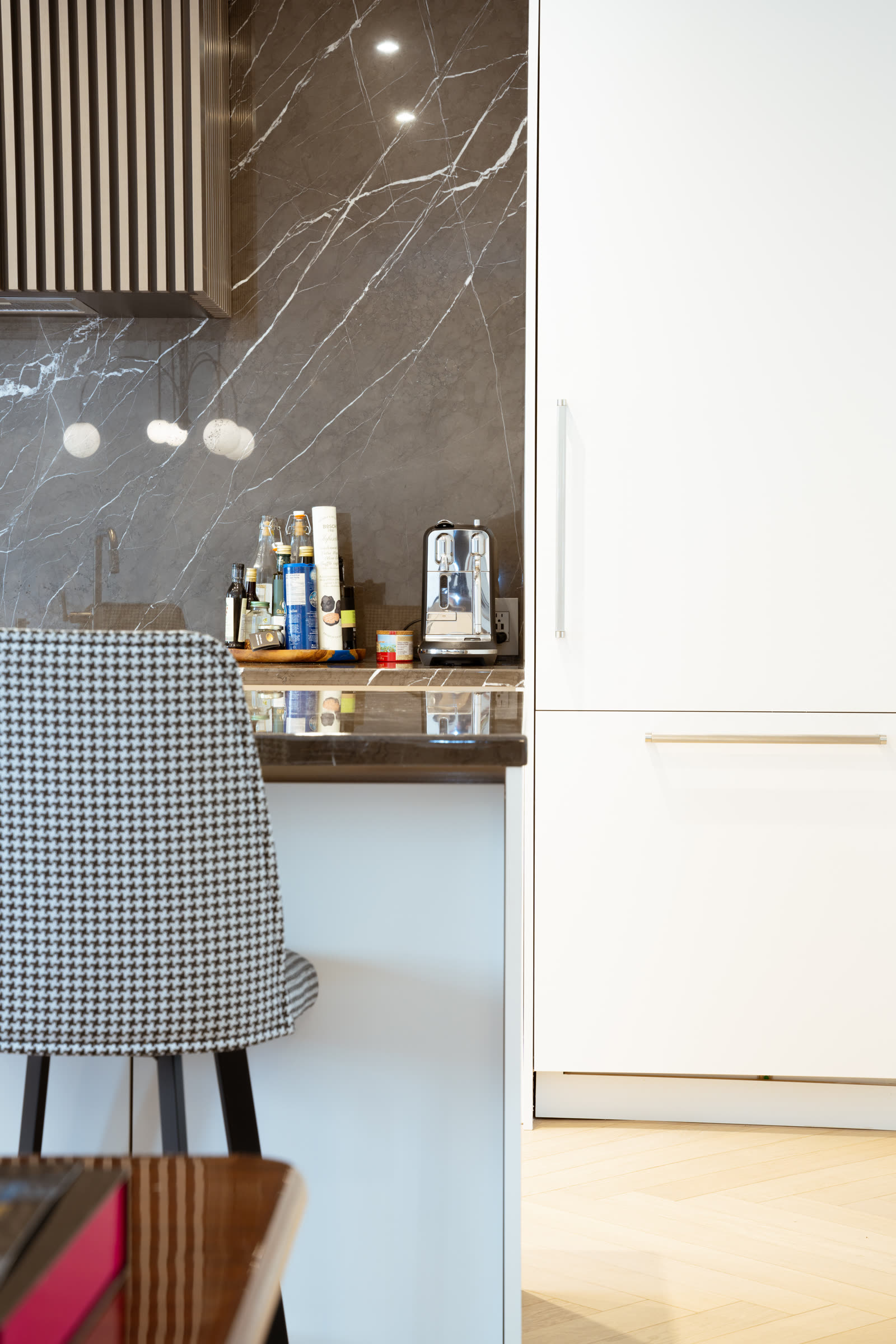
- Island backs and ends. The single best application. The seating side of an island is highly visible, never touched by cooking splatter, and benefits enormously from the depth texture adds — a trick worth considering alongside the clearance math in our kitchen island design guide.
- Bar, coffee, and butler zones. Small, jewel-like elevations where a textured door and a stone top make a moment.
- Vanities. Reeded white oak vanities are half our bathroom vanity orders right now, and for good reason — the moisture exposure is manageable and the texture flatters small rooms.
- Range walls: caution. Grooves beside a cooktop collect aerosolized grease in exactly the places a cloth doesn't reach. We'll build it if a client insists, but we say this sentence out loud first.
- Handle-free trap. Ribbed doors don't love integrated J-pull channels — the profiles collide visually. Textured fronts pair best with discreet edge pulls, small knobs mounted on a flat rail detail, or push-to-open hardware from the systems we compare in our European hardware guide.
How it's actually made: three construction routes
What you're buying differs radically depending on how the texture is produced, and this is where quotes diverge.
1. Solid machined panels. The premium route: flutes or reeds CNC-machined directly into solid wood or a thick sawn veneer lamination. The grain runs continuously through the profile, corners can be mitred so ribs wrap an island without interruption, and the surface can be repaired and refinished like any solid wood. Slowest and most expensive — a machined and hand-sanded fluted panel can carry three to five times the labor of a flat slab, because every groove must be sanded along its curve before finishing.
2. Applied slats or mouldings. Individual profiled strips glued and pinned to a flat substrate. This is how most slatted walls are built, and done well — consistent spacing jigs, matched grain, edge-banded gaps — it's excellent, and it lets us run slats over doors and adjacent fixed panels so the rhythm never breaks at a hinge line. Done badly, you can see filler at the pin holes and gaps that wander 2 mm across a run. Ask to see a corner detail before you sign anything.
3. Pressed and wrapped profiles. Thermofoil or paper-wrapped MDF ribbing, common in imported flat-pack "fluted" furniture. The tell is the corner: the wrap can't turn a mitre, so profiles die into a flat edge, and chipped ribs expose brown MDF core. Fine for a powder-room accent on a budget; not what we build, because it can't be honored under a lifetime warranty.
On finish: ribbed profiles are unforgiving of thick film finishes. A heavy coat pools in flutes and rounds over crisp reed edges, which is why our textured work gets sprayed in multiple thin passes and de-nibbed between coats. Matte and ultra-matte lacquers flatter texture best — gloss on ribs multiplies every highlight into visual noise.
The cleaning conversation
Let's be adults about this: grooves collect dust. Not dramatically — vertical ribs shed far better than horizontal ones, which is one reason we almost never run texture horizontally in kitchens — but a fluted island back wants a monthly pass with a soft paintbrush or vacuum brush attachment, and a textured vanity wants the same weekly wipe you'd give any bathroom surface, just with the cloth following the grooves. Slatted fronts with open gaps are the most demanding; that's a texture we steer toward low-splatter zones and media walls. If a client tells us they find dusting blinds intolerable, that's genuinely useful design information, and we'll propose texture on glass — reeded glass inserts deliver the ribbed look with a squeegee-simple surface.
What it costs, honestly
As a rule of thumb on our projects: applied-slat accent panels add roughly 15–30% to the affected elevations; solid machined fluting or reeding adds 40–80% to those fronts, driven almost entirely by machining and sanding labor. Because we use texture as an accent — an island back here, a vanity there, a bar niche — the impact on a whole-project budget is usually modest, a few percent on the numbers we walk through in our custom kitchen cost guide. A fully ribbed kitchen is a different conversation, both financially and visually.
Will it date? A straight answer
Some of it, yes. The skinny-slat feature wall is already showing its timestamp. But fluting predates the Parthenon, and reeded furniture runs continuously from Biedermeier through Art Deco to now — texture done in real wood, at classical scale, in restrained doses, has never really left. Our advice is the same we give on every trend: put trends in the elements you can change and keep the architecture of the kitchen calm. A reeded island back can be re-faced in a weekend; regretting forty linear feet of ribbed uppers is a bigger repair. If in doubt, start with texture in the powder room or the closet island — small rooms are where bold texture pays the highest return per dollar anyway.
Takeaways
- Fluted is carved in, reeded stands proud, slatted is square battens — and each casts a different shadow. Sample at full scale.
- Best placements: island backs, bars, vanities, media walls. Think twice at the range.
- Ask how the texture is made. Machined solid wood wraps corners and refinishes; pressed foil doesn't.
- Vertical ribs, matte finishes, restrained doses. Texture is seasoning, not the meal.
The only way to choose a profile is to touch it. Every iKitchen showroom carries fluted, reeded, and slatted samples in oak, walnut, and painted finishes — made in Canada, delivered in 8–12 weeks, warrantied for life. Book a free 30-minute design consultation and bring your inspiration photos; we'll tell you which ones will still look right in 2040.