
How to Budget a Full Kitchen Remodel
Most kitchen budgets fail before the first cabinet is ordered, and they fail the same way: someone budgets for the things they can see — cabinets, countertops, appliances — and forgets that a remodel is one-third product, one-third labor, and one-third everything nobody photographs. Then the electrician's invoice arrives and the "extra" money earmarked for the nice faucet pays for junction boxes instead.
After thirty years of watching budgets succeed and fail across our nine showrooms, here is the framework I give my own clients: the category percentages, three worked sample budgets, and the payment schedule so you know not just how much, but when.
The category breakdown that actually holds up
For a full gut remodel of a typical 150–250 sq ft kitchen, budgets land within these bands remarkably consistently:
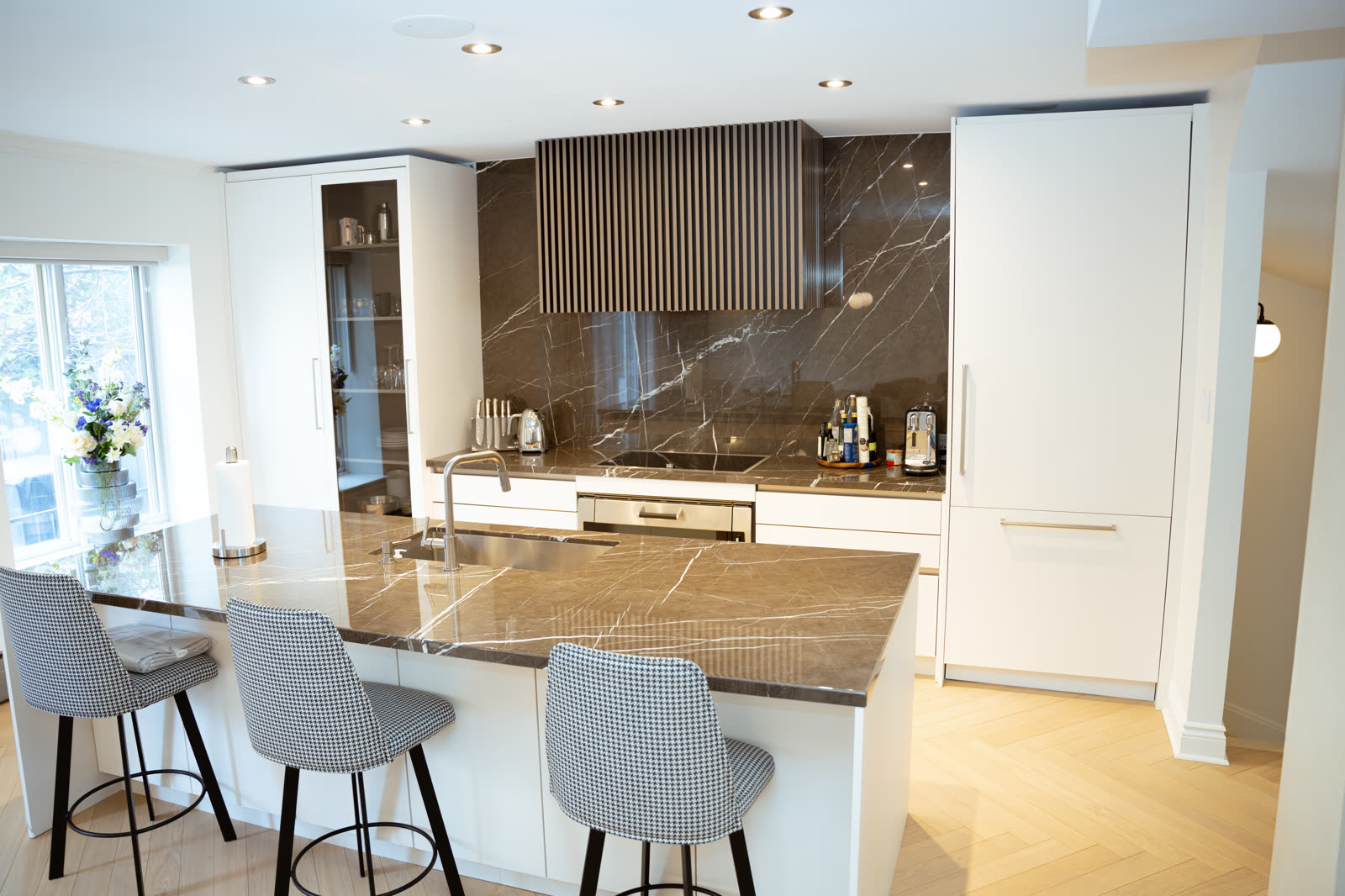
- Cabinetry: 30–40%. The backbone of the project and the piece that lasts longest. On a $130,000 remodel, that's roughly $40,000–$52,000. See the detailed tiers in how much a custom kitchen costs in 2026.
- Countertops and backsplash: 10–15%. Quartz runs $70–$120 per sq ft installed; natural stone and porcelain slabs run $100–$200+. A waterfall island edge adds $2,000–$5,000 on its own.
- Appliances: 15–20%. The widest range in the project. A solid appliance package runs $12,000–$20,000; a pro-style package with panel-ready refrigeration clears $50,000 without trying.
- Labor and trades: 20–25%. Demolition, framing, plumbing, electrical, drywall, painting, flooring installation, tile work. In major metros, expect $25,000–$40,000 on a full gut.
- Flooring, lighting, plumbing fixtures: 5–10%. The forgotten middle. Hardwood or large-format tile, recessed and pendant lighting, a quality faucet and sink — $8,000–$15,000 together.
- Contingency: 10–15%. Not optional. Open a 1970s wall and you will find 1970s surprises — aluminum wiring, corroded shutoffs, a vent stack exactly where the pantry was going.
Three sample budgets, worked through
The $75,000 remodel. Same footprint, no walls moved. Entry custom cabinetry at $28,000–$32,000, quartz counters at $8,000, appliances held to $14,000, trades at $18,000, flooring and fixtures $6,000, contingency $8,000. Achievable — if you make decisions early and change nothing mid-stream.
The $130,000 remodel. The most common project we see. Mid-range custom cabinetry with an island at $48,000, stone at $15,000, appliances at $24,000, trades at $28,000 (includes relocating plumbing for the island), flooring and lighting at $9,000, contingency $13,000. This is the budget where the kitchen in your saved photos actually lives.
The $220,000+ remodel. Walls move, ceilings open, cabinetry goes full-height in rift oak with a butler's pantry. Cabinetry $85,000+, stone $25,000, appliances $45,000, trades $40,000, the rest in lighting, glazing, and contingency. At this level, the design phase matters more than any purchase — read our note on working with an interior designer vs going direct.
When the money actually leaves your account
A budget without a payment calendar is half a budget. Here's how the cabinetry portion is structured at iKitchen — and most reputable custom shops run some version of this:
- Design retainer, from $3,000 — due at the start of design, credited in full toward your order. (Full details in our design retainer explainer.)
- 50% production deposit — due at final sign-off, when drawings and the itemized quote are approved. This releases production and is non-refundable once your cabinetry enters the build queue.
- Balance before delivery — the remaining 50% is due before the kitchen ships to your site.
Around that spine, your other payments stack up: appliance deposits at order (often 4–6 months before delivery on pro brands), countertop payment at templating and install, and trades billed progressively. Map it month by month — many families are surprised that roughly 70% of the total project cost is committed before demolition even starts.
Who pays whom — and who coordinates
One structural point that saves enormous confusion: iKitchen designs, manufactures, delivers, and installs your cabinetry. The surrounding renovation — demolition, plumbing, electrical, flooring, permits, inspections — is coordinated by you or your general contractor, per our terms and conditions. That's not us dodging work; it's the honest division of labor that keeps a manufacturer's pricing clean. Budget for a GC (typically 10–20% of the trades total as a management fee) or budget your own time to schedule and supervise trades. Both work. Pretending nobody has to do it does not.
The five places budgets blow up
- Mid-project changes. Moving one cabinet on paper is free. Moving it after production starts means remaking it. Sign off when you're sure — production runs 8–12 weeks and starts building your kitchen immediately.
- The appliance creep. The $14,000 package becomes $30,000 one "while we're at it" at a time. Pick the package before you finalize cabinetry — panel-ready and pro-depth appliances change the cabinet design itself.
- Discovered conditions. Old wiring, hidden water damage, out-of-level floors. This is what the contingency is for. If you finish with contingency unspent, congratulations — buy the better faucet at the end, not the beginning.
- Undefined scope between trades. Who patches drywall behind removed cabinets? Who reconnects the range? Every line without a name on it costs money and weeks.
- Skipping design to save money. Layout errors are the most expensive line item in renovation — they just get billed under other names. Our tour of common kitchen layout mistakes shows exactly which ones.
Practical takeaways
- Allocate: 30–40% cabinetry, 15–20% appliances, 20–25% labor, 10–15% counters, 5–10% fixtures and flooring, 10–15% contingency.
- Build a payment calendar, not just a total — retainer, then 50% at sign-off, balance before delivery, with appliances and trades layered around it.
- Decide who coordinates trades and permits on day one; that person is the real project manager.
- Finalize appliances before cabinetry drawings are signed.
- Protect the contingency until the last month.
A well-built budget is the least glamorous document in your renovation and the one that determines whether the process feels like a project or a crisis. If you'd like real numbers for your real kitchen, book a free 30-minute consultation with one of our designers, or start by exploring our custom kitchens to calibrate the cabinetry line.