
Outdoor Kitchen Countertops: Porcelain, Granite, Dekton Compared
Indoors, choosing a countertop is mostly an aesthetic decision — nearly everything on the market performs. Outdoors, the field narrows brutally. UV bleaches, resins yellow, freeze-thaw pries at every pore, grill lids radiate heat onto adjacent stone, and red wine sits in the rain overnight. After decades of fabricating and — more instructively — replacing outdoor counters, I can tell you there are exactly two families of material I'll put my name on outside, one conditional maybe, and a popular indoor favorite that has no business in the sun.
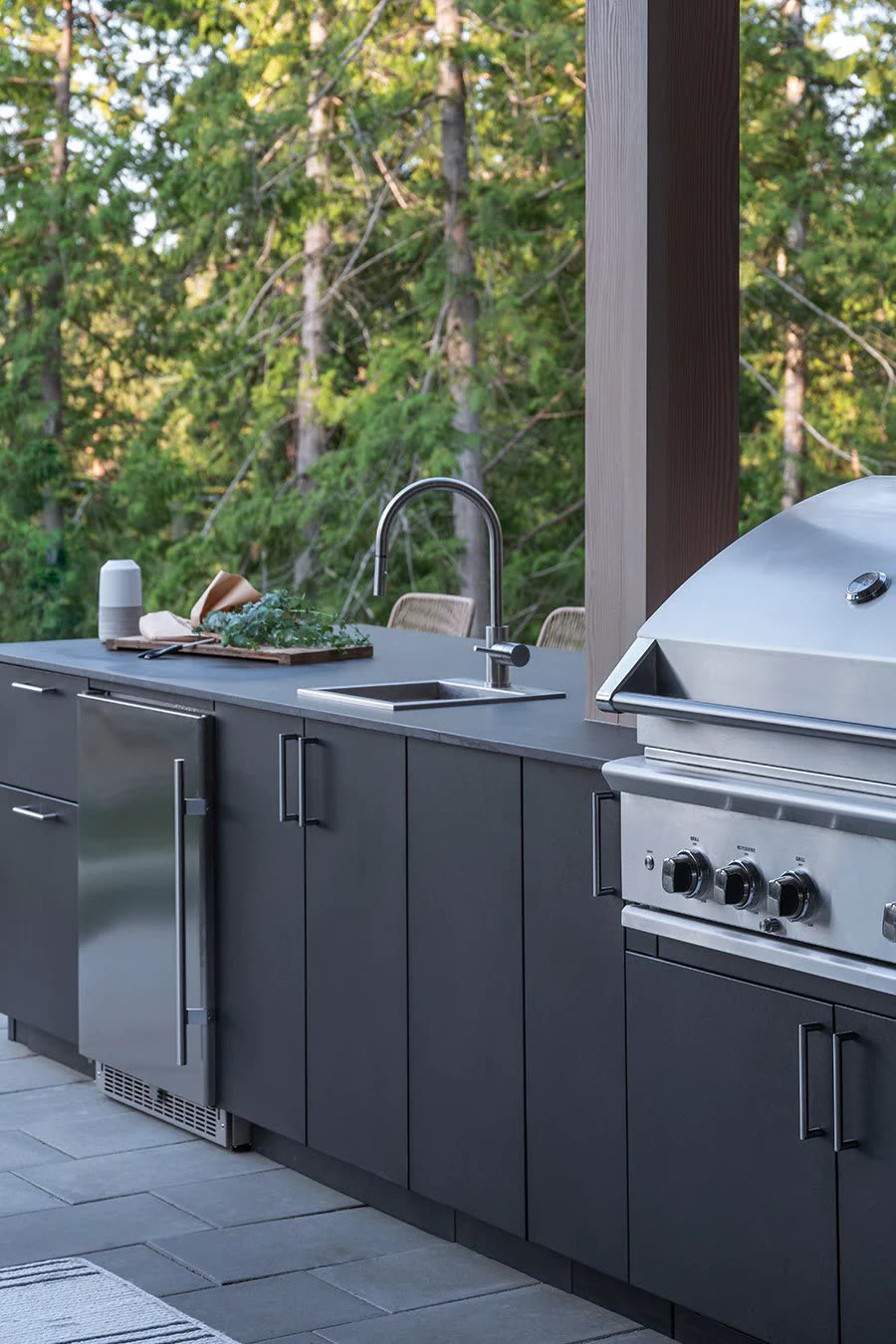
First, the disqualification: quartz
Engineered quartz — the material on half the indoor kitchens we build — is roughly 90% stone dust bound in polymer resin, and that resin is the problem. UV degrades it: whites turn cream, grays go khaki, and the surface can chalk within a single season of direct sun. Nearly every quartz manufacturer explicitly voids the warranty for outdoor installation. I've seen a north-facing, roofed outdoor bar in quartz survive respectably — and I've seen a $6,000 island top turn visibly two-tone in eight months where the shade line crossed it. The material takes heat poorly, too; a hot pan or radiant grill lid can scorch the resin. Whatever a fabricator with leftover slabs tells you: no quartz outdoors.
Granite: the proven veteran
Granite is the incumbent for good reason. It's genuinely UV-stable — the color you install is the color you'll have in twenty years — takes heat that would wreck engineered surfaces, shrugs off scratches, and in mid-tone colors hides the pollen-dust-waterspot reality of outdoor life better than anything. Cost runs a reasonable $60–$120 per square foot installed for outdoor-suitable colors.
Its demands are manageable but real. Granite is porous, so it needs sealing — annually for most stones, and more attentively outdoors where oil, wine, and tannin-heavy leaves sit longer than they would inside. Choose the stone by density: darker, tighter granites (absolute blacks, deep grays, blues) weather best; some light and rusty-toned stones contain iron minerals that can oxidize — literally rust — with constant water exposure. Two finish notes from the field: polished granite is a mirror for glare and shows water spots relentlessly outdoors, so we spec honed, leathered, or flamed finishes almost exclusively; and in freeze climates, a well-sealed dense granite handles freeze-thaw admirably.
Porcelain and sintered stone: the modern winners
Large-format porcelain slabs and sintered surfaces — Dekton being the name most clients know — are what granite would design if it went to engineering school. Both are made by compressing mineral powders and firing (or sintering under extreme pressure and heat) into a fully vitrified slab with near-zero porosity. The consequences read like an outdoor wish list: total UV stability, no sealing ever, stain immunity — wine and grease sit on the surface until wiped — genuine heat tolerance, and freeze-thaw indifference. Sintered slabs are also available in convincing marble looks, giving you outdoors what nature's marble could never survive there.
The honest costs: price runs $80–$150+ per square foot installed, comparable to premium granite. The material's hardness cuts both ways — it can chip at edges under a hard knock from a cast-iron pan, and edge details need a fabricator experienced with the material, because mitred porcelain edges done badly are a chip magnet. Thin 12 mm slabs, common in the category, want continuous support over cabinetry; we routinely build up mitred edges to a 3–4 cm visual thickness so the top reads substantial. Repair is the last caveat: granite chips can be filled invisibly, porcelain chips less so.
The conditional and the tempting
Concrete is the conditional maybe: cast-in-place or precast tops look spectacular in modern schemes and can be reinforced for huge spans. But outdoors, concrete lives or dies by its sealer — it's porous, it hairline-cracks as it cures and moves, and in freeze climates those hairlines become real cracks. Choose it with an artisan fabricator, a maintenance mindset, and ideally a roof. Natural soapstone is a sleeper choice: dense, non-porous, and UV-proof; it patinas to charcoal and scratches, both of which read as character or damage depending on the client. Tile, the old default, is the one I talk people out of weekly: the tile survives; the grout does not, and outdoors, grout is a full-time job. Marble etches with every citrus squeeze and acid rain shower — enjoy it indoors, as we discussed for interiors in our materials pieces; leave it off the patio.
Fabrication details that matter more outdoors
- Thickness and support: 3 cm granite spans standard cabinetry unsupported; 12 mm porcelain wants a substrate or continuous perimeter support. Over our welded aluminum kitchens, tops land on a flat, engineered plane — a real advantage over masonry, whose tolerances make fabricators sweat.
- Overhangs: keep unsupported stone overhangs to 6–10 inches depending on material, and bracket bar overhangs of 12+ inches — outdoors, someone will sit on the counter.
- Color and comfort: a black counter in full Sun Belt sun reaches 140°F+ — genuinely too hot to touch. In hot climates we steer counters toward light and mid tones and save the drama for cabinet powder-coat colors.
- Seams and drainage: fewer seams, sealed generously, and a couple of degrees of invisible pitch on covered installs so water sheets off rather than ponding against the backsplash.
- Around the grill: stone doesn't burn, but thermal shock at the cutout edge can crack it; we hold the manufacturer's cutout gap and use heat-rated flexible sealant, never rigid-bonding the top to a hot appliance.
Choosing in one paragraph
If you want proven, warm, and slightly cheaper: honed dark granite, sealed on schedule. If you want zero maintenance and modern looks: porcelain or Dekton-class sintered stone, fabricated by someone who does it weekly. If the design demands concrete or soapstone, go in with open eyes. And whichever you choose, remember the counter is one line in a bigger budget — our cost guide puts counters at roughly 10–15% of project spend — and it sits on cabinetry whose material matters even more, as our construction comparison lays out.
Living with outdoor stone: the short care manual
Whatever you install, the ownership routine is mercifully brief. Daily life: wipe spills when you see them — even sealed granite appreciates it, and bird droppings are mildly acidic enough to mark a polished surface if they bake on for a week. Seasonally: wash the whole top with mild soap and water (never wire brushes or acid cleaners — masonry cleaning products etch and strip sealers), check silicone joints at sinks and grill cutouts, and re-seal granite when water stops beading. Winter, in freeze country: don't chip ice off stone with metal tools, and skip rock salt on or beside the counters — chloride creep stains stone and attacks every metal fitting nearby. And year-round, the one habit that prevents the most damage we're called to repair: keep a trivet at the grill landing zone. The counter survives the 400°F pan; the thermal-shock crack three years of hot pans later is the one nobody saw coming.
Practical takeaways
- Quartz is an indoor material. Outdoors it yellows, chalks, and voids its own warranty.
- Granite (honed, dark, sealed annually) and porcelain/sintered stone (sealed never) are the two safe families.
- Match fabricator to material — porcelain edges punish inexperience.
- Light colors stay touchable in sun; dark stone in Phoenix or Florida is a griddle.
- Support thin slabs continuously, bracket big overhangs, and never rigid-mount stone to a hot grill.
We fabricate and install outdoor counters in granite and sintered stone over our welded marine-grade aluminum kitchens — one contract, one engineered fit. See our outdoor kitchens, or book a free 30-minute design consultation and we'll bring the sample boards.