
Quartz vs Granite vs Porcelain Countertops
Cabinets are my trade, but no cabinetry conversation survives ten minutes without turning to the surface that will sit on top of them. And because the countertop takes the abuse — the hot pan, the red wine, the dropped stockpot — it deserves the same engineering honesty we bring to hinges and finishes. The 2026 market has consolidated around three serious contenders: engineered quartz, natural granite, and sintered porcelain. Each has a physics profile, a failure mode, and a personality. Here's all three, without the showroom gloss.
What each material actually is
Engineered quartz is roughly 90% crushed quartz aggregate bound in 7–10% polymer resin with pigments, cast into slabs and cured. It's the market leader for a reason: consistent, non-porous, never needs sealing, and available in everything from salt-and-pepper minimalism to convincing marble mimicry.
Granite is quarried igneous rock — quartz, feldspar, and mica crystallized from magma. Every slab is a one-off geological event. Density and porosity vary by variety, which is why granite care advice always comes with "it depends."
Sintered porcelain / ultracompact surfaces (Dekton, Neolith, large-format porcelain slabs) are refined clays and minerals pressed under enormous pressure and fired around 1,200°C — essentially man-made stone finished in hours instead of millennia. The result is the hardest, most weatherproof surface in the conversation, in slabs as thin as 6–12 mm.
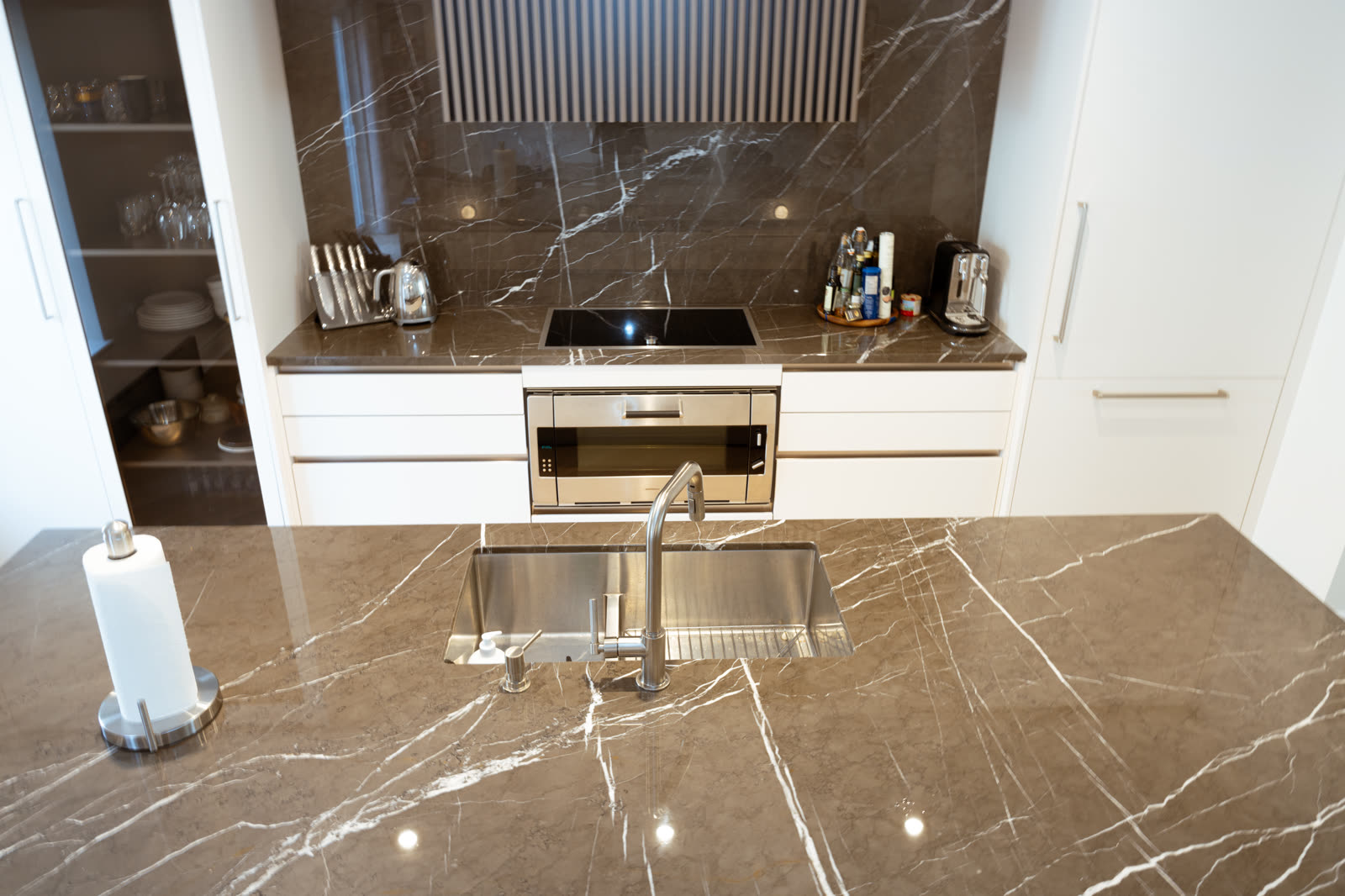
Heat: the demo that sells porcelain
The single sharpest difference between the three is the hot pan. Quartz's weakness is its resin: around 150°C (300°F) — trivially reached by cast iron off a burner — the polymer binder can scorch, leaving a permanent tan ring or a hazy patch that no polish removes. Trivets aren't a suggestion with quartz; they're the warranty's fine print. Granite tolerates casual hot-pan contact far better (rock formed in magma is unimpressed by your skillet), though violent thermal shock can, rarely, crack a slab at a weak vein. Porcelain simply doesn't care — it was born at 1,200°C, and a 260°C pan is a cool afternoon. For serious cooks and for anyone putting a countertop near open flame or outdoors, that indifference is decisive.
Stains, scratches, sealing, and daily life
Staining: quartz and porcelain are effectively non-porous (water absorption near 0.02% for good porcelain) — wine, turmeric, and coffee wipe away, no sealer ever. Granite spans a range: dense dark varieties barely absorb anything, while lighter, more open granites will drink oil and wine unless sealed. The old ritual — annual impregnating sealer, water-drop test to check — still applies to the porous end of the granite family, and only there.
Scratching: all three shrug off knives in normal life (quartz mineral is Mohs 7, granite similar, fired porcelain surfaces harder still — steel knives sit near 5.5; your cutting board is protecting the knife, not the counter). The nuance is chipping: porcelain's tremendous surface hardness comes with lower thickness and a more brittle edge, so a heavy pot landing exactly on a square porcelain edge can flake a chip that's harder to repair invisibly than in quartz or granite. Good fabricators mitigate with eased or mitered edges; it's a real consideration on hard-working islands with young dish-loaders.
UV: the quiet one. Quartz's resins amber and its pigments can shift in direct sun — most engineered quartz is explicitly not warranted outdoors or even for the sunniest indoor window runs. Granite and porcelain are UV-stable, which is why porcelain has become the default surface of our outdoor kitchen builds and every south-facing waterfall island we've done lately.
Fabrication: where design dreams meet the saw
Some of the most important differences appear at the fabricator's shop, not in your kitchen. Quartz is the fabricator's friend — predictable, forgiving, excellent for undermount sink cutouts and mitred waterfall edges, with seams that color-match nearly invisibly. Granite demands slab-by-slab judgment (veins hide surprises), and bookmatching dramatic slabs is an art priced accordingly. Porcelain is the diva: its thin section and hardness demand specialized blades, slower cutting, and experienced hands — an inexperienced fabricator can crack a $4,000 slab at the sink corner on a Friday afternoon. The payoffs are unique, though: 12 mm porcelain enables razor-thin contemporary profiles and full-height matching backsplashes cut from the same slab, and its large formats can skin an entire island in two pieces. Ask any porcelain fabricator how many slabs they've installed; the honest number matters more than the brand brochure.
Weight, for the record, lands on your cabinets: a 3 cm stone top runs roughly 80 lb per square metre, and a 10-foot island carries the mass of a motorcycle. This is a cabinetry blog after all — the boxes below must be engineered for it, which is why our island bases use reinforced construction and why "who levels and supports the stone" belongs in your quote comparison, as we noted in the custom kitchen cost guide.
Cost and the choosing framework
Installed 2026 ranges overlap heavily: quartz roughly $70–150/sq ft, granite $50–200+ depending on rarity, porcelain $90–180 with fabrication driving the top end. Exotic slabs in any category break the ceiling. Since price won't decide for you, let use-case do it:
- Choose quartz if you want consistency, marble looks without marble anxiety, and the widest fabricator pool — and you'll honor the trivet rule.
- Choose granite if you want a surface no one else on earth has, natural heat tolerance, and you're comfortable with (minimal, variety-dependent) sealing.
- Choose porcelain if heat, sun, or outdoor exposure is in play, you love thin modern profiles or slab-matched backsplashes, and you have a fabricator with real porcelain mileage.
And if your heart is set on real marble — a different animal entirely, with etching chemistry all its own — we've given it a full honest treatment of its own in Marble in Kitchens: Beautiful Ideas, Honest Warnings.
Practical takeaways
- Quartz's enemy is heat (resin scorches ~150°C) and UV; its friends are consistency and zero maintenance.
- Granite's enemy is porosity on light varieties (seal them); its friends are uniqueness and natural heat tolerance.
- Porcelain's enemy is edge chipping and inexperienced fabricators; its friends are total heat/UV/stain immunity and thin-profile design.
- Match the edge detail to the household: eased/mitered edges protect brittle materials on busy islands.
- The cabinets underneath carry it all — confirm reinforcement and stone support responsibility in writing.
The right top starts with the right base — and the right conversation. Book a free 30-minute design consultation and we'll pair surface samples with door samples in one sitting, or see the combinations we've built in our custom kitchens and outdoor kitchens.