
Marble in Kitchens: Beautiful Ideas, Honest Warnings
No surface makes a kitchen photograph like marble, and no surface generates more year-two phone calls. I've stood at islands with clients tracing the veining of a Calacatta slab like it was a painting — and I've stood at the same islands two years later while they pointed, hurt, at the ghostly rings where a lemon and a wine glass sat overnight. Neither reaction is wrong. Marble is genuinely the most beautiful countertop material on earth, and it is genuinely reactive to half the things in your refrigerator. Whether it belongs in your kitchen depends entirely on which of those facts weighs more with you — so let's give you the chemistry to decide.
Why marble etches: the chemistry nobody explains
Marble is metamorphosed limestone — calcium carbonate, the same mineral as chalk and antacid tablets. Calcium carbonate reacts with acid. Not "can react": reacts, every time, in seconds. Lemon juice (pH ~2), vinegar (~2.5), wine (~3.5), tomato (~4.3), coffee — each dissolves a microscopic layer of the polished surface on contact, leaving a dull spot where the polish used to be. That's an etch, and it's the crucial distinction people miss: an etch is not a stain. A stain is something added (oil, pigment soaking in); an etch is something removed — corroded, physically gone. This is why the second thing nobody explains matters so much: sealers do not prevent etching. A penetrating sealer clogs the stone's pores with resin so liquids can't soak in — it's real protection against staining. But the acid never needs to penetrate; it attacks the surface it touches. Sealed marble stains slower and etches exactly as fast. Anyone who tells you a sealer makes marble worry-proof is selling you a bottle, not a solution.
Marble is also soft — Mohs 3–4 against granite's 6–7 and quartzite's ~7. Knives, ceramic mug bottoms, and a dragged appliance all scratch it. Softness has a silver lining: scratches and etches can be honed and re-polished out by a stone restorer, indefinitely. Marble is damageable and repairable in equal measure — closer to a fine wood table than to quartz.
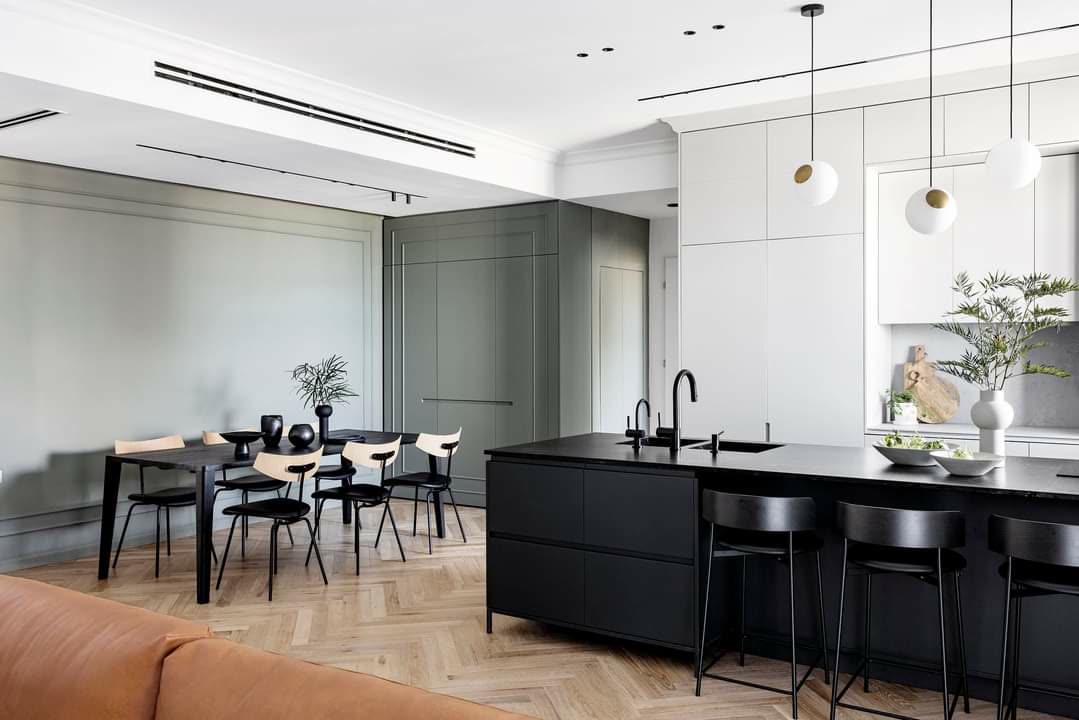
Honed vs polished: the single biggest livability decision
If you take marble into a kitchen, the finish decides your daily experience. A polished surface is a mirror, and every etch is a dull interruption of that mirror — visible from across the room in raking light. A honed (matte) surface is already dull, so an etch — a dull spot on a dull surface — has to be hunted for at the right angle. Honing doesn't slow the chemistry at all; it just makes the evidence disappear into the finish. We won't spec polished marble on a working kitchen counter, full stop; honed or the softly-textured "leathered" finish only. Polished marble belongs on the vertical: backsplashes, hood surrounds, bar walls, where hands and lemons rarely reach. The same finish logic — matte forgives, gloss testifies — runs through every surface in the room, cabinet doors included, as we detailed in Matte vs Gloss.
Which marble: Carrara, Calacatta, Danby, and the pretenders
Carrara — soft grey-white, fine feathery veining — is the workhorse: quarried at scale, the most affordable true marble, often cheaper than premium quartz. Calacatta — whiter ground, bold dramatic veining, sometimes gold-shot — is the showpiece, priced two to four times higher; each slab is effectively a one-off, which is why we send clients to the stone yard to tag the physical slabs rather than approve from photos. Vermont Danby is the sleeper pick: a domestic marble that's denser and less absorbent than the Italians — a marble that behaves slightly better in a kitchen while looking every bit the part. And a warning from the trenches: several stones sold as marble alternatives with marble looks — notably some "super white" material marketed as quartzite — are actually dolomitic marbles that etch nearly as readily as Carrara. The lemon test settles it: a drop of lemon juice on an offcut for ten minutes tells the truth about any stone, whatever the sales tag says.
The smart compromises: how we actually put marble in kitchens
The all-marble kitchen is a commitment few households should sign. But marble doesn't have to be everywhere to transform a room:
- Marble where marble wins, workhorse where work happens. The classic split: honed marble on the island or baking zone, quartz or granite flanking the range and sink. You get the beauty at the room's center and chemistry-proof surfaces where acids fly. The cost math of splitting stone this way is exactly the "splurge where it shows" logic of our splurge vs save guide.
- Marble on the vertical. A full-height Calacatta backsplash behind the range delivers maximum drama per square foot with near-zero etch risk — and lets a modest counter budget carry a magnificent wall.
- The baking slab. Marble's thermal mass keeps pastry cold — the reason pâtisseries work on it. An inset marble section in a larger counter is the most defensible marble in any kitchen.
- The engineered stand-ins. Marble-look quartz solves the chemistry completely but tops out on realism, struggles with heat, and its printed veining doesn't run through the slab — a mitered waterfall edge reveals the trick. Marble-look porcelain has improved dramatically, shrugs off acid and heat, and is our default recommendation for clients who love the look and honestly know they won't love the patina. The full three-way comparison lives in Quartz vs Granite vs Porcelain.
Living with it: the patina contract
Here's the conversation we have before any marble order, verbatim. Marble will mark. Sealing (yearly, ten minutes, wipe-on) prevents stains; nothing prevents etches. Cutting boards and coasters become reflexes; spills get wiped when noticed, not scrubbed in panic — a dry cloth beats a frantic vinegar-soaked one, which is itself an acid. And after about a year, one of two things happens: either the accumulating softness of the surface — what the Italians simply call vissuto, lived-in — starts reading as character, the way a leather jacket or a copper pot improves; or every mark keeps registering as damage. The first kind of person gets decades of deepening beauty from the most beautiful stone on earth. The second kind of person should buy porcelain and never look back — both are right. The only wrong answer is buying marble while expecting quartz behavior; that's not a stone choice, it's a future grievance.
Practical takeaways
- Marble etches because it's calcium carbonate meeting acid — sealers stop stains, never etching.
- Honed, always, on working counters; save polished marble for backsplashes and verticals.
- Carrara is attainable, Calacatta is couture, Danby is the quietly tougher domestic — and lemon-test anything called "super white."
- The island-only or backsplash-only strategies deliver most of the beauty with a fraction of the exposure.
- Buy marble for the patina or don't buy it at all; porcelain now impersonates it superbly.
Stone decisions are best made with real slabs and honest conversation about how you actually live. Book a free design consultation and we'll pair the right surface with the right cabinetry — or see how marble, quartzite, and porcelain live atop our custom kitchens and alongside the finishes library.