
Rift, Quarter, and Plain Sawn: How to Read Wood Grain
Two white oak kitchens can come from the same forest, the same species, even the same log — and look like they belong in different centuries. One has bold, arching "cathedral" grain that reads farmhouse; the other has grain so straight and fine it could pass for architectural millwork in a gallery. The species didn't change. The cut did.
How a sawmill converts a round log into flat boards is one of the most consequential and least understood decisions in cabinetry. It drives the look, the price, and — this is the part almost nobody explains — how much your wood will move for the rest of its life. Here's the whole picture.
It's all about the growth rings
Picture the end of a log: concentric growth rings, like a target. Every board cut from that log intersects those rings at some angle, and that angle — between the ring and the board's face — defines the cut:
- Plain sawn (flat sawn): rings meet the face at roughly 0–30°. The saw slices straight across the log, and where the blade runs tangent to the rings, the face shows big parabolic arches — the classic "cathedral" figure.
- Rift sawn: rings meet the face at roughly 30–60°, ideally near 45°. The result is tight, straight, remarkably uniform linear grain with no cathedrals and no fleck.
- Quarter sawn: rings meet the face at 60–90°, nearly perpendicular. Straight grain again — but in white oak, this cut slices through the medullary rays (ribbons of tissue radiating from the log's center), exposing them as shimmering "ray fleck" figure across the face.
Same tree. Three completely different faces.
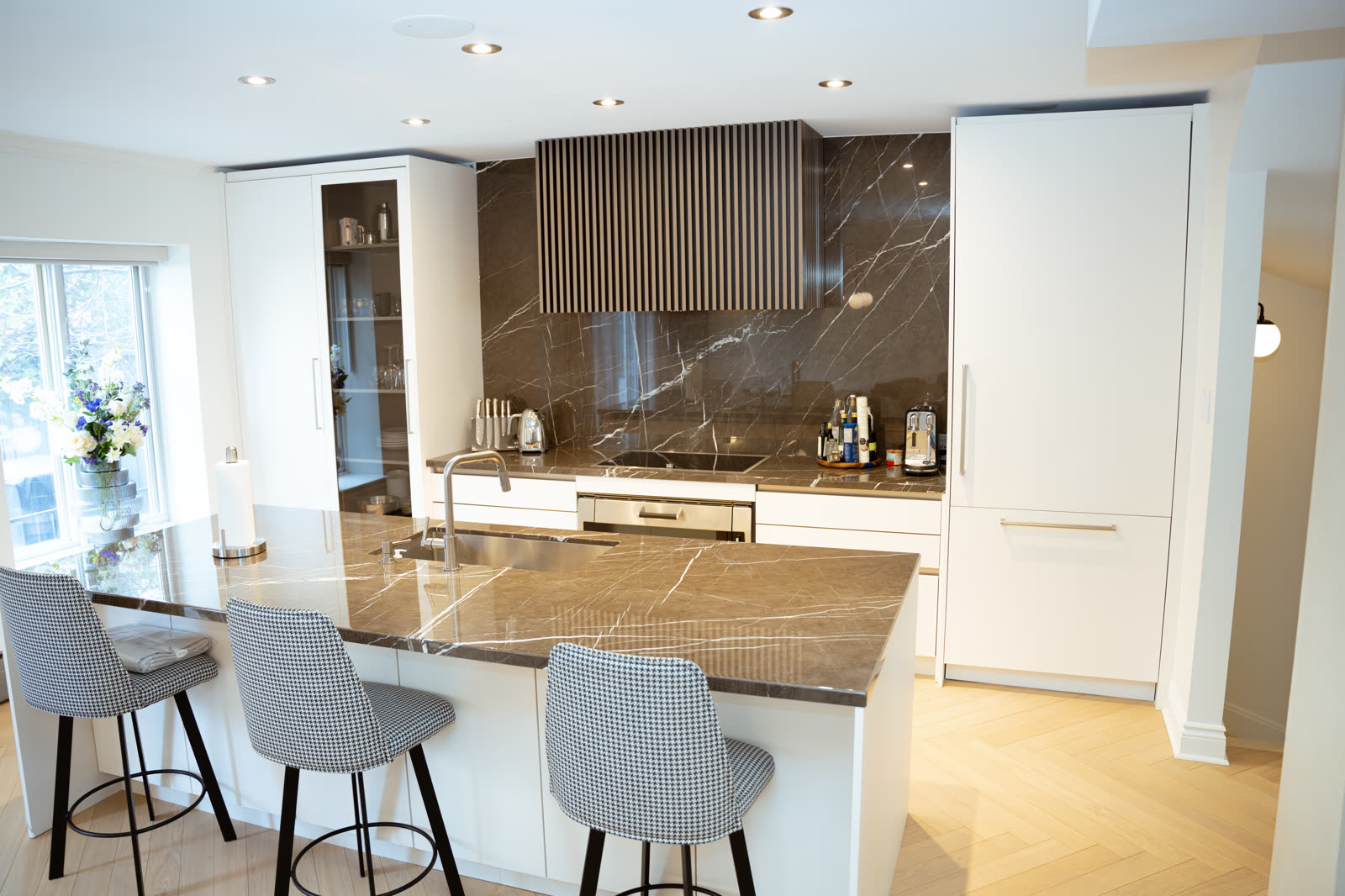
What each cut looks like in a kitchen
Plain sawn is expressive and traditional. Cathedral arches vary door to door, which gives warmth and rustic energy — perfect in a farmhouse or transitional kitchen, chaotic in a minimal one. It's also the default cut: every log yields it efficiently, so it's the most affordable way to own real wood.
Rift sawn is the cut behind the modern white oak boom. Those pinstripe-straight lines running uninterrupted across a bank of slab drawer fronts are what people are actually pointing at when they show us an inspiration photo and say "this oak." Rift's calm, tailored consistency is why it dominates high-end contemporary work — and why we wrote about it extensively in our white oak vs walnut comparison.
Quarter sawn is rift's flashier sibling. The ray fleck that Gustav Stickley built the American Craftsman movement around is unmistakable — silvery ribbons dancing across straight grain. In a Craftsman or heritage home it's glorious. In a spare modern kitchen, fleck can read as busy, which is why contemporary specs usually say "rift only" and heritage specs often say "quartered, heavy fleck." Neither is wrong; they're different instruments.
The movement story: why the cut matters after installation
Here's the craftsman's reason to care, beyond looks. Wood shrinks and swells with humidity twice as much tangentially (along the rings) as radially (across them). In white oak, tangential shrinkage runs about 10.5% green-to-ovendry versus 5.6% radial — nearly a 2:1 ratio, and most species are similar.
A plain sawn board has the rings running roughly parallel to its face, so its width moves at the higher tangential rate — and because the rings curve through the thickness, the two faces move unevenly, which is why plain sawn boards cup away from the heart. Rift and quarter sawn boards stand the rings on end: their width moves at the gentler radial rate and the geometry is symmetric, so they stay flat and move roughly half as much. That's why quarter and rift stock is the traditional choice for door frames, wide panels, and anything that must stay true through twenty heating seasons. It's not superstition; it's shrinkage anisotropy doing exactly what the wood science handbooks say it will.
Why rift costs more: the geometry of waste
If rift is so good, why isn't everything rift? Because logs are round and rift boards are a geometric tax. To keep rings at ~45° to every board face, the mill must saw each quadrant of the log radially, discarding wedge-shaped offcuts as the angles drift. Yield drops hard, labor and handling rise, and narrow boards are the norm. Quarter sawing wastes less, plain sawing wastes least. The market prices accordingly: expect quarter sawn white oak to run meaningfully over plain sawn, and true rift to run 30–50% over plain sawn — sometimes more when demand spikes, as it has through the 2020s oak wave.
This is also where veneer earns its place in fine cabinetry. Slicing a log into 0.6 mm veneer leaves rather than 25 mm boards multiplies the yield of precious rift and quartered figure enormously, and lets us sequence-match leaves so grain flows continuously across a whole wall of doors — something solid boards from mixed logs can never do. On big flat surfaces, rift-cut veneer over a stable engineered core is both the better-looking and the better-behaving construction.
How to spec it without getting burned
A few hard-won rules from our production floor:
- Say the words on the order. "White oak" alone gets you plain sawn. If you want the linear look, the spec must say rift sawn or rift-cut veneer — and on quarter sawn, specify your fleck tolerance (light, medium, heavy), because "quartered" spans a huge visual range.
- Ask how sequence and flow are handled. In a quality shop, drawer stacks are cut so grain runs continuously through all three fronts, and adjacent doors come from sequenced leaves. That level of control is a hallmark of true custom work — one of the real differences we outlined in custom vs semi-custom vs stock cabinets.
- Judge samples at door scale. A 3-inch chip cannot show you cathedral rhythm or fleck density. We finish full-size door samples for exactly this reason.
- Mind the mix. Rift faces with plain sawn solid edges will show a grain mismatch at the corner of every door. Good shops edge rift veneer with rift solids. It's a two-dollar detail that separates fine work from almost-fine work.
Practical takeaways
- The cut, not the species, decides the personality: cathedrals (plain), pinstripes (rift), or ray fleck (quarter).
- Rift and quarter sawn wood moves about half as much across its width and resists cupping — geometry, not marketing.
- Budget 30–50% over plain sawn for true rift; sequence-matched rift veneer stretches rare figure across big kitchens beautifully.
- Put the cut, the fleck tolerance, and grain-flow requirements in writing on your spec.
The fastest way to understand all of this is to hold the three cuts side by side in daylight. Book a free design consultation and we'll bring plain, rift, and quartered samples to the table — or see the cuts living in finished projects in our custom kitchens.