
Vessel vs Undermount Sinks for Custom Vanities
This decision looks like a style question and is actually a dimensions question. I have seen more beautiful bathrooms undermined by a vessel sink installed at the wrong height than by any other single choice, and I have also built vessel-sink powder rooms that clients still send me photos of ten years later. The difference is entirely in whether somebody did the arithmetic first.
The height math nobody does
Start here, because everything else follows. A comfortable rim height for washing hands is 34–36 inches above finished floor. That is the target no matter what kind of bowl you use.
- Undermount: the bowl hangs below the stone. Rim height = counter height. Build the cabinet at 34¾ inches, add a 1¼-inch top, and you're at 36 inches. Simple.
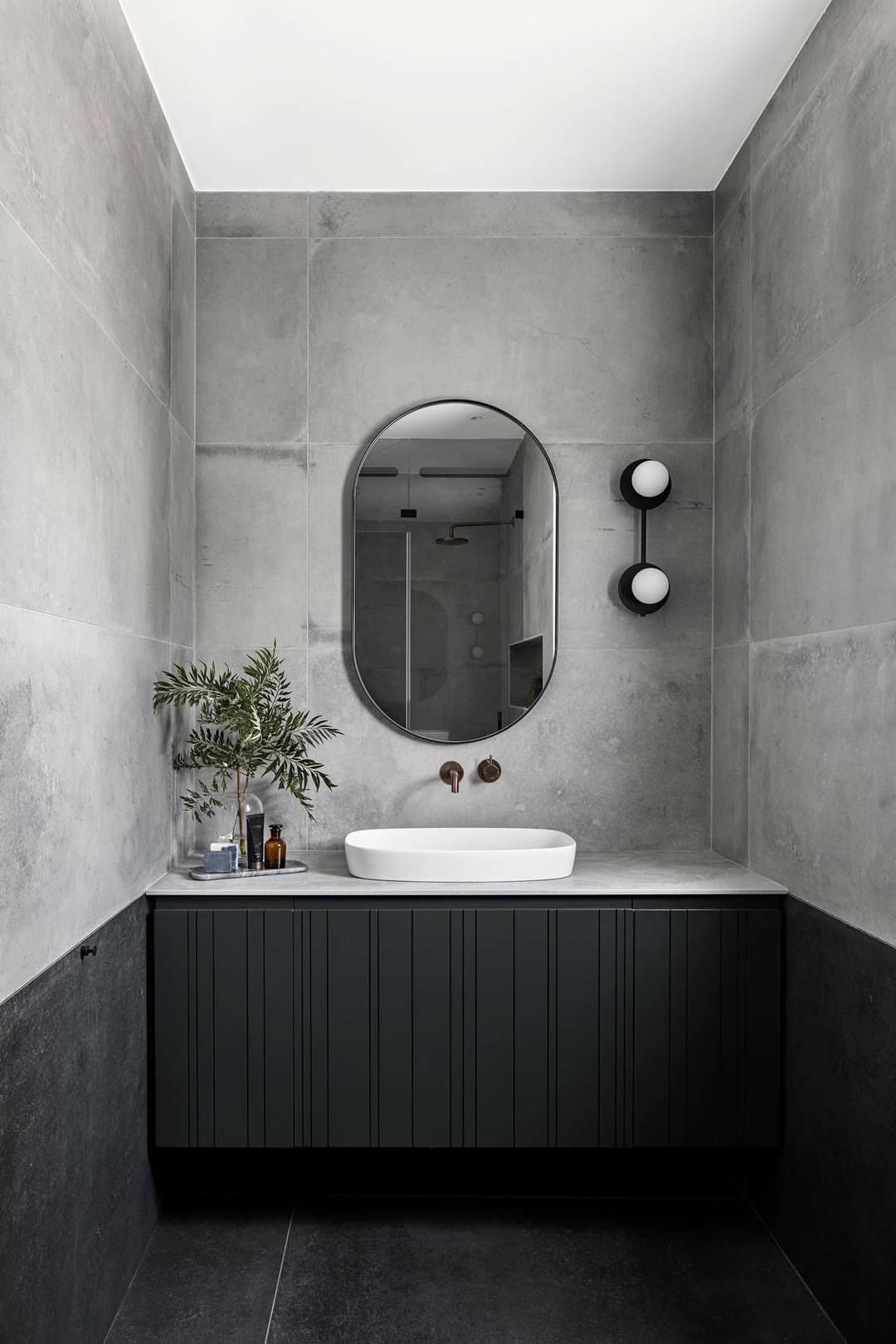
- Vessel: the bowl sits on the stone and adds its full height — typically 5–6 inches for a modern bowl, up to 8 inches for a tall ceramic. So the counter must drop to 30–31 inches for a 5-inch bowl, or 28–30 inches for a taller one.
- Semi-recessed: the bowl drops partway into the counter, adding 2–3 inches. Counter goes to about 32–33 inches. A useful middle path and criminally underused.
Now see the trap: someone orders a "comfort height" 36-inch vanity, sets a 6-inch vessel on it, and the rim lands at 42 inches — roughly chest height on an average adult. Washing your face requires lifting your elbows above the counter. It is genuinely unusable, and the fix after the fact is either a new cabinet or a new sink. The counter height and the bowl must be chosen together, in one conversation. Our vanity height guide covers the standing math in full.
Storage: the number that surprises people
Counterintuitively, vessels usually give you more usable cabinet volume. An undermount bowl plus its trap consumes roughly a 24 x 18 x 12 inch void inside the cabinet — that's an entire drawer's worth of space gone, which is why undermount sink bases so often have a false drawer front at the top. A vessel bowl sits above the counter; only the drain tailpiece and trap penetrate the cabinet. We can frequently build a full stack of real drawers under a vessel with nothing more than a slim U-notch in the top drawer.
That said, the vessel cabinet is a shorter cabinet — 30 inches instead of 36 — so you gain drawer depth and lose overall height. Net-net they're closer than they look, but if your priority is a specific number of working drawers at the sink, the vessel geometry helps.
Faucets: get this right or nothing works
The faucet must clear the rim and land the water stream near the drain. Three configurations:
- Vessel-specific deck faucet. Tall (typically 12–16 inches overall) with a spout reach that clears the bowl rim by 1–2 inches and lands 1–2 inches inside it. Do not use a standard bathroom faucet with a vessel — the spout will pour onto the rim.
- Wall-mounted faucet. The cleanest look for a vessel, and it frees counter depth. Rough-in height must be set from the finished rim height, which means the bowl must be purchased before the plumber returns. Get this wrong and you're opening tile.
- Standard 4-inch centerset or 8-inch widespread. Correct for undermount, wrong for vessel.
A number worth writing on the drawing: the spout outlet should sit roughly 4–6 inches above the bowl bottom. Higher than that and you get splash; lower and you can't fit your hands.
Splash, cleaning, and daily reality
Let's be honest about the practical downsides, because showroom photos never are.
Vessels splash. Water hits a shallow bowl from height and leaves the bowl. Deeper vessels (5½ inches or more of interior depth) splash far less than shallow decorative ones (3 inches). If you want a vessel that behaves, buy depth.
Vessels create a cleaning seam. Where the bowl meets the stone there is a caulk or sealant joint that collects toothpaste and, in hard-water regions, mineral scale. It needs wiping and, every few years, re-sealing. Undermount bowls have a seam too, but it's below the counter edge, so you can sweep water straight into it. The undermount reveal — whether the stone overhangs the bowl (positive), sits flush, or the bowl overhangs (negative) — matters here: a positive reveal is the easiest to clean and my default spec.
Vessels lose counter space. A 17-inch round bowl on a 22-inch-deep counter leaves very little to set anything on. In a small vanity that's a real cost.
Undermounts are boring. That's the honest counterweight. They disappear, which is often the point, but they never make anyone say anything about your bathroom.
Where each one genuinely wins
Choose a vessel when: it's a powder room and the sink is the statement; you want a specific material (hammered brass, carved stone, hand-thrown ceramic, cast concrete) that only exists as a vessel; the vanity is a furniture piece or a repurposed console; or you're working with a very shallow counter where an undermount bowl simply won't fit the depth.
Choose an undermount when: it's a daily-use primary or family bathroom; you have kids; you want maximum clear counter; you want the simplest cleaning; or you want a continuous stone surface that reads calm rather than sculptural. In a busy household undermount is right roughly nine times out of ten, and I say that as someone who loves a good vessel.
Choose an integrated bowl — one piece of quartz, porcelain, or solid surface with the sink formed into it — when you want zero seams and a seamless modern look. It costs more (often $1,200–$2,500 above a standard top) and the whole top is replaced if the bowl cracks, but there is nothing easier to keep clean.
Costs, 2026
- Vessel bowl: $200–$600 for good ceramic; $800–$3,000+ for stone, metal, or artisan pieces. Vessel faucet $300–$1,200.
- Undermount bowl: $150–$500 for a quality vitreous china bowl. Add $150–$350 in fabrication for the cut-out and polished reveal per bowl.
- Integrated: $1,200–$2,500 premium over a comparable slab top.
- Cabinet: essentially the same either way. Our custom vanity cabinetry runs $3,500–$7,000 for a single and $6,000–$15,000 for a double.
Countertop material interacts with the choice too — a vessel puts almost no stress on the stone, while an undermount cut-out is a structural weak point in softer marbles. Our quartz vs granite vs porcelain comparison walks through which stones tolerate a large cut-out and which need a rodded or supported edge.
Practical takeaways
- Set the rim at 34–36 inches AFF. Then work backwards to the cabinet height.
- Vessel = drop the cabinet to 30–31 inches. Undermount = build at counter height.
- Buy a deep vessel (5½+ inches) if you don't want splash.
- Vessel faucets and wall-mount rough-ins depend on the bowl — select the bowl first, always.
- Powder room: vessel. Family bathroom: undermount. Exceptions exist, but start there.
We build the cabinet around whichever bowl you fall for, in our USA and Canada plants, with a lifetime warranty. Explore our custom vanities or book a free 30-minute design consultation and bring the sink you're considering.