
New Construction vs Renovation: When to Order Cabinetry
"When should we order the cabinets?" sounds like a scheduling question. It's actually the question that decides whether your project finishes on time, because custom cabinetry is usually the longest-lead item in the entire build — ours runs 8–12 weeks in production — and everything at the end of the project stacks up behind it. Order at the right moment and cabinetry arrives exactly as the site becomes ready. Order at the wrong moment and you either store finished cabinets for months or stare at finished drywall for months. I've watched both, and this article exists so you do neither.
The right trigger point is different for renovation and new construction — opposite, in fact. Let's take them one at a time.
Renovation: order before you demolish
The instinct in renovation is to "get started" — and to most people, starting means demolition. That instinct is exactly backwards. In a renovation, the correct order is:
- Design first. Layout, materials, appliances, drawings — several weeks of decisions while your current kitchen keeps working perfectly.
- Order at drawing approval. The day you sign final drawings and pay the production deposit (50% at iKitchen), the 8–12 week factory clock starts.
- Demolish late in production. Site work — demo, rough plumbing and electrical, drywall, flooring — needs only three to five weeks. Start it around week 6–8 of production, and the site becomes install-ready the same week the truck arrives.
Sequenced this way, your kitchen-less window is two to four weeks. Sequenced the popular way — demolish first, then start choosing cabinets — it's four to six months. The full choreography is in our kitchen renovation timeline guide, but the one-line version is: the order date is the start of the project, and demolition is the middle of it.
The prerequisite worth underlining: appliances must be selected — not necessarily delivered, but specified to the model number — before drawings are finalized, because cabinetry is engineered around their exact dimensions. An appliance swap after ordering is the most common self-inflicted delay in renovation.
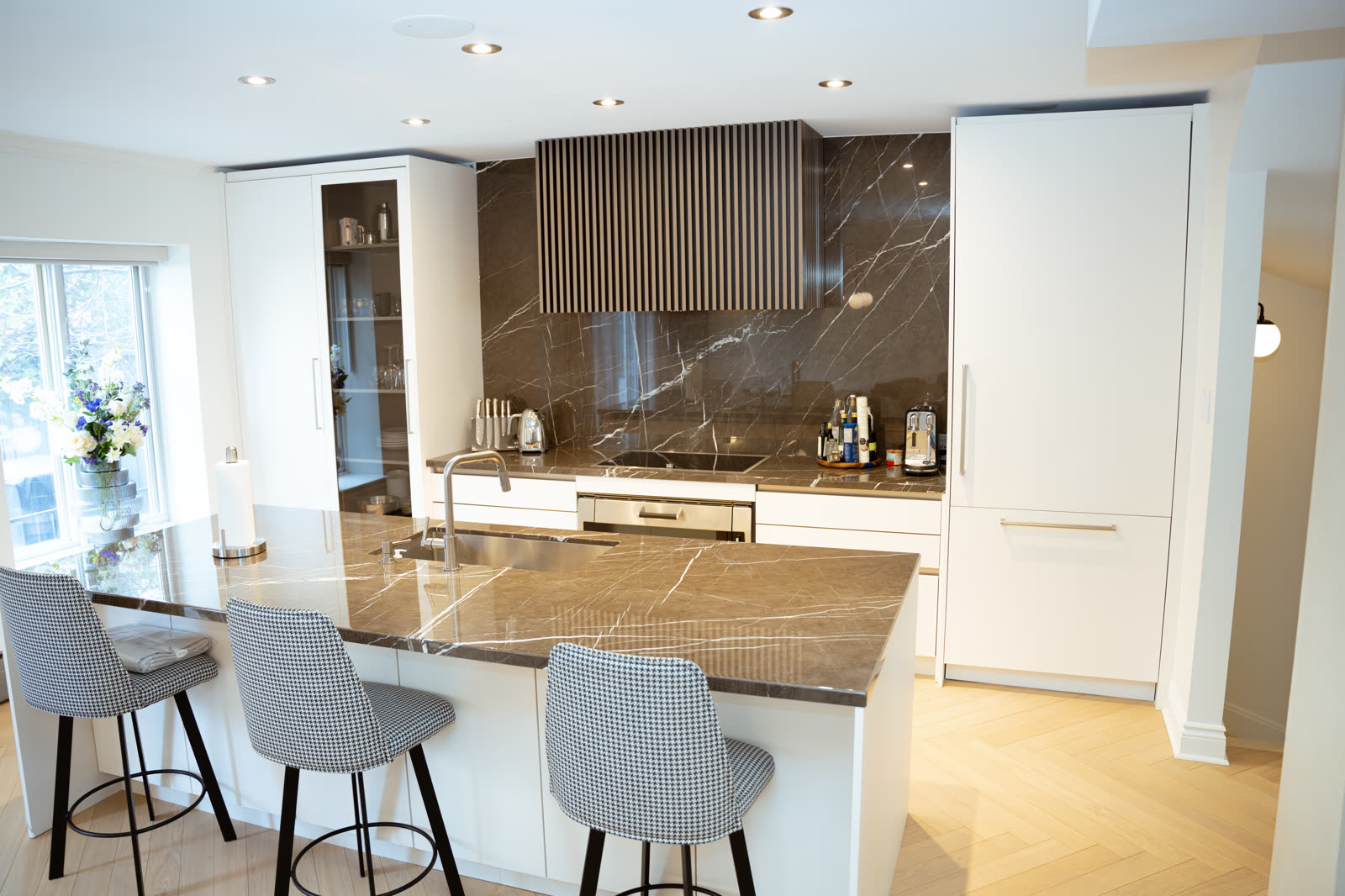
New construction: order later than the builder says
New builds flip the problem. There's no existing kitchen to preserve, so the temptation is to order early — sometimes absurdly early, at foundation stage, "to get ahead of it." The risk isn't the factory; it's the site. Cabinetry is built to real measurements, and a house doesn't have real measurements until it has walls.
Our rule, refined over hundreds of builds: final measure when drywall is hung and finished, order immediately after. At that point the rooms exist as physical fact — every stud bump, every out-of-square corner, every window that landed an inch off the plan. Cabinetry engineered to those numbers installs the way custom should: scribed tight, gap-free, no field surgery.
Design, though, should start far earlier — ideally at framing, even at permit stage. Layout development, material selection, and appliance specification take weeks, and doing them early means the only thing waiting on drywall is a tape measure. The sequence for a new build:
- Permit/foundation stage: begin cabinetry design; retainer (from $3,000, credited to the order) starts the process. Rough-in drawings go to the builder so plumbing and electrical land where the design needs them.
- Framing: finalize layout, materials, appliances. We're talking to the site super by now on smooth projects.
- Drywall complete: site measure, final drawing approval, production deposit, order placed. The 8–12 week production window begins.
- Production window: builder handles priming, flooring, ceilings, trim — none of which waits on cabinetry.
- Delivery and install: cabinetry arrives into a clean, painted, climate-controlled space. Countertop templating follows install.
The two classic failure modes
Failure mode one: ordering off the blueprints. A builder says "just use the plans, we build accurately." Sometimes they do. But a half-inch of drywall variance across a 12-foot run means fillers where there should be none, or a panel gap where there should be a scribe — visible forever in exactly the room guests stare at. When a schedule genuinely demands ordering before drywall, the honest compromises are designing in adjustability (scribe allowances, oversized fillers to cut on site) and accepting the aesthetic cost knowingly. We'll have that conversation, but we won't pretend it's free.
Failure mode two: trusting "we're about two months out." Builders' two months are famously elastic — weather, inspections, and trade availability stretch them routinely. If you order against an optimistic date and the house runs late, finished cabinetry needs storage; order against a pessimistic date and the house waits. This is why we anchor to a physical milestone — drywall — rather than a calendar estimate. Milestones don't slip semantically; either the drywall is up or it isn't. And if the house does run late anyway, cabinetry waiting in a warehouse is a far smaller problem than a house waiting for cabinetry: one costs storage, the other costs the closing date.
What about condos, additions, and phased projects?
Hybrids follow the same logic: anchor the order to the milestone that makes measurements real, and start design early enough that the order isn't waiting on decisions. In condo renovations, board approval adds weeks up front, so design and building paperwork begin together. In additions, order at drywall of the new space, exactly like new construction. In whole-home projects — kitchen plus closets, vanities, built-ins — one design phase and one production run serve multiple rooms, and install is staggered room by room. Choosing between the paths on cost? Our 2026 custom kitchen cost guide breaks down how renovation and new-build budgets differ.
Practical takeaways
- Renovation: design first, order at drawing approval, demolish around week 6–8 of the 8–12 week production run. Never demolish before ordering.
- New construction: design early (framing or sooner), but measure and order only when drywall is hung. Anchor to milestones, not builder estimates.
- Specify appliances to the model number before final drawings, in both paths.
- Count backwards: delivery date minus 12 weeks is your latest safe order date; order date minus 4–6 weeks is your latest safe design start.
- When in doubt between ordering early and late in new construction, early plus storage beats late plus a stalled site.
The cheapest insurance on any build schedule is a conversation before the schedule is set. Book a free 30-minute consultation — bring your plans or your builder's timeline — and we'll place the order date where it belongs. Then see what arrives at the end of the wait: our custom kitchens.