
Choosing a Built-In Grill: Sizes, BTUs, and What Actually Matters
The grill is the engine of the outdoor kitchen, the single most expensive appliance in it, and — because it gets built into cabinetry and stone — the one decision you can't casually reverse. Yet most people choose theirs off two numbers on a spec sheet: inches and BTUs. One of those numbers matters enormously. The other is close to meaningless. Here's how we help clients choose, having built kitchens around every class of grill on the market.
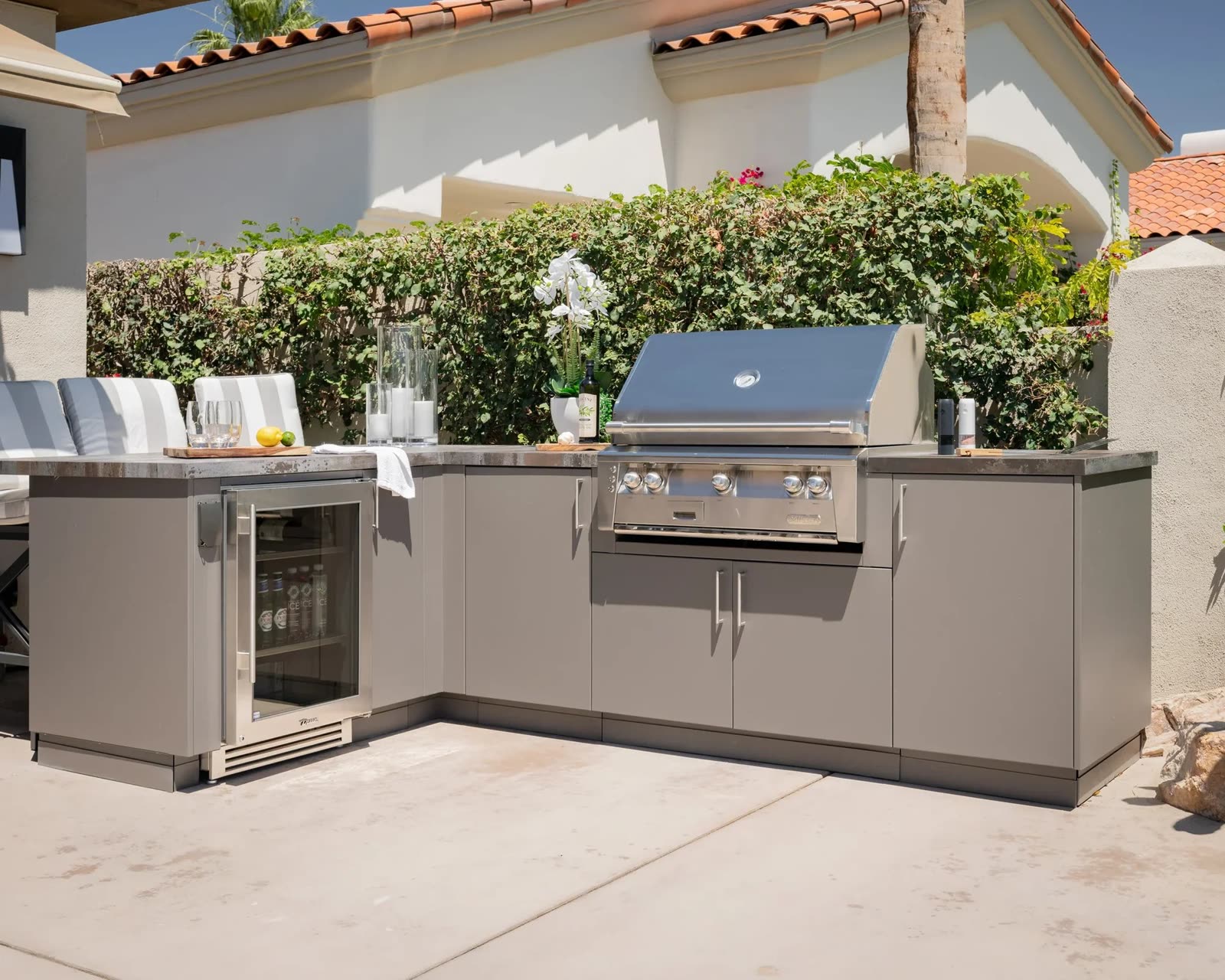
Size: buy for your Tuesday, not your Super Bowl
Built-in grills run from 26 to 56 inches wide. The instinct is to buy the biggest one the budget allows — and it's usually wrong. A grill sized for the twice-a-year crowd wastes fuel every ordinary evening, because you're heating 1,200 square inches of grate to cook four chicken breasts, and gas grills sear poorly when they're running half-empty and half-hot.
- 26–30 inches: couples and small families; fits tight linear kitchens; roughly 500–600 sq in of primary grate.
- 32–36 inches: the sweet spot for most households — three burners, room for indirect-heat cooking, handles 8–10 guests. This is what we spec most.
- 40–42 inches: frequent entertainers; four to five burners; enough real estate to run two heat zones properly.
- 48–56 inches: genuine event cooking. Beautiful — and demands a kitchen at least 12–14 feet long so it doesn't eat every inch of counter, as the landing-zone math in our layout guide shows.
If you're torn between a bigger grill and a second cooking appliance — side burner, griddle, smoker — take the second appliance. Two heat sources beat one huge one almost every time.
BTUs: the number that lies
Total BTUs is the most quoted and least useful spec in outdoor cooking. It's simply burner output added up — so a leaky, thin-bodied grill with six weak burners can post a bigger number than a superbly engineered one with four. What actually determines cooking performance:
- BTUs per square inch of primary cooking area. Roughly 80–100 is the healthy range for gas grills. Below 70, expect anemic searing; way above 110 with a thin body, expect flare-ups.
- Thermal mass and body construction. Double-walled hoods and heavy grates (thick stainless rod or cast components) hold and return heat. This is why a well-built 32-inch grill out-sears a cheap 42.
- Even heat, not peak heat. Ask whether the burner layout covers the grate edge-to-edge, and whether there's a true low end — 250°F matters more for ribs than 900 does for steak.
- Infrared searing zones (ceramic or radiant burners) reach steakhouse temperatures on demand — a genuinely useful option, unlike most spec-sheet garnish.
Construction: the 304/316 conversation again
Grill bodies are stainless steel, and the grade question mirrors the cabinetry one. 304 stainless is standard and fine inland. Near salt water it tea-stains, and grill lids — hot, thin, constantly heat-cycled — show it first. Premium grills in the class we install in our luxury projects — welded bodies, commercial-gauge steel, lifetime burner warranties — increasingly offer 316 components or thicker 304 that tolerates coastal life far better. Whatever the brand, look for: welded (not riveted) body seams, burners with a lifetime or 10-year warranty, and replaceable flame tamers — those are the parts that die first.
One thing the grill can't fix: what surrounds it. A superb grill in a rusting enclosure is still a rusting kitchen, which is why the cabinetry material — covered in our aluminum vs stainless vs masonry comparison — deserves as much attention as the appliance.
Gas, charcoal, hybrid, or pellet?
Natural gas is the built-in default: push-button, endless fuel, no tank swaps. If your home has gas service, run a line — and order the grill in an NG configuration from the start, because conversions are clumsy. Propane works where gas service doesn't exist, but a built-in deserves a proper remote tank or an accessible tank drawer, not a cylinder squatting in a cabinet designed for storage. Charcoal built-ins reward flavor purists and punish the impatient; if the household debates gas vs charcoal, the honest answer is a gas primary plus a charcoal or kamado second unit — see our smoker and kamado guide. Pellet grills in built-in form are still a young category; buy one only with clear service support, because they contain electronics living outdoors.
Planning the cutout: where grills and cabinetry meet
This is the part buyers skip and builders lose sleep over. Every built-in grill publishes a cutout spec — width, depth, and the clearances it demands to combustible and non-combustible surfaces. Three rules from our install crews:
- Buy the grill (or lock the model) before cabinetry is fabricated. Cutouts are not standardized; a 36-inch grill from two makers can differ by an inch and a half. We build to the documented spec of a chosen unit, always.
- Respect ventilation. Gas grills in enclosed islands require vent openings so LP or NG can't pool inside the cabinet. Our aluminum kitchens have engineered venting; if you're in masonry, insist on vents cut low and high.
- Insulated jackets: required whenever a grill sits in combustible construction, and a good idea for heat protection generally. Confirm before ordering — some grills don't offer one, which rules them out of certain builds.
Around the grill, plan the supporting cast: a side burner or power burner for sauces and boils, a sealed drawer stack for tools (ours ride on stainless-rated Blum and Hettich runners), a trash pull-out within one step, and refrigeration within the working core.
Budget: what grills really cost
Built-in gas grills cluster in three tiers: $1,500–$3,000 for entry built-ins (thin bodies, 3–7 year realistic life outdoors), $3,000–$7,000 for the serious mid-tier where most of our clients land (heavy 304, strong warranties, 10–20 year life), and $7,000–$20,000+ for the luxury tier with commercial-gauge construction and lifetime warranties. Where that sits in the whole project — typically 15–25% of total spend — is mapped in our outdoor kitchen cost guide. My advice after decades of this: buy one tier better than you planned, on the grill and the hinges both. The cheap version gets bought twice.
The showroom test
When you're standing in front of candidate grills, skip the spec cards and run the physical exam we run. Lift the hood: it should rise with damped, substantial weight and no flex or oil-canning in the lid — thin steel telegraphs instantly. Look under the grates at the burner bay: you want thick, welded burners and full-coverage flame tamers, not stamped tents over bare tubes. Check the grease path: a proper full-width tray that slides out from the front means the grill was designed by someone who has cleaned one; a cup hanging under the back means it wasn't. Wiggle the knobs — bezels that wobble in the showroom rattle forever. And ask the dealer one question that sorts the market instantly: "What parts do you stock for this?" A brand worth building into stone has burners, igniters, and tamers on the shelf. A brand with no parts program is a future cutout problem, no matter how good the sear.
Practical takeaways
- 36 inches serves most families better than 42; two heat sources beat one giant grill.
- Ignore total BTUs; judge BTUs per square inch, body gauge, and burner warranty.
- Coastal homes: push for 316 or heavy-gauge components, and mind the enclosure material.
- Lock the exact grill model before cabinetry fabrication — cutouts are not standard.
- Vent enclosed islands, use insulated jackets near combustibles, and pick fuel by lifestyle, not ideology.
We design outdoor kitchens around your chosen grill — any maker, any size — with welded marine-grade aluminum cabinetry built to its exact cutout. Explore our outdoor kitchens, or book a free 30-minute design consultation and we'll size the grill to how you actually cook.