
Smokers and Kamado Grills in Built-In Designs
There's a moment in almost every outdoor kitchen consultation when the client's spouse mentions, with a particular tone, "the smoker." Sometimes it's a beloved kamado that has followed the family through two houses; sometimes it's a pellet rig with more computing power than the first Mars rover. The question is always the same: can we build it in? The answer is almost always yes — but a smoker is not a grill, and building one into cabinetry without understanding how it differs is how you crack a $2,000 ceramic egg or cook the electronics out of a $3,000 pellet unit. Here's the engineering.
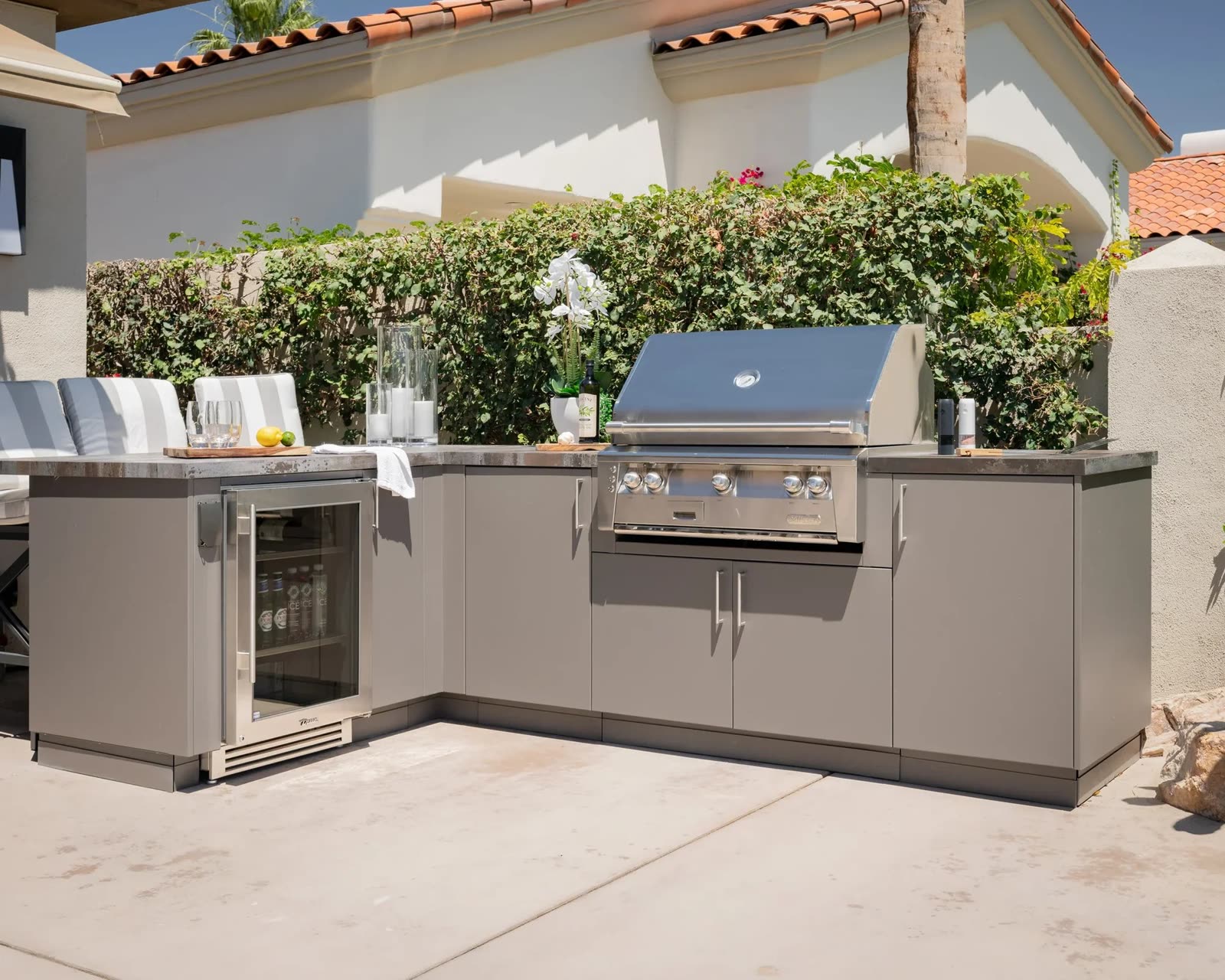
Why smokers change the cabinetry math
A gas grill is designed from birth to be built in: insulated shell, published cutout, front controls. Smokers grew up freestanding, and each type carries freestanding habits into the cabinetry conversation. Three differences drive everything: session length — a brisket means 10–14 hours of continuous heat soaking into surrounding materials, unlike a 40-minute grill session; fuel and ash logistics — charcoal, chunks, and pellets need dry storage nearby and ash needs a safe exit path; and airflow as a cooking control — smokers breathe through calibrated vents, so the enclosure must never compete with the appliance for air or block its intakes and exhausts.
The kamado: the natural built-in
Ceramic kamados are the easiest smokers to integrate beautifully, and the most common in our projects. The considerations, from dozens of installs:
- Weight: a large kamado runs 200–350 lbs before the table it sits in. Cabinetry must carry that as a point load — one argument for welded aluminum structure, which we reinforce at the kamado bay as a matter of course. The slab under it should be genuinely flat; ceramics tolerate no rocking.
- The air gap is sacred: kamado manufacturers specify clearance around the ceramic body — typically about 2 inches minimum to non-combustible surrounds, more to anything combustible. The ceramic exterior of a long cook runs hot enough to scorch; we line kamado bays with ventilated aluminum and leave convection paths under and around the body. Never foam-fit a kamado like a sink.
- Access for the ritual: the bottom vent and ash port must remain reachable without yoga — that's how the cook manages fire — and the hinged dome needs clear swing with the counter cut generously behind it. We hold counters at least a few inches back from the dome's arc and use heat-tolerant surfaces immediately adjacent: sintered stone and granite, per our countertop guide.
- Removability: ceramics occasionally crack and firms occasionally honor warranties — design the bay so the kamado lifts out without demolishing the counter. A built-in that can't be un-built is a hostage situation.
Pellet smokers: electronics in the heat
Pellet units are computers attached to fireboxes: auger, fan, controller, and a hopper of compressed sawdust that must stay bone dry. True built-in-rated pellet inserts exist but remain a young category; most "built-in" pellet installs are freestanding units nested into a designed alcove, and that works if you respect three things: service access (auger jams and igniter swaps are routine — the unit must roll or lift out), ventilated, rain-proof pellet storage (we build sealed hopper-side drawers with desiccant space; wet pellets turn to mush and jam augers), and a dedicated GFCI outlet inside the bay — planned at rough-in with the rest of the circuits from our utilities guide, not draped over the counter on a cord. Shade the controller side: display screens and control boards resent direct Sun Belt afternoons.
Offsets and cabinets: know when to stay freestanding
The full offset stick-burner — firebox on the side, smokestack, quarter-inch steel — is a glorious thing that does not want to live inside cabinetry. Its whole body is a radiating surface, its ember management is open-air, and its footprint dwarfs any island. For offset devotees we design a smoker court instead: a dedicated non-combustible zone at the kitchen's end, downwind, with hard surface underfoot, fuel storage in the adjacent cabinetry, and generous landing counter within two steps. The smoker stays freestanding; the kitchen embraces it. Vertical cabinet smokers (charcoal or electric) split the difference — several are rated for alcove installation with clearances; the manufacturer's sheet, as always with fire, is the law.
Layout for the low-and-slow lifestyle
Smoking reshapes how the kitchen gets used, and the layout should anticipate it. Put the smoker downwind of everything — twelve hours of oak smoke is wonderful in a brisket and less so in a bedroom window or across the pool furniture; the smoke-first siting logic from our layout guide applies double here. Give the station its own landing zone (a hot 15-lb brisket needs 24 inches of heat-proof counter now), a tool drawer deep enough for gloves, probes, and butcher paper on quality soft-close runners — the stainless-rated Blum and Hettich hardware we fit shrugs off the grease-and-heat environment of a smoke station — and fuel storage: a dry, ventilated cabinet bay for charcoal and wood, sized for a season, not a session. And because a long cook is a day spent nearby, the households that smoke most end up wanting the comfort layer — seating in the smoke-free zone, task light for the 5 a.m. fire-lighting and the 9 p.m. wrap, per our lighting guide. Overhead structures deserve respect too: under a pergola or roof, a smoker needs the same perimeter-or-flue treatment as a wood oven, because twelve hours of smoke will stain and creosote a ceiling that an hour of grilling never would.
One fire or two?
The perennial budget question: hybrid grill-smoker units versus dedicated appliances. Our honest take — combination units make compromises in both directions, and serious low-and-slow cooks are the least satisfied by them. The layouts that age best in our experience pair a gas grill (the weeknight engine, chosen with the criteria in our grill guide) with one dedicated smoking appliance matched to the owner's style: kamado for the tinkerer, pellet for the set-and-sleep cook, offset court for the purist. Two modest fires beat one giant compromise.
Safety and the long cook
A closing word on the part of smoking nobody photographs: fire management over many unattended hours. A built-in smoke station should assume the cook will walk away — because they will — and be safe when they do. That means non-combustible surfaces extending well beyond the appliance in every direction, including below (embers exit ash ports; a kamado bay over composite decking is a documented house-fire pattern); a metal ash vessel with a lid stored in the cabinetry, because "cold" ash stays capable of ignition for days; and clearance discipline behind the unit, where exhaust heat quietly cooks whatever someone leaned there in hour nine. Carbon monoxide deserves one sentence of respect: smokers are outdoor appliances, full stop — never under an enclosed lanai with the screens down and the doors shut. And in wildfire-prone regions, check burn-day rules and spark-arrestor requirements before designing around a live-fire appliance at all. None of this constrains good design; it is good design, engineered in once so a decade of briskets can be boring in the best possible way.
Practical takeaways
- Kamados build in beautifully: reinforce for the weight, keep the manufacturer's air gap, preserve vent access, and make it liftable-out.
- Pellet units need service access, dry pellet storage, and a planned GFCI outlet — treat the electronics like the appliance they are.
- Offsets stay freestanding in a designed smoker court; don't entomb a stick burner.
- Site smoke downwind of house, pool, and neighbors; give the station its own landing counter and fuel bay.
- Pair a gas grill with one dedicated smoker rather than buying a compromise machine.
We build kamado bays, pellet stations, and smoker courts into welded marine-grade aluminum kitchens — engineered for the weight, the heat, and the twelve-hour cook. Explore our outdoor kitchens, or book a free 30-minute design consultation and tell us what's in your smoker right now — we'll design the kitchen around it.