
Dark Kitchen Cabinets: How to Avoid Building a Cave
A dark kitchen, done right, is the most sophisticated room in a house — deep green cabinetry with brass, espresso walnut with limestone, near-black oak under a run of warm picture lights. Done wrong, it's a cave: gloomy at breakfast, gloomy at homework hour, gloomy in every photo the owner takes to ask me what went wrong. I've built both outcomes in thirty years — the second kind early on, which is how I learned — and the difference between them is never the color. It's light, texture, and proportion. If you're drawn to the dark side, this is the physics and the craft that keep it luxurious.
Understand what you're actually buying: reflectance
Every surface bounces some portion of the light that hits it — that's Light Reflectance Value, LRV, on a 0–100 scale. A white cabinet sits around LRV 80; it returns most of the room's light and effectively acts as a lighting fixture. A navy, forest, or charcoal door sits at LRV 5–12. Paint half a kitchen in it and you've removed the majority of the room's bounced light in one decision. Nothing is wrong with that — but it means a dark kitchen needs roughly double the installed lighting of a white one to hit the same working brightness, and it needs that light planned, not hoped for. This is the single fact that separates the moody kitchens from the caves.
The lighting plan, in numbers
- General light: aim for 70–80 lumens per square foot in a dark kitchen versus the 40–50 that serves a light one. In practice: recessed fixtures on a 4-foot grid rather than 6, or a denser track/spot layout.
- Under-cabinet task light is mandatory, not optional. Continuous LED strip — not pucks — at 300+ lumens per foot, 2700–3000K, high CRI (90+), on its own dimmer. Dark uppers over an unlit counter create a shadow trench exactly where you hold the knife.
- Interior and accent light: lit glass uppers, LED shelf lighting, toe-kick strips. In a dark kitchen these aren't decoration; they're the mid-level light that keeps the cabinetry reading as furniture instead of a void.
- Color temperature: stay 2700–3000K everywhere. Cool 4000K light on dark paint goes morgue-blue instantly. And dim everything — a dark kitchen at 30% light in the evening is the whole reason people want dark kitchens.
Where dark works — and where I talk clients out of it
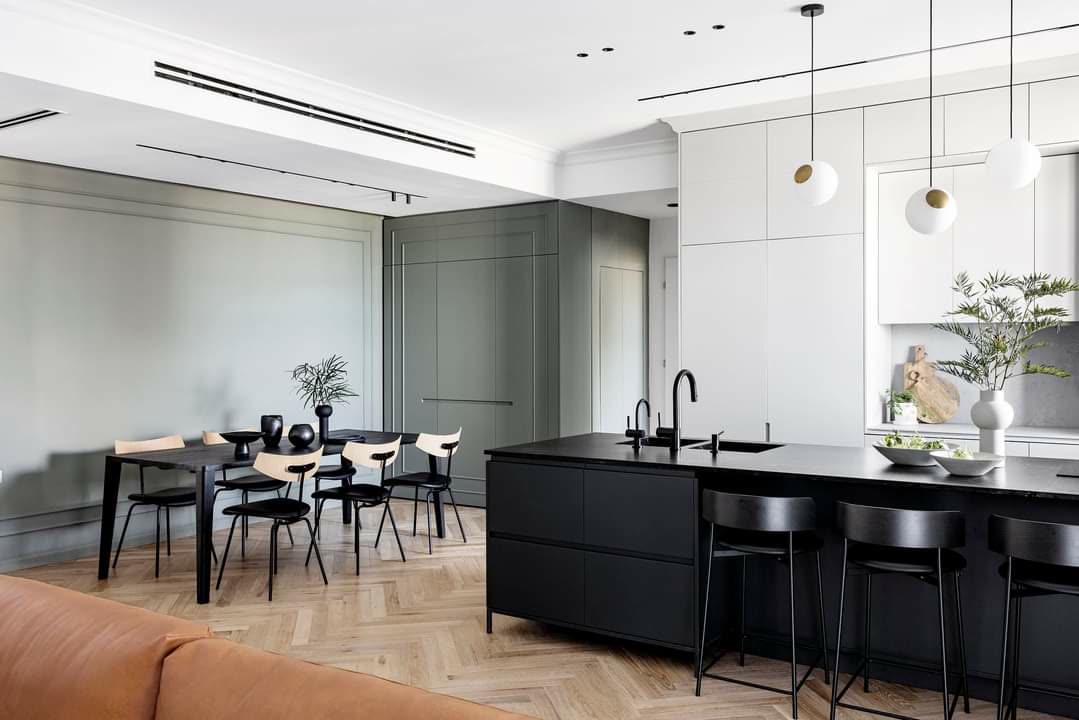
Dark loves rooms with real daylight: south or west windows, glass doors, open plans borrowing light from adjacent spaces. It also loves height — 9-foot ceilings and up carry dark uppers with ease. I get cautious in three situations: north-facing galley kitchens with one window, where I'll push dark to the lower cabinets only; small closed kitchens under 120 square feet, where full dark shrinks the room to a closet; and low 8-foot ceilings with dark uppers, which visually drop the ceiling another six inches. The compromise that almost always wins is the dark base / light upper split — dark grounds the room at the bottom where your eye expects weight, light uppers keep the walls open. It's the reverse of the tired gray-island formula and it works in nearly any room. Get the layout itself right first, of course — a dark kitchen amplifies planning errors because shadows hide in bad corners; my list of kitchen layout mistakes applies double here.
Finish and material choices that survive real life
Dark surfaces show dust, fingerprints, and scratches in raking light — the same raking light that makes them gorgeous. The finish schedule fights back. Sheen: keep it low. A 5–15% matte or super-matte hides handling; gloss on dark is a fingerprint archive (the new anti-fingerprint super-matte laminates and lacquers genuinely work, and we now spec them for most black kitchens). Texture beats flat. Dark-stained open-grain oak, wire-brushed finishes, and reeded or slatted fronts scatter light and hide micro-scratches that a flat painted slab displays like trophies; stained dark wood also touches up far more gracefully than dark paint, whose chips flash bright substrate. If you're choosing between dark species, walnut runs chocolate and smoke naturally — the comparison in my white oak vs walnut guide leans exactly this direction — while dark-stained rift oak gives you the straight-grain architecture with deeper color control. Hardware: warm metals. Brass and bronze glow against deep green and navy; matte black on black reads severe unless the room is deliberately monochrome.
Contrast: the one-third rule
The caves I get called to rescue share a pattern: dark cabinets, dark counters, dark floor, dark wall. My working rule is that at least one-third of the room's major surfaces must bounce light — and the counter is the most efficient candidate, because it sits mid-room and reflects the ceiling fixtures straight back up at the work. Light quartzite, warm white porcelain, or a honed marble-look surface over dark bases is the classic pairing for a reason. Backsplashes are the second lever: zellige, polished stone, or glass behind a dark run adds sparkle at eye level. Floors in mid-tone wood keep the composition from bottoming out. Reserve the all-dark, counters-included look for bars and butler's pantries — small doses of full drama, which is where it's genuinely spectacular.
Cost and commitment, honestly
The cabinetry itself costs the same dark or light — pigment is free. The honest premiums are around it: the doubled lighting plan adds $2,000–$6,000 in fixtures and wiring, and dark custom colors deserve factory 2K finishes with the formula kept on file for touch-ups (we keep every formula we've ever sprayed). Budget-wise the whole conversation lives inside the ranges in my custom kitchen cost guide. On commitment: dark is bolder at resale than warm white, no argument. But a well-lit deep green or walnut kitchen photographs like architecture, and I've watched dark kitchens sell houses. What sells is conviction plus light. What doesn't is gloom.
Practical takeaways
- Dark cabinets absorb light; plan roughly double the lumens and put every layer on dimmers.
- Continuous 2700–3000K under-cabinet strip lighting is mandatory over dark bases.
- Best-odds formula: dark bases, light uppers or open walls, light counters — the one-third bounce rule.
- Low-sheen, textured, or stained-wood dark surfaces live better than flat dark paint.
- Save all-dark-everything for the bar or butler's pantry, where drama has a door.
The best way to decide is to stand in a dark kitchen with the dimmers in your hand — we have them in our showrooms for exactly this reason. Book a free 30-minute design consultation or explore our custom kitchens to see dark done with the lights planned first.