
Italian vs German vs North American Cabinet Making
Walk into any luxury kitchen showroom district — Miami's design corridor, Manhattan's A&D Building, Toronto's Castlefield strip — and you'll meet three cabinet-making civilizations competing for the same wall of your house. Italian brands sell you a fashion object. German brands sell you a machine. North American custom shops sell you a fit. All three can be superb. They are also genuinely, structurally different — in how they're built, sized, ordered, shipped, and serviced — and most buyers only discover those differences after signing.
I've spent thirty years building in the European frameless tradition on this continent, which gives me a foot in every camp and loyalty to none of the marketing. Here's the honest anatomy of all three.
The Italian school: design first, always
Italy's kitchen industry grew out of its furniture and fashion houses, and it shows. The great Italian brands treat the kitchen as a designed object — materials you won't see elsewhere (heat-treated eucalyptus, liquid-metal lacquers, leather-wrapped shelving), proportions tuned like couture, and a willingness to make a kitchen look like sculpture. When a project's brief is a statement piece, Italian design language is the reference point, and I say that with real admiration.
The structural realities: Italian kitchens are factory products built in fixed module systems. Your room is designed to the modules, with filler panels absorbing the difference. Lead times to North America typically run 4–6 months, plus ocean freight, customs, and the prayer that nothing arrives damaged — because a replacement door rides the same slow boat. Service is the honest weak point: the brand is in Brescia, the dealer is a boutique that may or may not exist in five years, and a warped door in year four becomes an international diplomacy exercise. Price: the famous names command fashion-house premiums; you are partly buying the label, and it's fair to know that.
The German school: engineering as religion
The German industry — the giants of Herford and East Westphalia — builds the world's most industrially perfect kitchen. Automation at a scale no custom shop can match, tolerances held ruthlessly, finishes cured on lines that process thousands of fronts a day. German kitchens are ordered in a grid system of standardized widths and heights, engineered around the same premium hardware ecosystems we build with — the Blum, Hettich, and Häfele mechanisms are often literally the same parts. Value for engineering quality is genuinely strong, typically undercutting Italian pricing at equal or better construction consistency.
The same import physics apply, though: 3–5 month lead times, containers, and module-grid design. German plants offer more width increments than most Italian systems, but your 9-foot-4 ceiling still gets a bulkhead or a gap, your 1920s wall still isn't plumb, and the system doesn't care. And the service chain remains dealer-dependent — excellent where the dealer is excellent, and a coin-flip over a decade. If you're weighing a container-import kitchen of any nationality, the risk column deserves as much attention as the showroom does; we wrote the sober version of that math in our renovation timeline guide.
The North American school: made to measure, made nearby
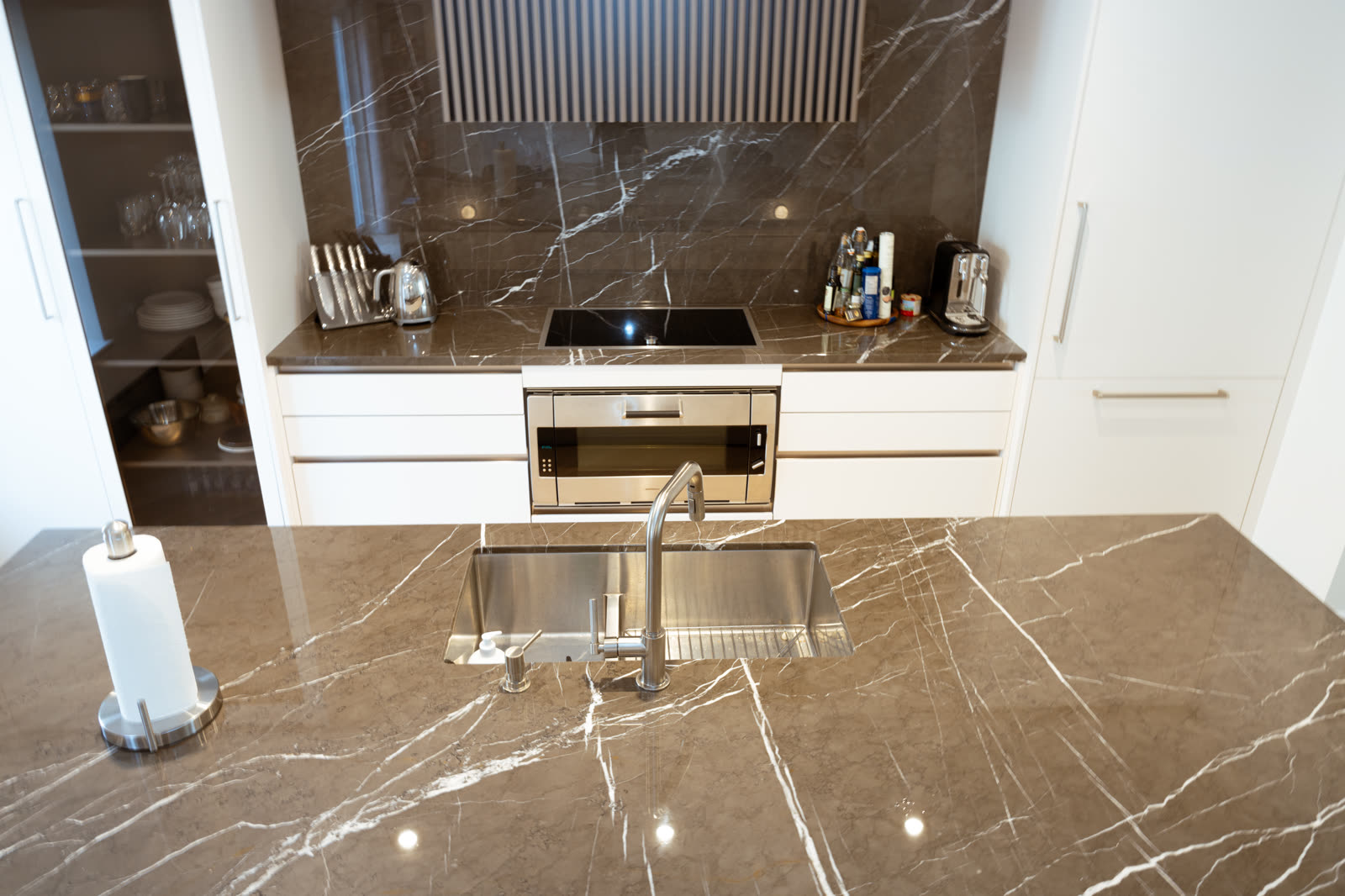
The third tradition is the one this continent under-rates because it doesn't arrive with an accent: the custom shop building European-style frameless cabinetry to the millimeter of your actual room. No module grid — a 613 mm cabinet where the chase demands it, uppers built to kiss your specific ceiling, an island sized to your clearances rather than to a catalog. This is the school iKitchen belongs to, and the honest pitch is not that we out-design Milan or out-automate Herford. It's three structural advantages the import model cannot copy:
- Fit. Custom dimensions, site-verified, engineered per project. In renovation work — old houses, condos, brownstones — this isn't a luxury; it's the difference between cabinetry and cabinetry-plus-fillers.
- Time. 8–12 weeks of production instead of 4–6 months, with no ocean in the middle. A damaged panel is remade in days, not re-shipped in months.
- Accountability. The factory, the designer, and the installer share one phone number, and the lifetime warranty is honored by the people who built the box — not by a dealer interpreting a manufacturer interpreting a contract across an ocean. Year-six service calls are where the three schools truly diverge, and it's the criterion buyers weight at zero on day one and at infinity on the day they need it.
The fair critique of my school: quality variance. "Custom shop" spans everything from world-class factories to two guys and a table saw, so the buyer must vet harder — construction methods, hardware brands, finishing facilities, references. The tells to check are exactly the ones in our custom vs semi-custom vs stock comparison.
The comparison that actually decides projects
- Construction quality: at the top tier, a draw. All three schools build frameless boxes with premium European hardware. Nobody should pretend otherwise.
- Design ceiling: Italy for radical statement pieces; German and North American custom for everything else, with custom winning wherever the architecture is irregular.
- Dimensional fit: North American custom, decisively. Modules vs millimeters isn't a close contest in renovation work.
- Lead time and logistics risk: North American custom (8–12 weeks, truck) over both imports (4–6 months, container).
- Long-term service: local manufacturing wins structurally; import service quality equals dealer quality, which is unknowable in advance.
- Price: broad overlap. Italian labels carry brand premium; German systems are efficient; quality custom sits in between — the full breakdown lives in our 2026 cost guide.
How to choose in one paragraph
If your project is a design statement in a new-build with generous timelines and a bulletproof local dealer, the great European brands will make you happy — they make me happy to study. If your room has history, your timeline has a moving date, or your definition of luxury includes someone answering the phone in year nine, buy the European construction philosophy built on this continent: frameless precision, Austrian and German hardware, and a factory within driving distance of your home. That combination — continental engineering, made-to-measure fit, made in Canada — is precisely the position we built iKitchen to occupy, and three decades in, I'd make the same bet again.
Come compare for yourself — bring the Italian and German brochures, honestly, and we'll walk you through the same details on our showroom floor: box construction, hardware, finishes, and the drawings for a kitchen built to your walls. Book a free 30-minute design consultation or explore our custom kitchens. Design retainers start at $3,000 and apply toward your project — and the phone number, 1-844-813-9996, will still reach us in year twenty.