
Kitchen Ventilation: Hood Types and Cabinet Integration
Ventilation is the least glamorous decision in a kitchen and the one you'll regret fastest if it's wrong. I've walked into five-year-old kitchens with $8,000 ranges and gorgeous cabinetry where the crown moulding above the cooktop is tacky with aerosolized grease, because somebody specified a recirculating hood to save a duct run. In thirty years of building kitchens, I've come to treat the hood the way a builder treats a foundation: get it right first, then make it beautiful. And because the hood lives inside or against cabinetry, it's very much a cabinetmaker's problem. Here's how we think it through.
The CFM math, without the mythology
Hood capacity is measured in cubic feet per minute. Two rules of thumb cover 90% of kitchens: for gas, take the range's total BTU output and divide by 100 — a 60,000 BTU pro-style range wants roughly 600 CFM. For electric and induction, figure 10 CFM per inch of cooktop width — a 36-inch induction top wants about 360. More is not automatically better. In the US, most codes require a makeup air system once you exceed 400 CFM — a damper and duct that lets replacement air in so your 900 CFM blower isn't pulling combustion gases back down the water heater flue. Makeup air adds $1,500–$4,000 to the project, which is why I often steer clients to a 400 CFM hood with excellent capture geometry instead of a 1,200 CFM trophy. Capture area beats raw power: a hood that's wider and deeper than the cooktop at moderate CFM out-performs a narrow hurricane.
Duct rules that decide everything
Duct size must match the blower: 6-inch round handles up to roughly 400 CFM, 8-inch to 800, 10-inch beyond that. Every elbow costs you the equivalent of 15–25 feet of straight run, and flex duct is banned from my projects — the corrugations collect grease and throttle airflow. Recirculating hoods, which filter and return the air, are a last resort for condos where the exterior wall is unreachable; modern recirculating units with charcoal filters are far better than they were, but they remove smoke and some odor, not heat or moisture. If you're in a condo tower, find out what the building allows before you fall in love with a range — this is one of the first questions in any renovation timeline, and it can move the whole schedule, as I covered in the kitchen renovation timeline.
The four hood formats, from a cabinetry standpoint
- Chimney / stainless wall hoods: the appliance is the statement. Cabinetry's job is to frame it with symmetrical flanking cabinets and get out of the way. Least cabinetry cost, most appliance-showroom look.
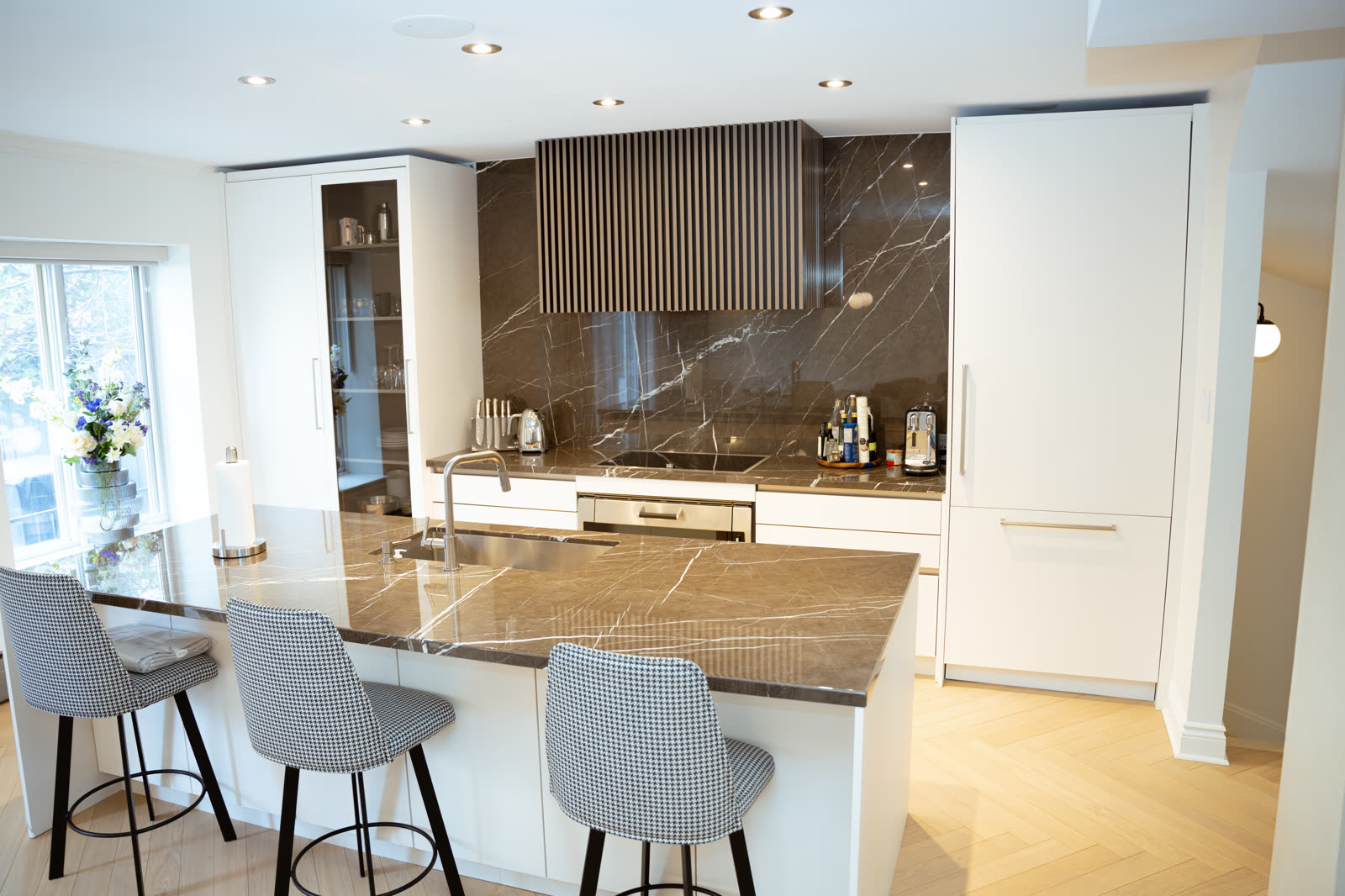
- Insert liners in custom surrounds: our bread and butter. A liner (Zephyr, Best, Vent-A-Hood, Faber — $600–$2,500) mounts inside a hood enclosure we build to match the kitchen: painted shaker box, plaster-look tapered canopy, white oak slat wrap, fluted columns. The surround costs $2,000–$6,000 in cabinetry and turns the ventilation into architecture.
- Under-cabinet and integrated flush hoods: the hood hides in the bottom of an upper cabinet or behind a matching door panel. Cleanest look for handle-free kitchens; the cabinet above loses about half its storage to the duct chase, which we plan honestly rather than pretending it's a shelf.
- Downdraft and ceiling-integrated: for islands. Downdrafts pull sideways against physics — steam rises — and I install them only when nothing overhead is possible. Ceiling cassettes work if flush-mounted with a real duct run, but they need 600+ CFM to overcome the distance, which triggers the makeup-air math above. My honest advice remains the one from my kitchen island design guide: think twice about cooking on the island at all.
Building the surround: what quality looks like
A custom hood surround is deceptively hard cabinetry. It hangs over the hottest, greasiest square yard in the house, so materials and construction matter more than anywhere else. Our rules: the liner must be a minimum 3 inches wider than the cooktop on each side where the wall allows — capture area again. Mounting height per manufacturer, typically 30–36 inches above a gas cooktop, 24–30 above induction; we build the surround to put the liner exactly at spec, not where the tile pattern wanted it. Interior surfaces near the liner get heat-tolerant, wipeable finishes; we never run raw MDF edges inside a hood chase, because grease vapor finds them and swells them. The blower's weight — up to 60 lbs with the liner — hangs from cleats lagged into studs, never from the flanking cabinets. And we always build in a removable access panel; blowers need service in year eight, and a surround that must be demolished to reach a capacitor is a design failure you won't discover for a decade.
Noise, the spec nobody reads
Hoods are rated in sones. One sone is a quiet fridge; most hoods run 4–8 sones at full power, which is loud enough to end kitchen conversation. Two fixes: buy a hood with a decent low-speed rating — you'll live on speeds 1 and 2 — or spec a remote/inline blower mounted in the attic or on the roof, which moves the motor noise out of the room entirely for a $400–$900 premium. In open-plan houses where the kitchen shares air with the TV, the remote blower is the single best acoustic upgrade in the project.
What the whole thing costs
Realistic all-in ranges, equipment plus cabinetry plus install: a quality stainless chimney hood, $1,200–$4,000. A liner in a custom surround, $3,500–$9,000. A flush integrated hood in handle-free cabinetry, $2,500–$6,000. Island ceiling ventilation done properly, $5,000–$12,000 with makeup air. On a full project these numbers sit comfortably inside the budget frameworks in my custom kitchen cost guide — ventilation typically lands at 3–5% of total spend, and it's the last 3–5% I'd ever cut.
Practical takeaways
- Size by the math: BTU÷100 for gas, 10 CFM per inch for electric — then check the 400 CFM makeup-air threshold before buying.
- Capture area beats CFM; go wider and deeper before you go louder.
- Rigid duct, minimum elbows, correct diameter — or the best hood underperforms.
- Custom surrounds need heat-safe interiors, stud-mounted support, and an access panel.
- Check sones at low speed; consider a remote blower in open plans.
If you're planning a range wall, bring your appliance spec sheet to a consultation and we'll design the surround and the airflow together. Book a free 30-minute design consultation or see finished hood surrounds in our custom kitchens.