
Thermofoil, Laminate, and Acrylic Doors: The Honest Guide
Not every great kitchen wears wood or paint. Some of the most durable, most cleanable, most precisely made doors on the market are surfaced in engineered materials — and some of the worst warranty disasters I've seen in thirty years wear the same three words on the spec sheet. Thermofoil, laminate, and acrylic are categories, not qualities. Within each lives a spectrum from bulletproof to regrettable, and the differences are invisible in a showroom photo.
Here's how each is actually made, where each fails, and how to buy the good version.
Thermofoil: a vacuum-formed skin, for better and worse
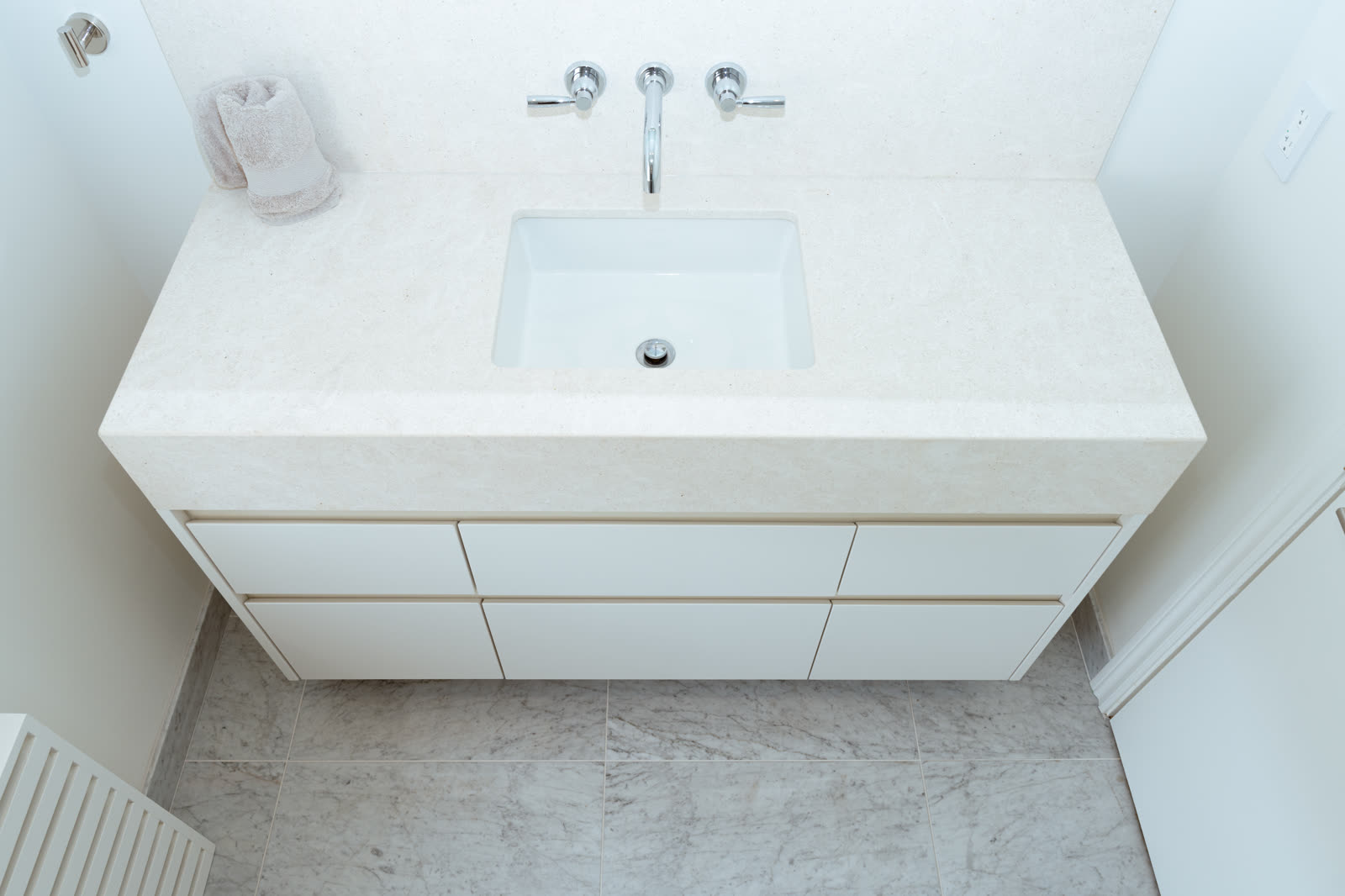
Thermofoil (also called RTF — rigid thermofoil) is a flexible PVC membrane, usually 0.3–0.5 mm, heated and vacuum-pressed over a routed MDF door. Because the film stretches over profiles, it's the only engineered surface that can wrap a raised-panel or shaker shape in one seamless skin — no joints, no edges to band, nothing for moisture to find. That seamlessness makes thermofoil genuinely excellent in one place above all: bathroom vanities and laundry cabinetry, where splash-and-wipe life rewards a sealed monolithic surface.
Its enemy is heat. PVC softens around 60–70°C (140–160°F), and the classic thermofoil failure is delamination beside the oven or over the toaster — the film releasing from the MDF and curling at the edge, unrepairable except by door replacement. Self-cleaning oven cycles and undersized appliance clearances are the usual killers. If a kitchen spec includes thermofoil near heat, insist on the appliance-side heat-shield strips (thin aluminum barriers on the adjacent cabinet edge) — we install them as standard — or better, keep thermofoil away from the range wall entirely. Quality also varies with the film itself: thicker films with acrylic-capped wear layers age far better than bargain PVC, which can amber near windows over years of UV.
Laminate: the misunderstood workhorse
"Laminate" covers two very different products, and knowing which one you're quoted matters more than the color name.
HPL — high-pressure laminate — is the serious one: multiple layers of kraft paper saturated in phenolic resin, topped with a decorative sheet and melamine wear layer, fused at over 1,000 psi into a dense ~0.7–1 mm sheet, then glued to a core. This is the material of airport counters and hospital casework; scratch, impact, and stain resistance are the best of anything in this article. It's why HPL dominates our commercial work, as we detailed in the commercial cabinetry spec guide — and why a matte HPL kitchen is a genuinely smart choice for rental properties and hard-living families.
TFL — thermally fused laminate (once called "melamine") — is a resin-saturated decor paper fused directly to the board under heat and pressure. Thinner and less impact-resistant than HPL, but far better than its 1990s reputation: modern TFL comes in deeply textured "synchronized" woodgrains where the embossing aligns with the printed grain, convincing enough that clients regularly mistake it for oak until they touch a corner. On cabinet interiors, TFL is the industry-standard finished surface at every price level, including luxury.
The tell on any laminate door is the edge. Laminate can't wrap a corner, so every door needs edge banding — and this is where quality shows. A 1–2 mm ABS edge applied with modern laser or PUR polyurethane edgebanding produces a near-invisible, waterproof joint; old EVA hot-melt glue leaves a visible dark glue line that opens with steam and time. Ask which system your fabricator runs. It's a one-sentence question that separates decades.
Acrylic: the mirror finish that actually lasts
High-gloss acrylic doors are a sheet of PMMA — the optical polymer of aircraft canopies — typically ~1 mm thick with color behind it, bonded to MDF and edge-banded to match. Because the color sits under a thick transparent layer, acrylic has visual depth no sprayed gloss can match, and its gloss holds at 90+ GU for decades. Unlike thermofoil it doesn't mind normal kitchen heat; unlike polyester gloss it can be machine-polished to erase fine scratches, the way a detailer restores a car. The trade-offs: it fingerprints like any mirror (see our full discussion in matte vs gloss finishes), it demands microfiber-only cleaning (paper towel is technically an abrasive on PMMA — it will haze it over years), and the doors carry premium pricing that overlaps sprayed 2K work. Its matte sibling — super-matte AF nanotech surfaces — shares the construction with an anti-fingerprint topcoat, and is currently our most-requested engineered surface.
Where each belongs: a manufacturer's honest map
- Thermofoil: vanities, laundry, closets, white five-piece looks on a budget. Keep it off the range wall, demand heat shields, and treat sub-$10 films with suspicion.
- HPL: rentals, commercial, mudrooms, hard-wearing family kitchens, anywhere durability is the brief. Modern matte and woodgrain HPL belongs in design conversations it rarely gets invited to.
- TFL: cabinet interiors always; exteriors where budget leads and texture-matched woodgrains carry the look.
- Acrylic / super-matte PMMA: modern statement kitchens, handleless designs, small dark spaces that need gloss light-bounce — with the cleaning discipline to match.
And a spending note: engineered doors move the budget meaningfully — HPL and TFL sit below painted MDF, thermofoil near it, acrylic above it. Where each lands in a whole-project number is exactly the kind of line-item transparency we advocate in our custom kitchen cost guide.
The construction details that outlive the surface
Whatever skin you choose, the door under it is still an MDF or particleboard panel, the box behind it is still built well or badly, and the hinges still open 100,000 times. An acrylic door on a stapled box with no-name hardware is lipstick; a TFL door on a doweled, edge-sealed box swinging on Blum hinges will outlive it by decades. We build every engineered-surface door on the same cores, same PUR edgebanding, same Blum/Hettich/Häfele hardware, and same lifetime warranty as our wood and painted work — because the surface is a choice, but construction is a standard.
Practical takeaways
- Thermofoil = seamless and moisture-proof, but heat-sensitive: heat shields at appliances or keep it off the range wall.
- HPL is the toughest door surface made; TFL is the standard interior surface and a fast-improving exterior one.
- Judge laminate doors by their edges: laser/PUR banding with no glue line is the quality tell.
- Acrylic gloss is polishable and permanent where sprayed gloss is neither — but it lives by the microfiber cloth.
- The surface is only as good as the core, edge, and hinge behind it. Spec the whole door, not the photo.
The fastest education is holding a cheap door and a good one in the same minute — the difference travels up your arm. Book a free 30-minute consultation to handle every surface in this article, or see them specified in real projects across our custom kitchens and vanities.