
Stone Tops for Vanities: Quartz, Marble, Porcelain Compared
Bathroom counters face a chemical assault that kitchen counters never see. Kitchens deal with heat, oil, acid from citrus and wine, and physical abuse. Bathrooms deal with hair dye, nail polish remover, retinol serums, self-tanner, hydrogen peroxide, bleach-based cleaners, perfume, and hairspray overspray — plus standing water at every seam, every day. That list eliminates several materials that are perfectly fine in a kitchen.
Here's the honest comparison, from someone who has replaced a lot of stained vanity tops.
Quartz (engineered stone) — the default, and rightly so
Roughly 90% of the vanity tops we specify are engineered quartz. It's about 90–93% crushed natural quartz bound in polymer resin, which makes it non-porous. Nothing soaks in. Hair dye wipes off. It needs no sealing, ever.
Watch for: resin is a polymer, so quartz is not heat-proof — a flat iron left face-down at 400°F will scorch it. Buy a heat mat or, better, put the hot tools in a lined drawer. Direct prolonged UV can yellow the resin in some brands, which matters if your vanity sits under a south-facing window; check the manufacturer's UV rating. Solvent-based nail polish remover should still be wiped promptly.
Cost, fabricated and installed: $70–$140 per square foot. A 72-inch double vanity top with two undermount cut-outs typically lands $1,800–$3,500.
Porcelain and sintered stone — the technical winner
Large-format porcelain slabs and sintered surfaces (Dekton, Neolith, Laminam and similar) are fired at extreme temperature and pressure with no resin binder. That gives you a surface that is essentially zero-porosity, UV-stable, and genuinely heat-proof. Nothing in a bathroom can stain it. It's the only material where I'd shrug at a curling iron set directly on the counter.
It's also thin — usually 6, 12, or 20 mm — so a substantial edge requires a mitered build-up, which is a fabrication skill not every shop has. The pattern is printed on the surface, so an exposed cut edge shows the body colour of the slab unless the fabricator uses a "through-body" product or mitres the corner. And it's brittle during handling; a bad fabricator can crack a slab at the sink cut-out.
Cost: $85–$180 per square foot installed. Vet the fabricator harder than you vet the material.
Natural marble — beautiful, and honest about what it costs you
Marble is calcium carbonate. Any acid — and cosmetics are full of them — dissolves the surface polish and leaves a dull ring. That's etching, and it is not a stain; it is physical damage to the stone, and no sealer prevents it. Sealing only slows absorption of colour, which is a separate problem.
I'm not going to tell you never to use it. I will tell you exactly what you're signing up for:
- A honed finish hides etching far better than polished. If you want marble in a bathroom, hone it.
- Light stones (Carrara, Calacatta) hide etch marks; dark marbles (Nero Marquina, Rosso) show every ring.
- Blue and dark hair dye will stain white marble permanently in minutes. If anyone in the house colours their hair at home, choose something else.
- Expect to re-seal annually and to accept patina as part of the material's character.
- A powder room is a much better place for marble than a primary bath — no daily cosmetics, no dye, guests only.
Our fuller argument is in marble countertops: beautiful ideas, honest warnings. The bathroom version of that argument is simply stricter.
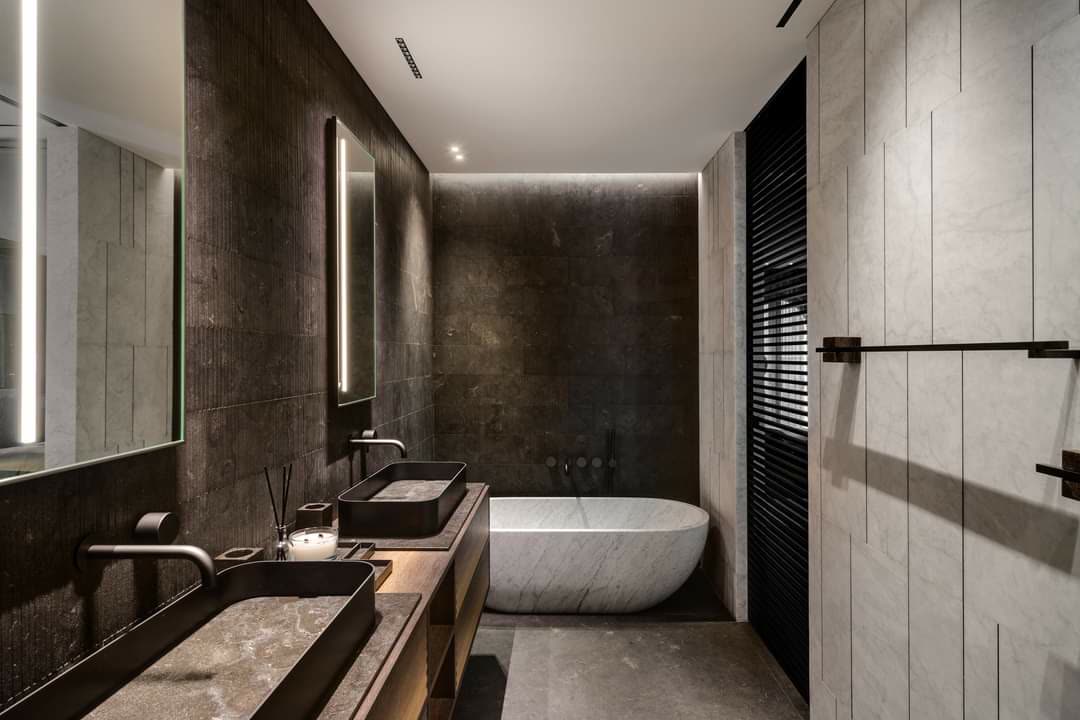
Granite and quartzite
Granite is harder than marble and doesn't etch from cosmetics, but it is porous and needs periodic sealing; unsealed granite will absorb oils and darken around the faucet. It has fallen out of fashion in bathrooms mostly for aesthetic reasons — the busy speckled patterns that dominated the 2000s don't suit current design language — but a quiet, uniform granite is a perfectly durable choice.
Natural quartzite (not to be confused with engineered quartz) is genuinely hard and stunning, with marble-like veining and much better etch resistance. It is expensive, often $120–$250 per square foot installed, and the trade is full of material mislabelled as quartzite that is actually dolomitic marble. Ask for an acid test on a sample before you buy. See our quartz vs granite vs porcelain breakdown.
Solid surface and integrated bowls
Acrylic solid surface (Corian and equivalents) is the underrated bathroom material. It's non-porous, thermoformable, and — the key advantage — the bowl can be seamlessly integrated into the top with no joint at all. No seam means no caulk line, no mould, and a counter you can wipe from wall to drain in one motion. It's repairable too: a scratch or a burn sands out, which is true of no stone.
The trade-off is that it looks like what it is — a matte polymer surface, not stone. In a modern bathroom that's a feature; in a traditional one it isn't. Cost runs $60–$120 per square foot installed, and an integrated bowl adds roughly $1,200–$2,500 over a standard top with an undermount sink.
Fabrication details that matter more than the material
Two vanity tops in the same material can perform completely differently depending on how they're cut:
- The undermount reveal. Positive reveal (stone overhangs the bowl slightly) is the easiest to clean and my default. Zero reveal looks tightest but is unforgiving of fabrication error. Negative reveal (bowl overhangs stone) collects grime at the lip.
- Rodding. A large sink cut-out leaves a narrow strip of stone at the front edge. In softer marbles and thin porcelain, that strip should be reinforced with a steel or fibreglass rod set into a routed channel. Ask whether it's included.
- Edge profile. Eased or 1/8-inch bevel for modern, mitred build-up for a thicker look. A thin 20 mm edge with a mitred fold to 40 mm reads expensive; a bullnose reads 1998.
- Backsplash and the seal. Ninety percent of "the vanity swelled" calls trace to water running down the back of the counter at the splash joint. Whether you use a 4-inch splash or tile to the mirror, that joint needs a proper silicone bead — not grout.
- Template after cabinet install. Never template from drawings. The fabricator measures the installed cabinet, then cuts. Building this into the schedule is why stone typically arrives 10–14 days after cabinet install.
How I'd choose in ninety seconds
- Family or primary bathroom, real daily use: quartz. It's the default for a reason.
- Hot tools live on the counter, or a very bright window: porcelain or sintered stone.
- Powder room, statement piece, guests only: marble. Go dramatic — a remnant slab covers a small top for $600–$1,500.
- Seamless cleaning is the top priority, or an accessible bath: solid surface with an integrated bowl.
- Someone colours their hair at home: anything non-porous. Not marble.
Whatever goes on top, what's underneath matters just as much — moisture-resistant cores, sealed edges, and hardware that survives steam, all covered in our vanity materials guide. Explore our custom vanities, browse the finishes library, or book a free 30-minute design consultation and we'll pair the cabinetry and the stone together.