
The Waterfall Island: When Stone Should Wrap
The waterfall edge — countertop stone turning ninety degrees and running down the island's end to the floor — is the most requested single detail in the kitchens we design, and the one whose price surprises clients most. It's also a detail I have strong opinions about, because I've seen it done magnificently and I've seen $6,000 of quartzite wrapped around an island whose stone pattern made the whole gesture pointless. A waterfall is theater. Theater is worth paying for when the play is good. Here's how to know — and how to judge the fabrication before you've paid for it.
What it actually costs
Plan on $2,500–$7,000 over a standard finished edge for a two-sided waterfall, and here's where the money goes. Material: each leg consumes a full-height strip of slab — roughly 36 by 27–48 inches per side — and because the veining must continue around the corner, the legs must come from the same slab, adjacent to the top's edges. On a busy quartzite that frequently forces the purchase of a second slab ($1,500–$5,000 by itself). Fabrication: the corner is a mitred joint — both faces cut at 45–46 degrees, edges polished, glued, and seamed so the vein flows over the fold. That mitre is two to four hours of skilled bench work per corner, and there are two corners per leg on a thick-look edge. Install: the legs need mechanical support and shimming to dead-plumb, because a leg that's an eighth out of plumb reads crooked from across the room in a way no cabinet ever does.
How to judge quality: the three tells
- The vein turns the corner. Hold a photo of the slab layout before cutting — good fabricators provide one — and confirm the movement on the top runs continuously down the leg. A leg cut from elsewhere in the slab, veins colliding at the fold, is the number-one giveaway of rushed work.
- The mitre line is hairline. Run your fingernail across the fold on the fabricator's previous work. You should feel almost nothing. A fat glue line, or a corner eased so heavily it reads as a separate strip, means the shop's saw or bench work isn't up to it.
- The leg meets the floor cleanly. The bottom edge should be scribed to the floor with a shadow gap or a dead-tight fit — not caulked. Caulk at the floor is the fabricator apologizing.
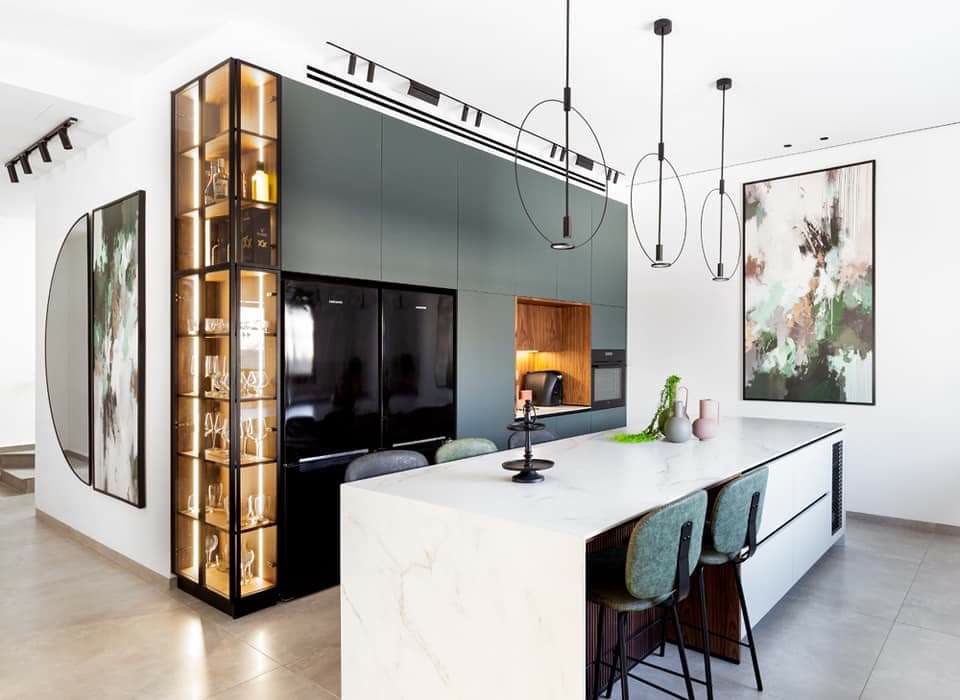
When the waterfall earns its money
Say yes when the island is the room's centerpiece and the stone has movement worth displaying — a dramatic quartzite, a heavily veined marble or marble-look porcelain, where the fold shows the pattern cascading. Say yes when the island end faces the main sightline from the living space or entry: the waterfall is a view detail, and it should face the view. Say yes in minimalist and handle-free kitchens, where the stone monolith supplies the architecture the flat doors decline to. And say yes at the seating end for a practical reason nobody markets: a stone leg beside stools takes shoe scuffs and chair-back hits that would destroy a painted panel — it's armor that happens to be beautiful. Waterfall legs also conceal the structural steel for generous overhangs; the seating-and-support math from my kitchen island design guide gets easier, not harder, with a wrapped end.
When to spend the money elsewhere
Skip the waterfall on uniform stone. A plain white quartz waterfall is paying $4,000 for a fold nobody can see — the whole point is watching the pattern turn the corner, and a patternless slab turns invisibly. Skip it when the island end sits against a walkway wall or faces cabinetry three feet away; theater needs an audience. Skip it when the budget is straining, because the alternative is genuinely lovely: a furniture-grade wood end panel — walnut, rift white oak, or a painted panel with applied detail — costs $600–$1,800, adds warmth stone can't, and lets you put the saved thousands into hardware or interior fittings where hands touch daily. The species conversation in my white oak vs walnut guide is exactly the one to have here. And skip stone waterfalls entirely on outdoor or high-slam locations where a corner chip means an unrepairable mitre — porcelain's edge chips, in particular, show white substrate and cannot be polished out.
Material notes from the install side
Quartzite and granite: the best waterfall candidates — thick, forgiving mitres, repairable edges. Marble: beautiful and soft; expect the leg's outer corner to collect character (call them scars or patina according to temperament). Engineered quartz: consistent and economical, but most patterns are printed more faintly on the slab's edge zones — check the actual strip that will become your leg. Porcelain: the pattern is printed on the face, so a mitred porcelain waterfall shows pattern beautifully at 12mm thinness — but the mitred corner is fragile in transit and unforgiving forever after; I insist on the fabricator carrying the corner risk in writing. Whatever the material, the cabinetry beneath must be built for it: we engineer the island box flush to the leg interior, with cleats to carry the leg's 150–300 lbs, and we do it at drawing stage — a waterfall added after cabinet fabrication is a compromise bolted onto a box that wasn't expecting it. Where the budget lands in the bigger picture is covered honestly in what a custom kitchen costs in 2026.
Practical takeaways
- Budget $2,500–$7,000 over a standard edge; busy stone may add a second slab on top.
- Demand vein continuity around the fold, a hairline mitre, and a scribed floor fit — the three tells.
- Wrap stone with movement, facing the room's main view; skip it on plain slabs and hidden ends.
- A walnut or rift-oak end panel is the smart-money alternative at a fifth of the cost.
- Decide at drawing stage so the cabinetry is engineered to carry and meet the legs.
If you're weighing a waterfall, bring your slab photos — or your Pinterest board — and we'll tell you honestly whether your stone deserves the fold. Book a free 30-minute design consultation, or see wrapped and panel-end islands side by side in our custom kitchens.