
Boca Raton Kitchen Design: What Local Homes Ask For
Boca Raton has a design accent all its own. Addison Mizner gave the city its pink-stucco Mediterranean DNA a century ago, the country clubs gave it a renovation economy that never sleeps, and the last decade of teardown-rebuilds gave it a taste for bright, transitional interiors behind those barrel-tile roofs. When Boca homeowners sit down at our showroom, they're rarely asking abstract questions — they're asking what works in their building, their club, their exposure. So here is the local answer key.
The three Boca kitchens
- The country club renovation. Boca West, Broken Sound, Woodfield, St. Andrews, Royal Palm Yacht & Country Club. Homes from the 1980s through the 2000s with good square footage and dated kitchens — dropped soffits, raised-panel cherry, granite the color of a golf-course bunker. These are our most common Boca projects: soffits come down, cabinetry goes full height, the peninsula becomes an island, and the palette lightens by a decade. The HOA layer here is real but manageable — approvals focus on contractors, hours, and parking rather than your door style.
- The beachfront and downtown condo. From the towers along A1A to the newer buildings around Mizner Park and Royal Palm Place, condo work runs the standard South Florida script: alteration agreements, board cycles, insurance certificates, freight elevator bookings, no wet-wall moves. We wrote that script down in our condo renovation guide — Boca buildings follow it faithfully.
- The new build or full gut. East Boca's teardown wave — Por La Mar, Boca Villas, the Estate Section — produces houses designed around great rooms with 12-foot ceilings, and kitchens specified early alongside the architect. This is where sculleries, butler's pantries, and full cabinetry walls flourish; our pantry design guide could have been written about East Boca alone.
The Boca look, decoded
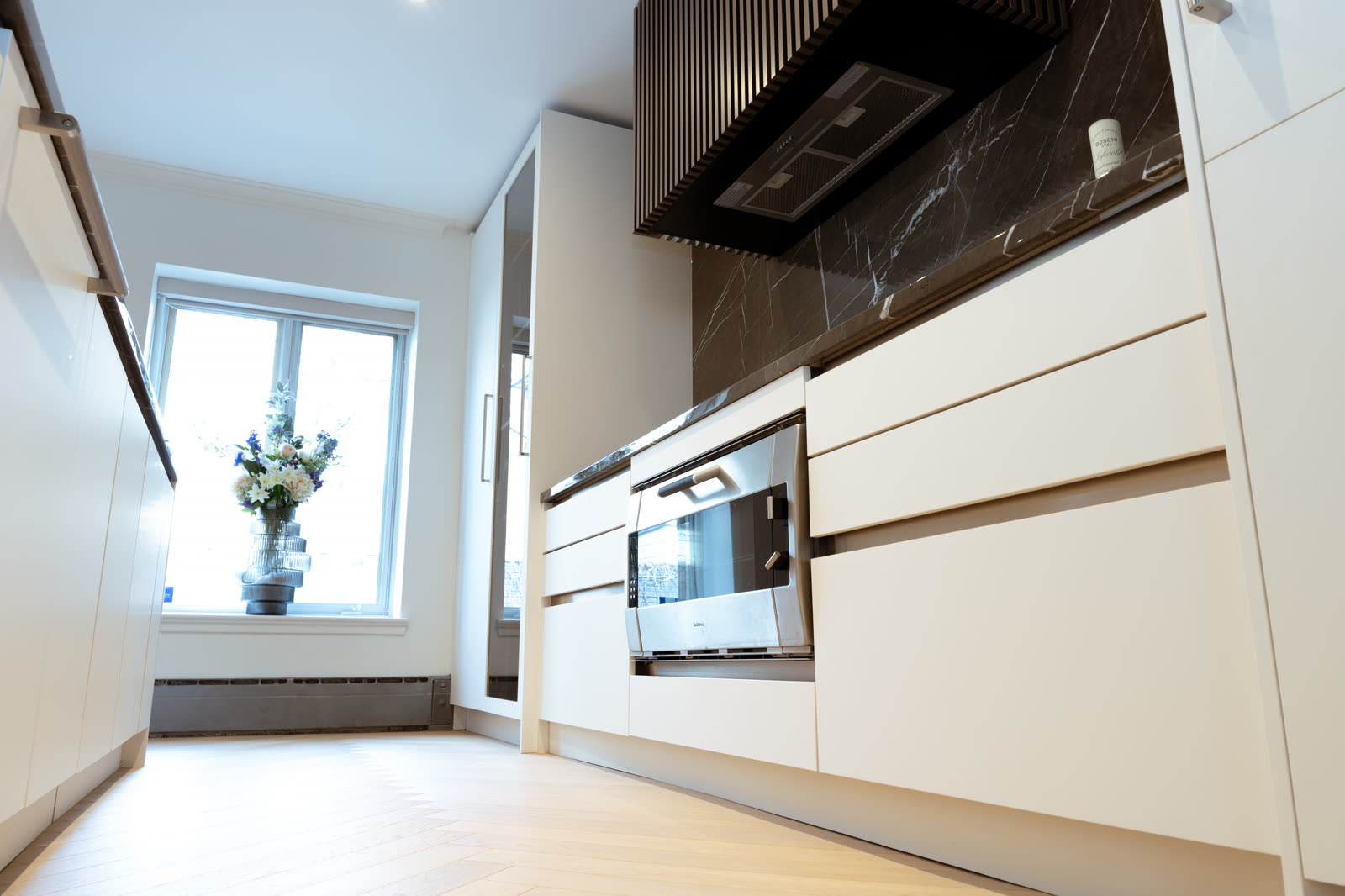
Boca style in 2026 is transitional with a coastal warm-up. In practice, the specification list reads:
- Doors: clean shaker or thin-rail shaker up front, slab in the scullery. Full inset for the estate section, where the budget carries it.
- Colors: whites and warm creams still lead, but almost always paired — a white perimeter with a white-oak or muted-blue island is the default request. Our guide to two-tone kitchens covers how to keep the pairing intentional.
- Hardware: polished nickel and unlacquered brass; matte black is fading here faster than elsewhere.
- Counters: quartz and porcelain dominate — marble looks belong to the look, but the maintenance conversation usually lands on engineered surfaces.
- Appliances: panel-ready everything. A Boca kitchen in 2026 hides its refrigerator as a matter of principle.
Climate and construction: the non-negotiables
Boca sits on the same coastal corridor that punishes cabinetry all over South Florida — salt air off the Atlantic, interior humidity, brutal UV through all that impact glass. Our baseline spec for the city: moisture-resistant substrates with sealed edges, climate-stable finishes that won't yellow or chalk, and Blum, Hettich, and Häfele hardware rated for coastal service, all backed by a lifetime warranty. In a market where much of what's sold as "custom" is imported boxes with a local label, construction is the difference you can't see at the showroom but live with for twenty years.
Timing around the season — and the club calendar
Like the rest of Palm Beach County, Boca renovates against the season. Design in spring, produce over early summer, install before Thanksgiving: that's the rhythm. Country club communities add a wrinkle — many restrict construction during peak season weeks, and gate access for trades takes coordination. Our 8–12 week production window is a fixed manufacturing schedule, which makes it the one part of your project that lands when promised; sequence the rest around it using our renovation timeline guide.
Beyond Boca: Delray, Deerfield, and Highland Beach
The same design logic radiates out from Boca proper. Delray Beach's cottages and Lake Ida ranches lean more relaxed-coastal and take color more playfully; Highland Beach and Deerfield's oceanfront buildings are pure condo-script territory with maximum salt exposure; and the newer communities west toward Lyons Road follow the HOA playbook with bigger footprints. Our Boca showroom serves the whole stretch of south Palm Beach County, and the constants hold everywhere: coastal-grade construction, seasonal scheduling, and paperwork submitted before demolition dreams get scheduled.
How we serve Boca Raton
Our Boca Raton showroom puts iKitchen's design team in the middle of the market we've been building for across three decades — visit the Boca Raton showroom page for address and hours. We're the manufacturer: made-to-measure design, production in our own USA and Canada facilities, white-glove delivery, installation by our team. Your contractor runs demo, trades, and permits from our complete drawings. Start with our custom kitchens, or bring your floor plan — or your club's renovation rules — straight in.
The country club renovation, step by step
Because it's the most common Boca project, here's how the club-community kitchen actually runs. Weeks one to four: design — two or three sessions, a site measure, and a finish selection that accounts for the house's light (golf-course exposures pour green-tinted reflected light into kitchens; whites need warmth here or they go clinical). Weeks four to six: drawings finalized, HOA architectural packet submitted with our documentation, contractor quotes locked. Weeks six to fourteen: production in our facilities while the HOA approves and the contractor schedules demo around the club's construction calendar. Weeks fourteen to eighteen: demolition, soffit removal, electrical and plumbing updates — 1990s houses almost always need outlets and lighting brought to current expectations — then cabinetry installation by our crew. Weeks eighteen to twenty-two: counters, backsplash, appliances, punch list. Five months, door to door, and the single biggest schedule risk is starting the HOA paperwork late — the committee that meets monthly does not care that your countertop templater is ready.
What resale watches in Boca
Boca's housing market turns over briskly — club memberships change hands, families size up and down, and buyers walk into kitchens with sharp eyes. What holds value here: full-height cabinetry (buyers read soffits as a to-do list), panel-ready appliances, a real pantry, and neutral-warm palettes with one confident accent. What doesn't: aggressively trendy color on every surface, and visible economy in the boxes — a beautiful door on a flimsy carcass reads instantly when a drawer is opened at a showing. Our take on where money returns lives in the kitchen ROI guide; the short version for Boca is that quality construction in a calm palette is the safest money in the house.
Practical takeaways
- Name your project type first: club renovation, condo, or East Boca gut — each carries its own approvals and calendar.
- Take the soffits down and go full height; it's the single most transformative move in a 1990s Boca kitchen.
- Two-tone, panel-ready, and a working pantry are the current local defaults — deviate deliberately, not accidentally.
- Buy construction, not just style: sealed substrates and coastal-rated hardware are what make the kitchen still look new in 2036.
Designing a kitchen in Boca Raton? Book a free 30-minute consultation — bring photos of the kitchen you have and the club or building rules you're working under, and we'll design toward the kitchen the house wants.