
Kitchen ROI: What Remodels Return at Resale in 2026
Somebody at a dinner party once told me, with total confidence, that a kitchen remodel "pays for itself at resale." I build kitchens for a living and I wish that were true — I'd have a much easier sales pitch. The real numbers are more interesting: some kitchen spending returns nearly all of its cost, some returns a third, and the difference is almost entirely predictable in advance.
Here's the honest ROI picture for 2026 — what the resale data says, which upgrades buyers actually pay for, and the different math you should use when you're renovating to live rather than to sell.
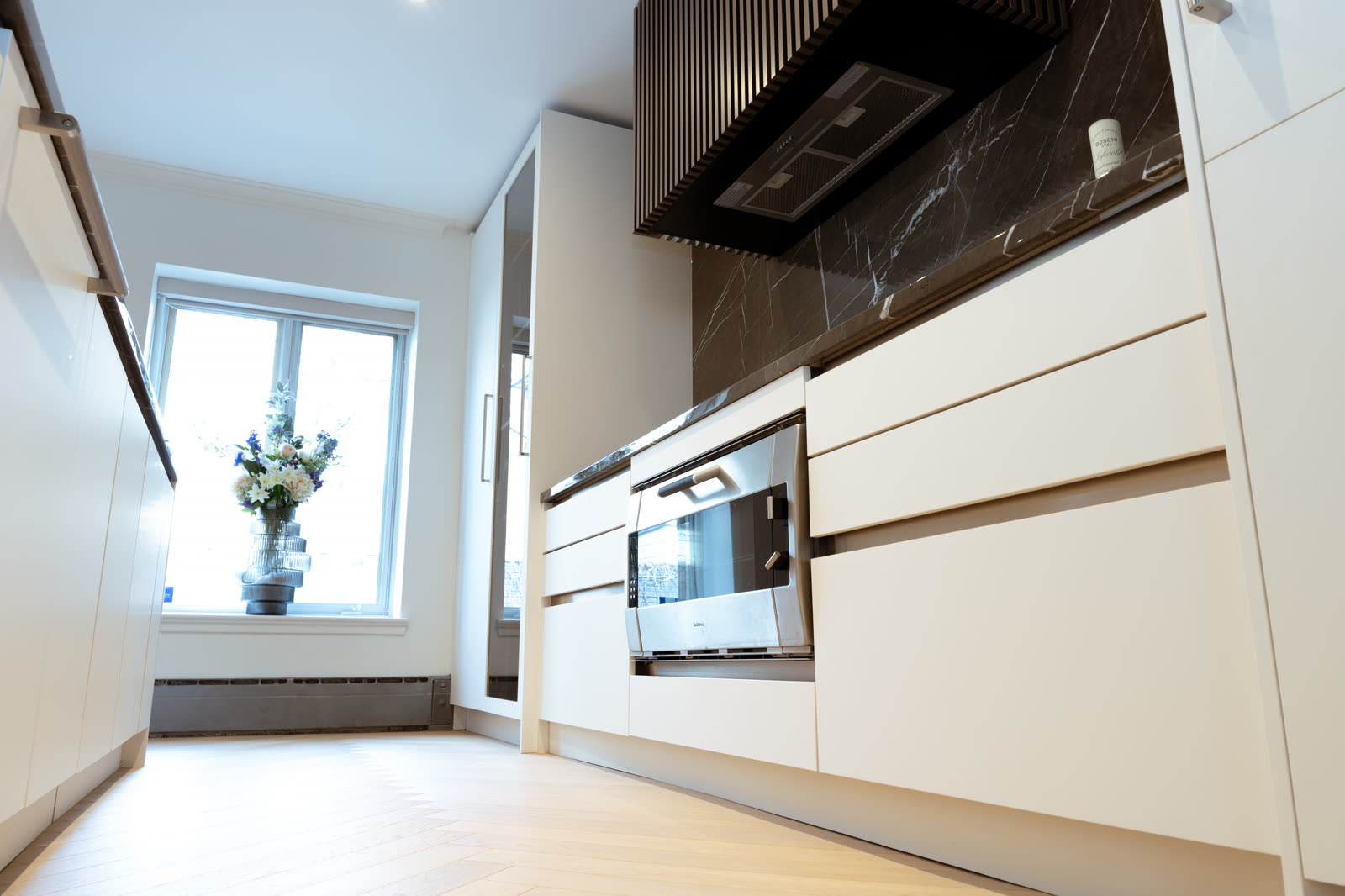
The 2026 recoup rates, by tier
Cost-versus-value data across North American markets has told the same story for years, and 2026 is no exception:
- Minor kitchen refresh ($25,000–$45,000): 70–95% recouped. Cabinet refacing or entry-level replacement, new counters, appliances, lighting, paint. The highest-ROI renovation in the house, because it removes buyer objections at modest cost.
- Major mid-range remodel ($80,000–$150,000): 45–60% recouped. Full gut, new custom or semi-custom cabinetry, stone, appliance package. This is the tier most of our clients live in — the $130,000 project from our budget breakdown.
- Upscale remodel ($150,000–$300,000+): 30–45% recouped. Structural changes, panel-ready pro appliances, premium millwork throughout. The dollars recovered are large; the percentage is the lowest in the house.
Read those numbers correctly: they are averages at immediate resale. They describe what happens if you renovate and sell next spring. Almost nobody does that — and that changes everything, as we'll get to.
Why the percentage falls as spending rises
Buyers pay for the absence of problems and the presence of function; they don't itemize your receipts. A dated, broken kitchen actively suppresses offers — fixing that is worth almost its full cost. But the difference between a $90,000 kitchen and a $220,000 kitchen reads, to most buyers, as taste rather than value. They'll love it; they won't price it. The appraisal system reinforces this: appraisers bracket your home against neighborhood comparables, and no kitchen lifts a house far above its street's ceiling.
The practical rule I give clients: a kitchen budget of 5–15% of home value is defensible at resale. Below 5% and you may be leaving buyer objections unfixed; above 15% and you're renovating for yourself — which is a perfectly good reason, as long as you know it.
What buyers actually pay for
Within any budget, some choices hold value dramatically better than others:
- Layout and storage. An island with seating, a pantry, deep drawers — function is the most durable value in the room. A brilliant layout from a modest budget outsells a clumsy layout in walnut. (Avoiding the clumsy version is the whole point of our layout mistakes guide.)
- Quality that's legible in ten seconds. Buyers open two drawers and one door. Soft-close everything, aligned reveals, solid weight — that ten-second test is where premium hardware and real box construction pay their resale dividend.
- Timeless over trendy. White, cream, wood-tone, and muted two-tone kitchens resell across style tribes. The bolder the color story, the narrower the buyer pool. If you love bold — do it on the island, where it's a repaint, not a remake.
- Counter-depth, panel-ready integration. The built-in look reads as luxury even to buyers who can't say why.
- What doesn't hold: appliance one-upmanship (the $20,000 range premium evaporates fastest), hyper-personal features, and anything a buyer would rip out on principle. Our splurge vs save guide maps almost one-to-one onto resale durability.
Longevity is the hidden ROI variable
Here's what the resale tables miss: the recoup percentage decays with the kitchen, and cheap kitchens decay fast. A builder-grade kitchen looks "new" for five years and dated-and-worn at year ten — its resale contribution rounds to zero. Quality custom cabinetry with a lifetime warranty is still opening smoothly and reading as an asset at year twenty. When we say cabinetry is the 30-year layer of the kitchen (the argument of our cost guide), that's not poetry — it's amortization. And condition at time of sale, not original spend, is what the buyer's ten-second test measures.
The other math: renovating to live
Most of our clients stay 10–20 years after renovating. For them the honest equation is cost per year of use, plus residual value at sale:
Take a $130,000 remodel, held 15 years, recovering a conservative 30% of its (by then well-aged) value at sale. Net cost: about $91,000, or roughly $17 per day — for the room where your family spends two to four waking hours daily. Compare that against anything else you spend $17 a day on. This is why "is it worth it?" has a different answer than "what does it return?" — and why I tell clients renovating their forever home to optimize for their own mornings, not a hypothetical buyer's.
One caveat for the 3-to-5-year movers: you're the group the resale tables were written for. Renovate to the neighborhood, keep finishes broad, hold the budget near 10% of home value, and put the money in cabinetry condition and layout — the things still fresh at sale time. Production timing matters for you too: our 8–12 week production window plus design means a kitchen started in January is photographing beautifully for a spring listing the following year, fully settled and punch-listed.
Practical takeaways
- 2026 recoup rates: minor refresh 70–95%, mid-range remodel 45–60%, upscale 30–45% — at immediate resale.
- Keep kitchen budgets between 5–15% of home value if resale is a factor.
- Buyers pay for layout, storage, condition, and ten-second quality; they don't pay for appliance badges or bold personal statements.
- Quality cabinetry holds its resale contribution for decades; builder-grade decays to zero by year ten.
- Staying 10+ years? Use cost-per-year math and build for your own life.
Whether your horizon is three years or thirty, the design decisions that protect value are knowable in advance — and they're exactly what a design consultation is for. Book a free 30-minute consultation to talk through your kitchen and your timeline, or see what durable value looks like in our custom kitchens.