
Outdoor Kitchens in the Northeast: Designing for Winter
People assume Florida is where I've watched the most outdoor kitchens die. It isn't. Salt air corrodes politely and predictably; a Northeast winter is a demolition crew. Water finds every pore and joint in October, freezes and expands nine percent by volume in January, and by April the countertop seam has opened, the masonry veneer is spalling, and the "outdoor" faucet has split its casing. Building from Montreal to the Hamptons has taught us that winter isn't a season your outdoor kitchen endures — it's a load case you design for from the first sketch.
And here's the part that surprises clients: done right, a Northeast outdoor kitchen isn't a three-month toy. Our most devoted grillers are in Toronto and Connecticut, flipping steaks in parkas in February. The design just has to make that possible.
Freeze-thaw: the physics that picks your materials
Every material decision in a cold-climate kitchen reduces to one question: does it absorb water? If it does, winter will find it. That single filter reshapes the material rankings from our aluminum vs stainless vs masonry comparison:
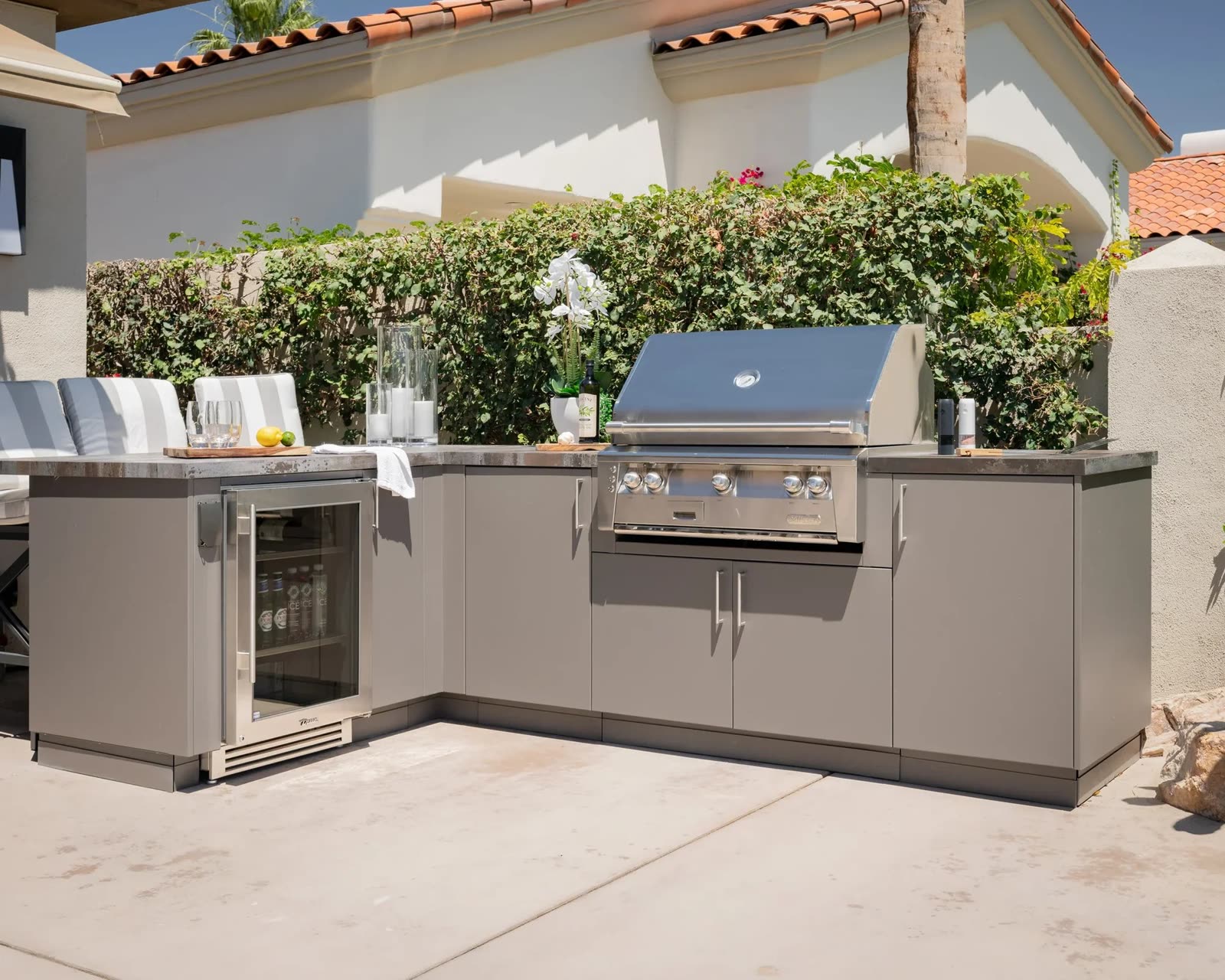
- Welded marine-grade aluminum is essentially winter-proof: non-absorbent, dimensionally stable across a hundred-degree annual swing, and its powder-coat doesn't mind the cold. The 5052/5083 alloys we build with were developed for environments far nastier than a Buffalo January. Road-salt spray near driveways and walkways is the one caution — the same rinse discipline we preach for coastal Florida applies to the snow-melt zone.
- Masonry is where winter feasts. Block, mortar, grout, and natural stone veneer all absorb water; freeze-thaw cycling opens joints, pops veneer, and spalls surfaces. It can be done right — proper caps, flashing, drainage, breathable sealers, and annual inspection — but "done right" is a maintenance contract, and most aren't.
- Stainless handles cold fine; its winter enemies are road salt and the fact that bare steel at 10°F is miserable to touch. Powder-coated surfaces are kinder in every way.
- Counters: dense granite and sintered stone (near-zero porosity) shrug off freeze-thaw; marginal, porous stones and tile-with-grout fail here even faster than they do in the South. The full rundown is in our countertop guide.
Water is the enemy; design it an exit
Beyond material choice, cold-climate detailing is drainage detailing. Cabinet interiors need weep paths so condensation and blown snow leave instead of pooling and freezing against doors. Counters get a slight pitch so meltwater sheets off rather than refreezing into a glaze at the grill landing. Door gaskets should be compression types that don't freeze shut. And the kitchen should sit on a slab or footings below frost line — frost heave under a 2,000-lb masonry island cracks it like an egg, one more argument for lighter welded construction on problem soils.
Winterization: the October ritual
Every water-touched component needs a shutdown protocol, and the time to design it is before rough-in — a point we hammer in our utilities planning guide. The checklist we hand clients:
- Plumbing: interior shutoff, then drain and blow out the supply lines with low-pressure air through fittings installed for exactly this. Disconnect and drain faucet cartridges; they're the most common casualty.
- Ice maker and fridge water lines: drain fully — trapped water splits solenoid valves.
- Refrigeration: most outdoor-rated units get emptied, cleaned, unplugged, and propped slightly open for winter; a few premium models are rated for year-round operation — the manual, not the brochure, is the authority. More in our outdoor refrigeration guide.
- Gas: stays live if you winter-grill (most of our clients do); otherwise shut it at the master valve. Either way, keep burner ports clean going into the season.
- Counters and cabinetry: a fall clean and — for granite — a fresh sealer coat before freeze-up; check that weep paths are clear of leaves.
Total time once the fittings exist: an hour. Cost of skipping it once: a spring plumbing bill and possibly a split faucet inside a stone wall.
Designing for four-season use
If you're building the kitchen anyway, the marginal cost of making it usable in January is small — and it changes the ownership math completely.
- Put the kitchen near the house. The 40-foot journey to a distant island is charming in July and decisive in December. Cold-climate kitchens want to live within a few steps of the back door, ideally sharing the house's wind shadow.
- Block the wind. Wind chill, not temperature, ends most winter cook sessions. A wall, a windward screen, or siting in an ell of the house extends the season by months. Roofed structures help enormously — with the smoke and clearance rules from our pergola guide applying year-round.
- Heat the people, not the sky. Mounted radiant heaters (electric or gas, to manufacturer clearances) over the standing zones; a fire feature earns its keep twice over here.
- Light for 4:30 p.m. darkness. Winter grilling is night grilling. Task lighting at the grill isn't a luxury item north of Philadelphia; it's how dinner happens.
- Spec appliances for cold starts: grill ignition systems and larger BTU capacity matter more when the ambient is 15°F and the cast grates are heat-sinking your preheat. Keep the grill under a fitted cover between sessions; sublimating snow is surprisingly corrosive company.
- Hardware that laughs at frost: soft-close mechanisms rated for temperature swings — we fit the same stainless-rated Blum and Hettich hardware in Toronto that we fit in Fort Lauderdale, and winter is precisely why.
Snow country specifics
Three details for the lake-effect belt: keep the kitchen out of the roof's slide path (a spring avalanche off a metal roof will rearrange appliances); think about where shoveled snow goes, because the kitchen shouldn't be the snow dump; and remember snow-melt chemicals are salt — rinse adjacent cabinetry in spring the way a coastal owner would after a storm.
What winter does to the budget — and the season math
Clients sometimes ask whether a cold-climate outdoor kitchen "pays," given the shorter season. Run the honest numbers: a fair-weather-only kitchen in Connecticut gets perhaps 20 usable weeks; the same kitchen sited in the house's wind shadow, with a roof, radiant heat, and task lighting gets 40-plus — the comfort layer literally doubles the return on everything else you spent. On the cost side, winter adds modestly, not dramatically: frost-depth footings where masonry or structures are involved, blow-out fittings and interior shutoffs on the plumbing, and the shade-and-heat package. Call it 10–15% over a Sun Belt build of the same size. What it subtracts is bigger: no annual masonry repairs, no replaced doors, no spring plumbing surprises — the failures that quietly total more than the winterization details would have cost. The cheapest cold-climate kitchen, as with everything in this trade, is the one built for the climate the first time.
Practical takeaways
- Design for water's expansion, not just its presence — non-absorbent materials win winters.
- Welded marine aluminum and sintered stone/dense granite are the cold-climate combination.
- Build winterization fittings into the plumbing at rough-in; the October ritual takes an hour.
- Site near the house, block the wind, add radiant heat and task light — and the kitchen works in February.
- Masonry in freeze country is a maintenance commitment; go in with eyes open or go aluminum.
We build four-season outdoor kitchens from Montreal and Toronto through New York and New England — welded marine-grade aluminum, engineered for the freeze. Explore our outdoor kitchens, or book a free 30-minute design consultation and tell us your zip code — we'll design for your winter, not the brochure's.